AI marketing workflows
Give your marketing agent a campaign workflow it can finish
Map one campaign outcome, source context, human checkpoints, and a measurable review before connecting an AI agent to marketing tools.
In this guide
The useful starting point
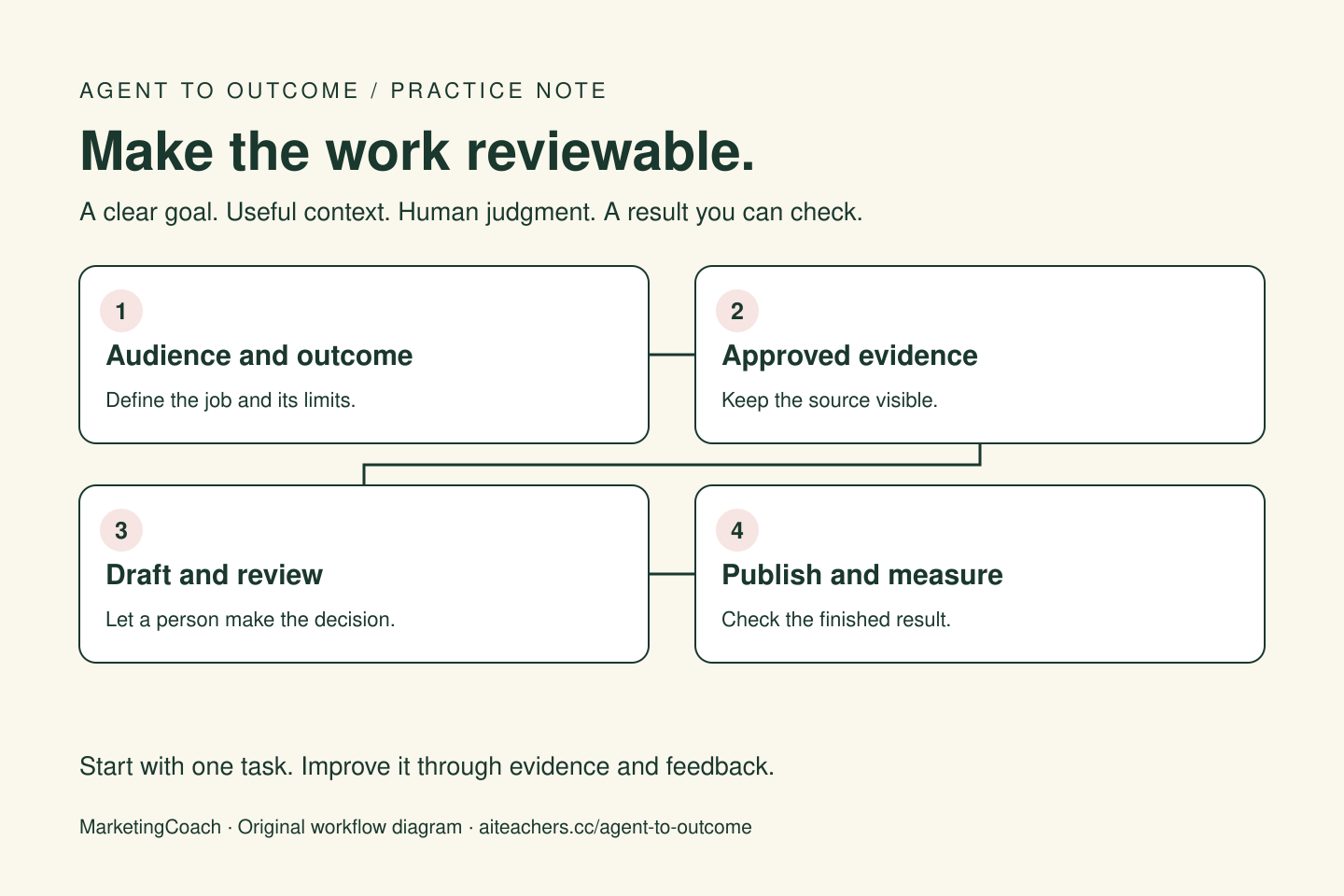
Start with one recurring campaign job. Give the agent approved facts, a defined deliverable, tool limits, and a review point attached to the actual publish or send action. Measure accepted work and customer response separately.
A marketing agent becomes useful when it owns a well-defined piece of work. “Grow the business” is too broad for a first assignment. A stronger starting point is preparing next week’s customer newsletter from an approved offer brief, recent customer questions, and a small collection of source material. The marketer still decides what the business should promise and which audience needs to hear it.
Choose a finished deliverable
Define what someone will be able to review. For a newsletter, that could be one subject line shortlist, a complete email draft, verified destination links, and a short explanation of the intended reader action. Set a length and a deadline. If the task includes a landing page, specify whether the agent should propose changes or implement an approved version.
Make acceptance concrete: the offer is current, every factual claim has support, the call to action works, the tone fits the brand, and no personal customer information appears. These criteria make feedback easier than a vague request to improve the copy. Start with a campaign whose inputs you understand well enough to check.
Give the agent a small source pack
Provide the audience, current offer, approved proof, tone examples, channel constraints, and campaign history relevant to this task. Include the source of each fact and the date it was checked. Identify which document wins if two files disagree. A retired pricing page should not overrule the current offer brief simply because the agent found it first.
Keep source statements separate from your interpretation. An interview note may show a customer asking for a faster setup. It does not prove that everyone has the same problem. Ask the agent to flag missing support and unresolved questions before it turns them into confident marketing claims.
Choose the working environment
A file-based assistant can prepare a campaign without direct access to your email platform. A connected agent can also read approved assets or create a draft in the destination system. OpenAI describes dots as ongoing agents that work across connected tools and bring decisions back to the owner. That is one current option, not a guarantee that every marketing integration or account supports the same actions.
Evaluate the tool against the job: can it access the right material, preserve context, show changes, and hand over an editable draft? Check the exact permissions before connecting it. More connections are useful only when they supply relevant context or enable an action you actually intend.
Put review where the audience will be affected
Let the agent assemble the brief, research approved sources, and prepare alternatives. Keep a named person responsible for the offer, claims, audience selection, and final distribution. Ask to see the actual recipient segment, subject, body, links, and schedule before the send action.
An instruction to ask first is helpful, but a supported tool-level checkpoint provides an additional control. n8n documents human review of an agent’s proposed tool and parameters before that tool executes. Inspect what your chosen product can enforce and test the rejection path as well as approval.
Start with one agent and a clear handoff
One agent is often enough for the first campaign. If the work later separates cleanly, assign a research specialist to produce a short evidence table and a drafting specialist to use only the approved findings. Give each a bounded input and output. Keep one owner responsible for reconciling conflicts and checking the complete campaign.
Multiple agents should solve a coordination problem you can name. They also add handoffs, repeated context, and usage. Avoid letting two agents edit the same campaign independently. A reviewer can flag unsupported claims, but its approval is still another machine judgment rather than proof of truth.
Measure the whole cycle
Record research time, drafting time, review time, tool charges, and rework. Count an output only when it passes your acceptance criteria. Separately measure what the campaign was intended to change: qualified replies, useful appointments, completed onboarding, or another observable customer action. A larger pile of drafts is not evidence of better marketing.
After each run, save one correction as a reusable instruction: which source to trust, which claim to avoid, or which review check was missing. Test the next version on a similar task. Increase scope only when the workflow reliably produces work your team can use.
Put this into practice
Bring one real campaign brief and choose the smallest useful task you can delegate this week. Start with the free Agent to Outcome tutorial, then use the workflow planner to map your goal, context, tools, human checkpoints, and success criteria. Explore the Agent to Outcome workshop and kit for a guided learning path. For implementation or team training, see Waymaker Agency’s agent workflow service.
Sources and further reading
Sources checked October 16, 2026. Tool features and plan availability can change; review the linked publisher documentation before connecting an account.
Put one idea to work
Choose one recurring marketing task and define the inputs, review, and next action before connecting tools.
Plan an AI marketing workflow →Explore more from MarketingCoachKeep practicing
 Advertising measurement
Use AI to review ROAS without confusing revenue with success
Calculate ROAS correctly, inspect conversion quality and business costs, and use AI to prepare a careful campaign decision.
October 22, 2026 · 5 min read Freelance work
Upwork MCP for marketers: find projects that fit the evidence in your portfolio
A practical Upwork MCP workflow for marketers building a freelance pipeline: project fit, honest proposals, bid review, portfolio evidence, and a small side-work test.
October 20, 2026 · 4 min read