Sales workflows
Use AI for thoughtful sales follow-up people can actually answer
Turn conversation notes into accurate, helpful follow-up drafts with clear next steps, human review, and reliable reminders.

In this guide
- The useful starting point
- Give the assistant a reliable conversation record
- Extract before drafting
- A worked example: a workshop conversation
- Use this drafting prompt
- Make reminders part of the workflow
- Automate preparation before sending
- Check quality and recover gracefully
- Questions you might be asking
- Sources and further reading
The useful starting point
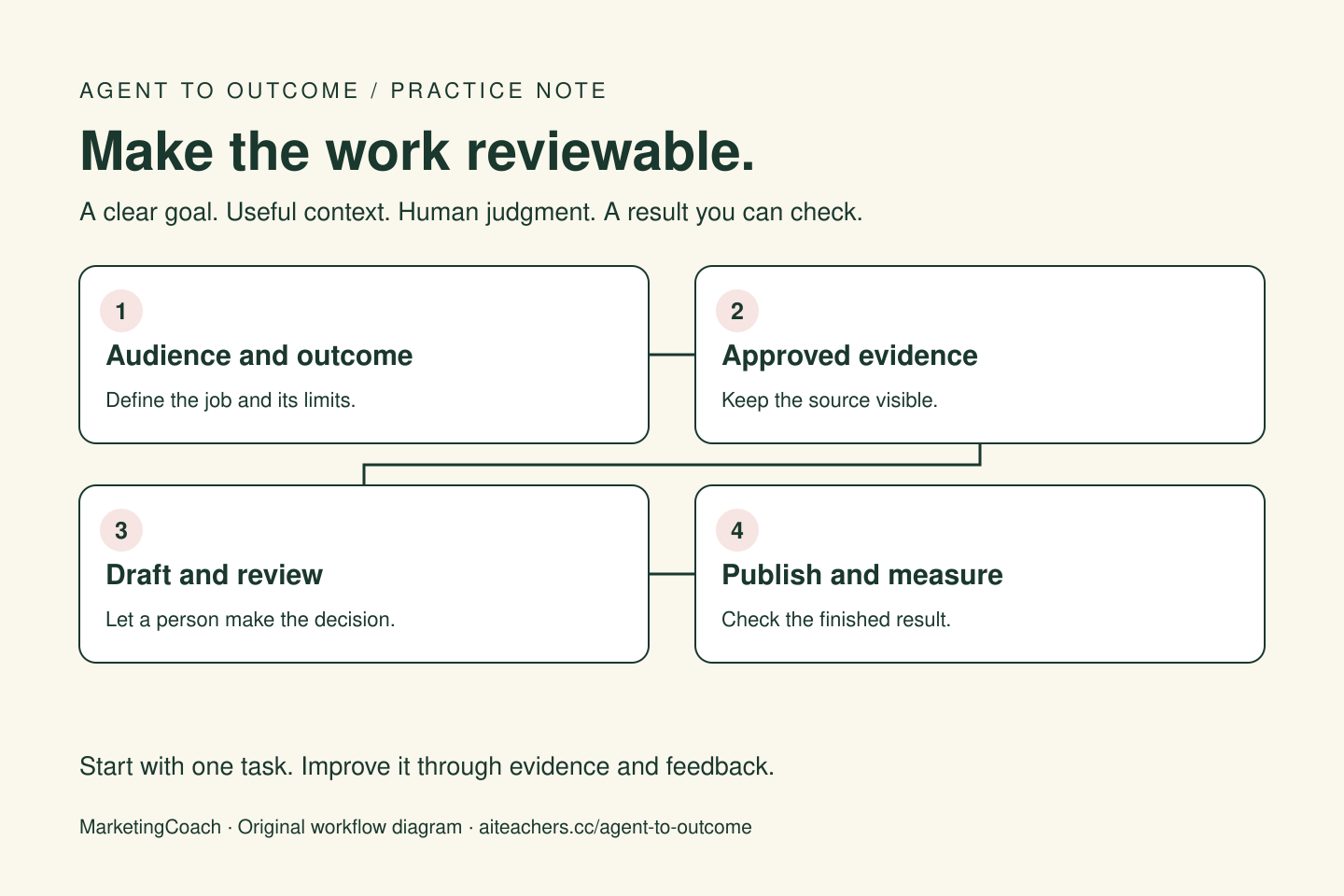
Give AI approved conversation notes and ask it to extract commitments, unanswered questions, and a helpful next step. Review the draft against the original, send it yourself or through an explicitly approved workflow, and track the agreed action in your CRM.
Good follow-up makes a conversation easier to continue. It reminds someone what mattered, supplies something useful, and makes the next step clear. AI can help you do that consistently without turning every message into a generic sequence.
Start with a recent, legitimate conversation. A prospect asked for an example, a customer needs a decision clarified, or a partner promised to send information. Your first workflow should help you honor those commitments accurately.
Give the assistant a reliable conversation record
Use approved notes that you are permitted to process. Separate direct quotations from your interpretation. Include the person's stated goal, constraints, questions, and any agreed next step. Remove personal details that do not help with the task.
Do not ask AI to guess a budget, private concern, personality, or purchasing authority from thin evidence. “They asked about implementation time” is an observation. “They are worried their team is incompetent” is an unsupported story.
A simple note structure works well: what they said, what we promised, what remains unknown, and what happens next. If you use a transcript, check the important names, dates, and commitments against the recording or your own reliable notes before relying on them.
Extract before drafting
- List commitments. Identify who promised what and whether a date was actually agreed.
- List unanswered questions. Keep factual gaps visible rather than filling them with plausible answers.
- Choose one useful contribution. This might be a relevant example, a scoped explanation, or a requested resource.
- Draft a short message. Reflect the person's goal, provide the contribution, and suggest a manageable next step.
- Review and send. Check accuracy, tone, claims, recipient, attachments, and whether the timing respects the conversation.
Doing extraction first makes invented commitments easier to spot. It also gives you something useful even if the final message needs a complete rewrite.
A worked example: a workshop conversation
Imagine a fictional conversation with Maya, an operations manager considering an AI workshop. She says her team loses time turning meeting notes into action lists. She wants to see an exercise and check whether people need paid tools. She has not agreed to a date or budget.
A poor draft might say, “I'm excited to launch your transformation next month.” It assumes a purchase and a schedule. A better draft says, “You mentioned that turning meeting notes into clear actions is taking too much time. Here is a sample exercise showing the input, review checklist, and final action list. I have also outlined the tool requirements. Would a short discussion about your team's current process be useful?”
The difference is not a clever closing technique. The useful version respects what Maya actually said and makes it easy to decide whether to continue.
The internal task might be “Send requested sample exercise to Maya,” with the relevant contact and deal attached. If no follow-up date was agreed, choose a reasonable internal reminder without claiming Maya requested that timing.
Use this drafting prompt
Use only these approved conversation notes. First extract the person's stated goal, questions, explicit commitments, and unknowns. Then draft a warm follow-up under 160 words. Include one useful contribution and one easy next step. Do not invent urgency, budget, agreement, personal details, or results. Mark any fact I must verify before sending. Keep the draft unsent.
For an important message, add: “Show me any sentence that goes beyond the evidence.” You may discover a flattering claim or a promise that sounded harmless until it was made explicit.
Make reminders part of the workflow
A well-written message does not help if you forget to send the promised resource. Use your CRM or task system to record an owner, action, due date, and relevant contact. HubSpot, for example, documents tasks associated with contacts, companies, or deals.
Keep the task specific enough that another person could understand it. “Follow up” is vague. “Answer Maya's question about workshop tool requirements and attach the sample exercise” is useful.
When the person replies, update the task and conversation record before drafting the next message. A sequence that ignores a reply can make a thoughtful business look inattentive. Stop or change the workflow when someone declines, requests no further contact, or takes a different next step.
Automate preparation before sending
If the manual process works, you can consider a workflow that prepares a draft and a review task. Tools such as n8n support human approval for selected agent tool calls, and Zapier offers review steps within Zap workflows. Those controls must be configured; they are not a guarantee that every AI-generated action waits for approval.
A useful first automation ends with a draft in a review queue. Keep the recipient, subject, body, source notes, and proposed next action visible. The reviewer should approve the actual message that will be sent, not a vague instruction to “handle follow-up.”
Check quality and recover gracefully
- Wrong detail: correct the source note and regenerate only the affected draft.
- Missing answer: research it or ask a colleague; do not let AI improvise a promise.
- Duplicate draft: check the contact and conversation identifier before creating another task.
- Overly formal voice: supply a short example of your natural writing and remove unnecessary ceremony.
- Unclear next step: offer one specific choice that fits the conversation.
Judge the workflow by commitments kept, useful replies, and fewer missed handoffs. Open rates alone cannot tell you whether a person felt understood. The lasting skill is paying attention and helping someone make a good decision. AI can make that habit easier to practice, while you remain responsible for the relationship.
Questions you might be asking
Should AI send my sales follow-ups automatically?
Begin with reviewed drafts. If you later automate sending, use explicit permissions, accurate recipient records, clear stop conditions, and a workflow appropriate to the relationship.
What should I provide to get a better draft?
Provide approved notes with the person's actual goal, questions, commitments, and constraints. Include your offer details and a short example of your normal writing.
What if the prospect does not reply?
Consider whether you supplied the promised value and made the next step clear. Use a reasonable, respectful reminder when appropriate, and honor a decline or request to stop.
Sources and further reading
Sources checked October 16, 2026. Tool features and plan availability can change; review the linked publisher documentation before connecting an account.
Put one idea to work
Choose one recurring marketing task and define the inputs, review, and next action before connecting tools.
Plan an AI marketing workflow →Explore more from MarketingCoachKeep practicing
 AI marketing workflows
Give your marketing agent a campaign workflow it can finish
Map one campaign outcome, source context, human checkpoints, and a measurable review before connecting an AI agent to marketing tools.
October 23, 2026 · 4 min read Advertising measurement
Use AI to review ROAS without confusing revenue with success
Calculate ROAS correctly, inspect conversion quality and business costs, and use AI to prepare a careful campaign decision.
October 22, 2026 · 5 min read