How should marketers use Claude Code’s new sessions?
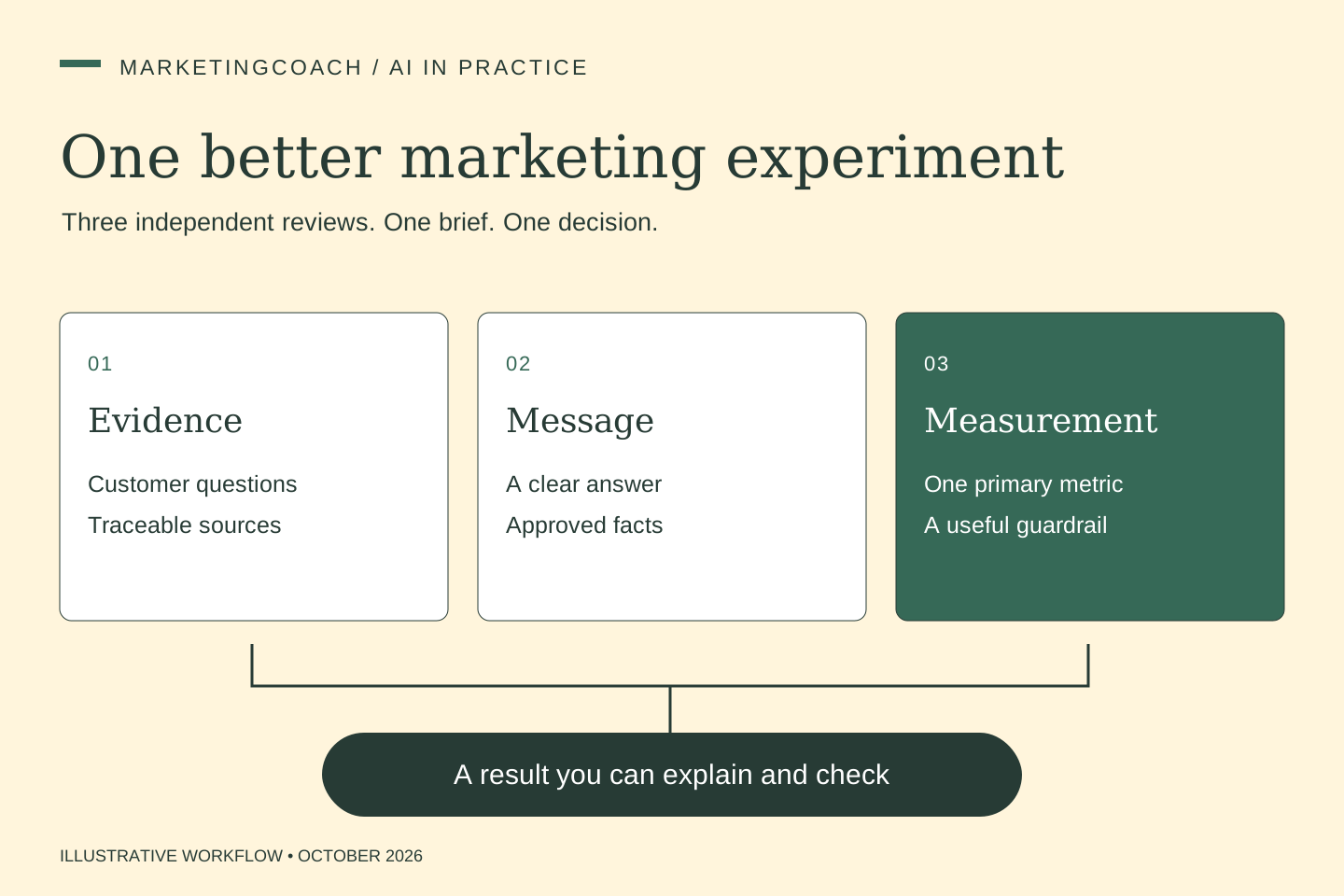
Use independent reviews to prepare one stronger experiment brief. Separate customer evidence, message interpretation, and measurement, then reconcile them before changing a page or campaign. Keep hypotheses separate from observed results.
Anthropic’s October 17, 2026 Claude Code newsletter introduces session improvements that make parallel work easier to organize. For marketing teams, the useful question is which decisions become clearer when the work is divided.
A good first project is a landing-page experiment. Code is useful when you are working with the page’s actual source files, a small analysis script, or an experiment tracker. For a simple copy discussion, you can use the same method in an ordinary AI conversation.
Start with a customer question
Imagine a fictional consultancy whose page attracts relevant visitors but leaves them unsure what happens after they enquire. The team has five anonymized sales questions and a current service outline. It does not have enough evidence to blame the price, the channel, or the form length.
A useful hypothesis is: explaining what the first conversation covers will help appropriate prospects decide whether to enquire. That is specific enough to test and modest enough to distinguish from a general promise to “improve conversion.”
Give three reviews different jobs
The evidence review extracts questions from supplied records and preserves their wording. The message review checks whether the page answers them. The measurement review checks whether the team can observe the intended behavior.
Do not ask the evidence reviewer to invent a persona. Do not ask the copy reviewer to fabricate urgency or proof. Do not ask the measurement reviewer to declare a winning variant before the experiment runs.
| Review | Return | Keep distinct |
|---|---|---|
| Customer evidence | Question, source, and frequency in this sample | Sample observations and market-wide claims |
| Message clarity | Missing answer and proposed wording | Approved facts and creative suggestions |
| Measurement | Primary metric, guardrail, and tracking check | Observed behavior and causal explanation |
Prepare one landing-page experiment from the approved service outline, current page, and anonymized sales questions. Use separate reviews for evidence, messaging, and measurement if they can run independently. Return source-linked findings, one hypothesis, one proposed change, a primary metric, a guardrail, and a review date. Flag missing data. Do not invent customer quotes, results, offers, or policies. Do not publish changes, send campaigns, or change ad spend.
Reconcile before generating more variants
Suppose the evidence review finds questions about preparation, while the copy review proposes a discount. Those findings do not support the same intervention. Ask why the discount would answer the observed question. If it does not, set it aside.
Draft one section that explains what to bring to the first conversation and what the prospect will receive. Confirm that the proposed description matches the actual service. A clearer page is only useful if delivery keeps the promise.
Write a brief you can evaluate later
- Audience: which visitors should benefit?
- Hypothesis: what uncertainty should the change address?
- Change: what exactly will differ?
- Primary measure: what behavior will you count?
- Guardrail: which unwanted effect must you watch?
- Review: who decides, when, and from which records?
In this example, qualified enquiries may be more informative than button clicks. Define “qualified” before collecting results. A reasonable guardrail is the count of enquiries that misunderstand the service scope. Keep the definitions stable across the review period.
Choose a test that fits your traffic
If traffic is limited, start with a comprehension exercise: ask a few representative people what the service includes and what they expect after enquiring. Record their answers before explaining the page. This can uncover ambiguity without pretending to measure a conversion lift.
If you run a live experiment, document the allocation method and other changes that could affect results. A before-and-after comparison can be confounded by changes in channel mix, seasonality, or sales follow-up. Report counts and uncertainty rather than announcing a winner from a handful of events.
Keep the operating cost visible
Claude Code usage includes the context and work of delegated tasks. A second reviewer may be valuable; several overlapping reviewers may simply repeat the same analysis. Use a small task to compare total review time, corrections, and usage before making a larger workflow the default.
A recurring campaign brief is a separate project. First establish that a manual brief changes a decision. Then specify the inputs, freshness checks, recipient, schedule, and what happens if data is unavailable. Missing data should remain visibly missing.
Close the loop with a decision note
Finish with five lines: what we expected, what we changed, what happened, what we still cannot conclude, and what we will do next. The result may be “keep investigating.” Preserving that uncertainty is better than manufacturing a success story.
Use the free Marketing Reset to choose a bottleneck, or connect this method to your marketing experiment tracker. The point of organizing AI work is to make your next marketing decision easier to explain.
Frequently asked questions
Should I connect an ad account for this exercise?
No. Start with approved exports and source material. Account connections and permission to change campaigns are separate decisions.
Does AI-generated analysis prove why conversion changed?
No. Analysis must reflect the test design and available evidence. A plausible explanation is still a hypothesis unless the evidence supports it.
Sources and further reading
Product sources checked October 19, 2026. Examples and prompts are original teaching material. Features and account access may change.
Keep exploring
Meta Muse for marketers: build a research brief you can actually use
Build your first Shopify marketing experiment around a buyer question