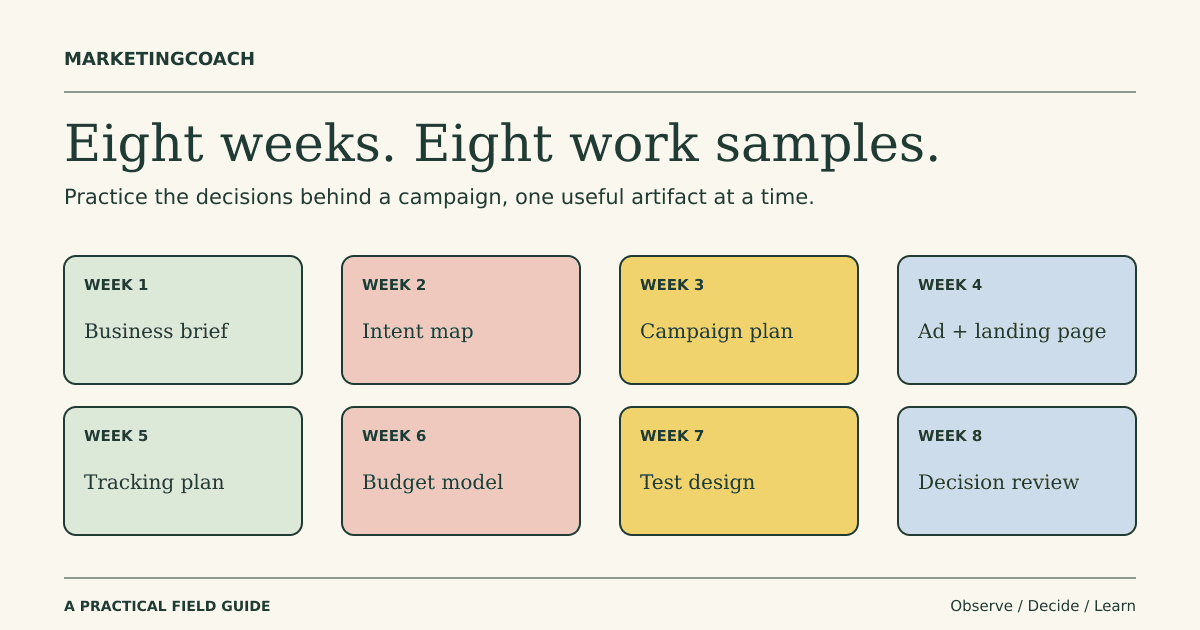
The most useful way to learn PPC, keyword research, and digital marketing is to connect study with a real project. Choose one business, one offer, and one audience. Each week, produce something you can review: a brief, an intent map, a measurement plan, an ad draft, or an evidence-based decision.
This eight-week roadmap is a suggested practice schedule of four to six hours per week. It can establish a foundation. Expertise takes repeated work across different campaigns and the ability to explain uncertainty, diagnose problems, and improve business outcomes.
Understand where PPC fits
PPC means pay per click, a payment model associated with many search campaigns. Paid digital advertising also uses other buying models, including impression-based charging. Digital marketing is broader: SEO, content, email, lifecycle programs, paid media, conversion optimization, partnerships, and retention all play a role.
Begin with search because it makes the relationship between a customer question, a message, and a destination visible. Add other channels when you can explain why the audience and creative fit. Learning every platform at once can spread both your attention and your test budget too thin.
Week 1: customer, offer, and economics
Study positioning, buying triggers, customer research, and contribution margin. Define the buyer’s problem and alternatives before collecting demographic labels. Estimate delivery costs and the amount available for acquisition, profit, and overhead.
Assignment: write a one-page campaign brief. Include one primary business outcome, the desired customer action, the reason someone should choose the offer, evidence for your claims, and the constraints. Review standard: another person can identify the buyer, offer, and next action without asking you to translate.
Week 2: keyword research and intent
Learn the difference between a targeting keyword and an actual search term. Classify informational, comparison, and purchase-oriented searches. Research query meaning, demand estimates, geography, seasonality, and potential exclusions.
Google’s exact match can include the same meaning or intent. Phrase match includes searches containing the keyword’s meaning. Broad match can reach related searches and needs careful measurement and bidding choices; Google emphasizes using Smart Bidding with it. None of these settings removes the need to inspect relevance.
Assignment: research 20–30 queries and group them into a few useful themes. For each theme, write the likely intent, appropriate page, proposed match type, and negative-keyword risks. Review standard: you can defend the commercial relevance of every paid-search theme.
Week 3: measurement before launch
Study Google Analytics 4, Google Tag Manager, campaign parameters, conversion definitions, and how outcomes reach a CRM or order record. Learn to distinguish a button click from a successful submission and a submitted inquiry from a qualified lead.
Assignment: build an event map with action, trigger, owner, destination, and verification method. Test successful and unsuccessful submissions and check for duplicate events. Review standard: you can follow one test action through the complete reporting path and explain the consent choices involved.
Week 4: campaign structure and search ads
Study campaigns, ad groups, targeting, budget controls, auctions, bidding strategies, and assets. Understand how automated bidding uses the outcomes you supply. Avoid accepting recommendations simply because they improve an account score.
Google responsive search ads accept up to 15 headlines and four descriptions; headlines allow up to 30 characters and descriptions up to 90. Write assets that make sense in different combinations and keep every promise supportable. See the official reference below for current format details.
Assignment: prepare a campaign draft with a clear theme for each ad group, relevant assets, exclusions, destination URLs, and a written rationale for settings. Review standard: the message, targeting, and conversion goal all support the brief. Drafting does not require turning ads on.
Week 5: landing pages and conversion
Study message consistency, customer objections, proof, accessibility, form friction, mobile usability, and the next step after conversion. A persuasive ad cannot compensate indefinitely for an unclear offer or a broken checkout.
Assignment: audit one landing page against five questions: Is it for me? What do I get? Why believe it? What does it require? What happens next? Watch someone attempt the task. Review standard: identify one observed obstacle and a change that directly addresses it.
Week 6: analysis and experiment design
Calculate click-through rate, cost per click, conversion rate, cost per lead, customer acquisition cost, and return on ad spend. State denominators, attribution windows, and included costs. ROAS is attributed revenue divided by ad spend; it does not establish profit or incrementality.
Assignment: write a one-page performance review using real data or a clearly labeled practice dataset. Separate findings from hypotheses. Propose one test with a primary measure, budget boundary, review window, and guardrail. Review standard: explain what the evidence supports and what remains inconclusive.
Week 7: Meta audiences and creative
Explore Meta Blueprint’s lessons on objectives, audience choices, creative, measurement, and automated campaign options. Search often responds to an expressed need; a social ad may need to help someone recognize the problem first. The offer and buying situation determine which approach is appropriate.
Assignment: develop three genuinely different creative concepts: a problem demonstration, a process explanation, and substantiated customer evidence where available. Describe the message and proposed test for each. Review standard: the concepts test different reasons to care, not just different colors.
Week 8: connect the full marketing journey
Map acquisition into follow-up, first value, repeat use, and retention. Identify where SEO or educational content can answer questions, where email can support an interested prospect, and where the product or service itself needs improvement.
Assignment: assemble a 90-day plan and a case study containing the brief, research, choices, limitations, evidence, and next move. If the campaign was only a draft, label it a practice project. Review standard: someone can follow the reasoning without assuming you achieved results you have not measured.
Use a simple mastery check
Score each skill from zero to three: zero means unfamiliar; one means you can explain it; two means you can do it with guidance; three means you can perform it, verify it, and explain a trade-off independently. Revisit the weakest skills with another project. Course completion alone does not demonstrate campaign judgment.
AI can help classify searches, critique briefs, and suggest tests. Require it to distinguish provided evidence from inference, verify calculations, and keep spending decisions under human review. Never use fabricated campaign results to fill a portfolio.
Start with the free Marketing Reset, explore the traffic and growth learning path, or use Marketing Coaching for feedback on the project you are executing.
Official learning resources
- Google Skillshop: Search and Measurement training
- Google Analytics Academy
- Google Ads: keyword matching options
- Google Ads: responsive search ads
- Meta Blueprint learning catalog
Platform references reviewed October 14, 2026. Exercises and numerical scenarios are original teaching examples, not campaign results or vendor guarantees.
Keep exploring
Forward Deployed Design for Marketing Teams: From Brand Rules to Better Experiments
How to run a useful marketing experiment when your audience is small