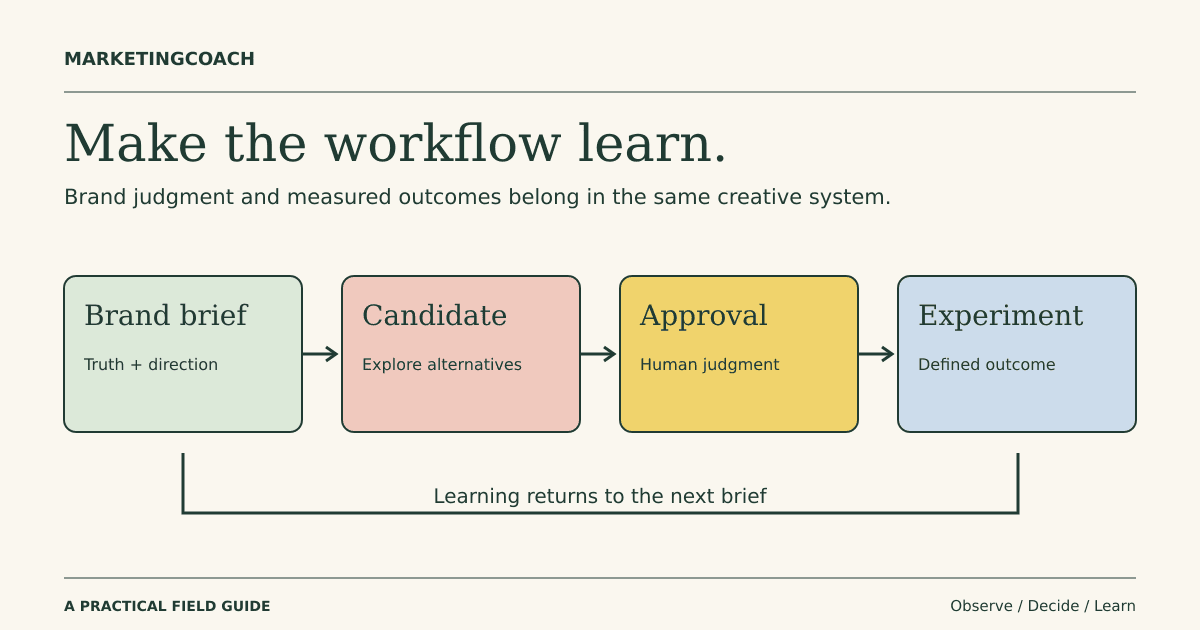
What is forward deployed design in marketing?
In a marketing context, a forward deployed designer works directly with a customer team to make a creative or marketing platform useful in its real workflow. That can mean translating brand rules into repeatable creative systems, improving review and production, supporting adoption, and returning customer feedback to the product team.
This is a real role label, not a universal job specification. Hightouch's listing, reviewed in October 2026, for a Forward Deployed Creative Designer, Ads connects customer collaboration, AI creative workflows, performance testing, and product feedback. Other employers use the title for product implementation rather than advertising. Read the responsibilities before assuming the roles are interchangeable.
The operational problem to solve
A marketing team can generate many assets and still struggle to launch a useful campaign. Brand direction may live in a slide deck; claims may need review; the landing page may promise something different; and performance reports may arrive without enough context to explain what ran.
An embedded designer can help connect these steps. The value comes from improving the operating process and the work it produces. A larger folder of variations is not an outcome by itself.
Illustrative scenario: a retailer wants to promote a travel organizer. Its AI image drafts look polished but show compartments the real product does not have. The issue is not solved by selecting the prettiest image. The workflow needs reliable product references, factual review, and a way to reject unsupported variations before they reach customers.
Build a brief that a creative workflow can use
Start with the customer, the buying situation, the offer, and the intended next action. Add the evidence behind every product or performance claim. Include brand examples, channel constraints, exclusions, and the person responsible for approval.
Separate hard rules from creative choices. Product dimensions and a verified price are facts. A color mood or composition is a creative direction. Required disclosures and permissions need explicit review. Mixing these into a long prompt makes it harder to detect a consequential mistake.
| Brief component | Example question | Owner to identify |
|---|---|---|
| Customer and offer | Who is this useful for, and why now? | Marketing lead |
| Product truth | Which features and claims are verified? | Product or merchandising owner |
| Brand direction | What must feel recognizably ours? | Brand or creative lead |
| Landing experience | Does the destination keep the promise? | Web or product owner |
| Measurement | Which outcome and guardrails matter? | Campaign and analytics owners |
Define the designer's responsibility and the handoffs
The designer can lead visual direction, reference systems, prototype workflows, quality criteria, and feedback to the platform team. The media buyer remains responsible for campaign operations within the agreed scope. Legal or compliance reviewers retain their decisions. The product owner decides which platform changes become roadmap work.
Make these boundaries explicit. Otherwise a single customer-facing designer can become the default owner for strategy, production, media, tracking, support, and engineering. That creates a bottleneck while making success difficult to evaluate.
Run a useful creative experiment
Write a hypothesis about a meaningful difference: demonstrating product organization may help shoppers understand the use case better than a lifestyle-only concept. Keep the offer and destination comparable where possible. Record what changes, who sees each version, and which outcome will guide the decision.
Measure beyond click-through rate. Qualified actions, purchases, contribution, and customer feedback may change the interpretation. A version that draws curiosity but attracts unsuitable customers can make a campaign look busy without improving the business.
Before reading the result, check delivery differences, audience overlap, attribution settings, and sample size. A small directional observation can inform the next test; it is not a universal winning formula. Use the campaign experiment builder to document the decision before launch.
Return learning to the system
After a test, record both creative and operational learning. Which idea helped? Which prompt or reference repeatedly produced mistakes? Which review step caught them? What did the customer need that the platform made unnecessarily difficult?
Maintain a small library of approved examples with their context, rights, factual boundaries, and review date. Avoid calling an asset a “winner” without specifying the audience, offer, time, and measure. Retire examples when product information or brand direction changes.
This is where the role connects customer delivery to product development: recurring problems should become better defaults, clearer controls, or reusable patterns. A workaround that only one person understands has limited long-term value.
Your operating review exercise
Take one campaign from brief to report. For each stage, record the input, owner, review rule, failure mode, and handoff. Find one repeated source of rework and propose a bounded change. Then define how you would check whether it improved quality, time, or customer outcomes.
Use the eight-week PPC and keyword research plan to strengthen the measurement side, and the weekly marketing review to keep decisions connected to evidence.
Common questions
Is this the same as a creative strategist?
The responsibilities can overlap. A forward deployed role usually adds close involvement in a customer's use of a platform and a feedback loop to the product team. The employer's actual scope is the deciding factor.
Does it replace a performance marketer?
Not automatically. Creative systems, media buying, analytics, lifecycle strategy, and product implementation are different responsibilities. Decide which skills are needed rather than assuming one title includes all of them.
What should a portfolio demonstrate?
Show a brief, constraints, alternative directions, review decisions, the delivered workflow, and an honest evaluation. Distinguish shipped customer work from a simulated exercise and attribute collaboration accurately.
Primary source
Hightouch: Forward Deployed Creative Designer, Ads, checked October 14, 2026. The operating framework above is MarketingCoach editorial guidance; it is not an endorsement or a reproduction of that employer's playbook.
Hire a specialist around one marketing bottleneck
If your team lacks a creative systems designer or implementation specialist, use the operating brief above to scope a paid project. Compare work that shows brand judgment, review steps, and a measured handoff. Keep budget ownership, campaign approvals, and factual claims with the responsible people on your team.
Affiliate disclosure: We may earn a commission if you become a qualifying Upwork customer through this link.
Explore hiring on Upwork. Compare relevant work, agree on a small paid milestone, and review the deliverable before expanding the project. Marketplace access does not guarantee a suitable hire or business results.
Keep exploring
How to Learn PPC and Keyword Research: An Eight-Week Practice Plan
How to run a useful marketing experiment when your audience is small