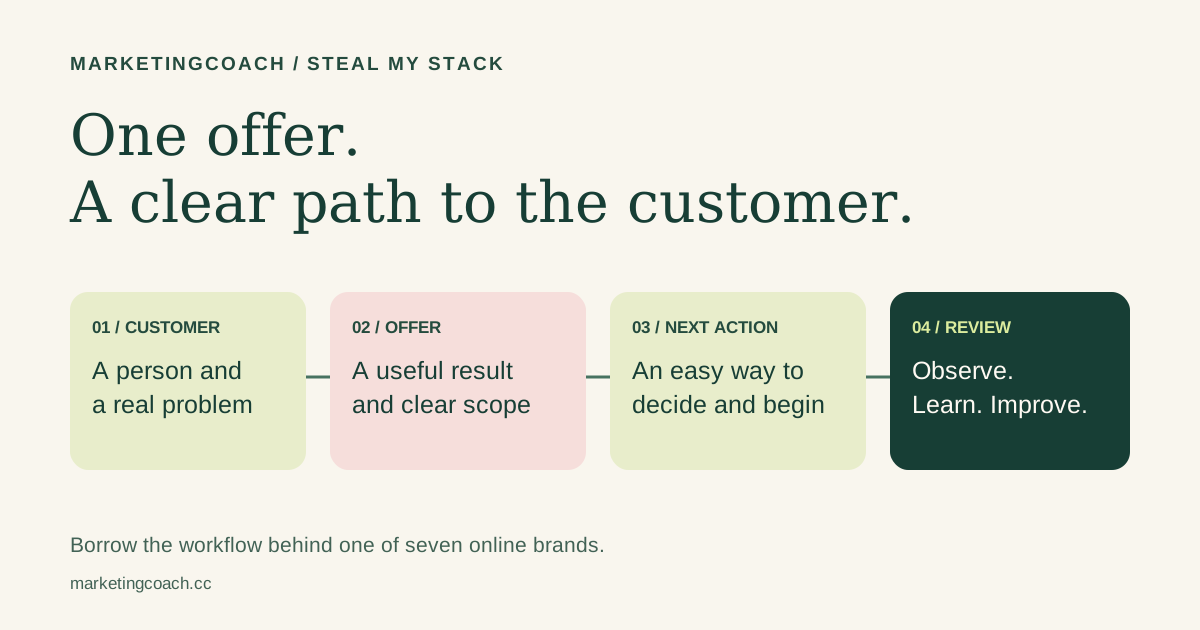
I built seven online brands and mapped the offers, tools, and workflows behind them. Steal My Stack is a way to inspect those connections and borrow an approach for something of your own.
MarketingCoach's part of the map begins with a practical question: someone discovers your business—what helps them understand the offer and decide whether it fits?
The answer shapes the page you build, the content you publish, the follow-up you write, and the work you agree to deliver. Start with one offer so you can see that whole path clearly.
Give the offer a specific customer and result
Write one sentence describing who needs help, the situation they are in, and what they will receive. “Marketing support” leaves a lot to interpret. “A focused plan for one audience, one offer, and the next campaign” gives someone a more concrete basis for a conversation.
Then make the boundaries visible. What information does the customer provide? What is included? How do revisions work? What happens after the engagement? A prospect should be able to understand the work before asking about the details.
MarketingCoach offers Marketing Clarity sessions, ongoing coaching, and marketing plans. Implementation is delivered through Waymaker Agency. Those are available ways to work together; this campaign makes no claim about sales volumes or earnings from them.
Map the customer's path
| Moment | Question to answer | Something to make clear |
|---|---|---|
| Discovery | Why should this person pay attention? | A useful answer to a problem they recognize. |
| Understanding | What could help them? | The intended customer, result, scope, and evidence. |
| Decision | What do they need to decide? | Price or scoping process, expectations, and a clear action. |
| Delivery | What happens after they say yes? | Inputs, responsibilities, timing, and review points. |
| Learning | What should improve? | Customer questions, completion, and the quality of the result. |
Choose one real entrance, such as a post, search result, recommendation, or email. Follow its link as a new visitor would. Does the next page continue the promise? Can you find the scope? Does the button explain the next action? Keep the useful parts and choose one confusing handoff to improve.
Give every tool a job in that path
A working stack has a reason for each tool. A planning document holds the approved brief. A design or website tool presents the offer. A booking or inquiry form captures a request. Email helps the person understand what happens next. A measurement tool helps you review the result.
You may already have enough to start. Record the gap before adding another subscription. Ask whether a new tool improves the task, reduces an avoidable handoff, or makes the work easier to check.
AI can help turn your notes into a first brief, compare draft messages, and identify questions a buyer may have. Supply the actual offer and evidence. Review claims, prices, links, and tone before publishing. The human checkpoint belongs where a draft becomes a commitment to a customer.
Use a brief that keeps the facts visible
Using only the details below, draft a one-page offer brief. Identify the customer, their problem, the deliverable, inputs, exclusions, timeline, and next action. Mark missing information as a question. Separate facts from suggestions. Do not add testimonials, performance figures, guarantees, or services I have not described. Then identify the three questions a buyer would most need answered.
Add your real details under the prompt, then edit the output yourself. A clearer brief can supply the main page, a short social post, and a follow-up message. Adapt each format to its job; the customer should recognize the same offer in all three.
Choose one useful test
Pick a specific uncertainty. Perhaps people cannot tell whether the offer is for them, or they need to understand the deliverable before booking. Change the relevant copy or page section, keep a record of the change, and set a review date.
Track what happened after the visit as well as the visit itself. A qualified inquiry, a useful scoping conversation, or a completed purchase tells you something different from an impression or a button click. Pair the numbers with what people actually ask. A small sample can guide your next question without settling the whole strategy.
The free marketing toolkit includes an offer and message map, an AI workflow planner, campaign experiments, and a weekly review. Choose the resource that helps with the decision in front of you.
Borrow one part of the seven-brand map
The wider map connects Wealth Experiment, AI Side Hustle, Secretly Domestic, AI Freelancer, MarketingCoach, AI Teachers, and AI Superpower. It distinguishes available offers and free resources from products still being developed.
Explore Steal My Stack or download the free seven-brand map. Start with one customer, one problem, and one offer. Then trace how someone will find it, choose it, and receive the value you promised.
Keep exploring
How to measure AI discoverability without chasing a made-up ranking score
How to read analytics reports: a visual walkthrough for beginners