
Start here
Open one unanswered proposal. Check whether the prospect can identify the monthly deliverables, cleanup work, exclusions, responsibilities, price and start conditions. Clarify the missing item in one useful follow-up.
Step 1 of 6
Choose a client type and a concrete monthly service
Start with a client segment the practice can serve well: for example, owner-led service businesses with a straightforward bookkeeping process. “Accounting for everyone” makes scope and proof difficult to explain. Choose the operational situation, service boundary and capacity before writing a campaign.
List the work the client receives each month. Reconciliation, reports, a review meeting and response coverage are understandable deliverables when they are actually included. Specify entity count, account count, transaction-volume assumptions, reporting timetable and the information the client must provide. Use your own economics to set prices; the fictional kit price is not a market benchmark.
Separate initial cleanup or catch-up work from the recurring service. Identify payroll, sales tax, tax preparation, advisory, audit, review and other services individually; do not imply they are included or offered if they are not. Confirm any professional designation and the standards or local rules that apply to the actual practice.
Put it to work
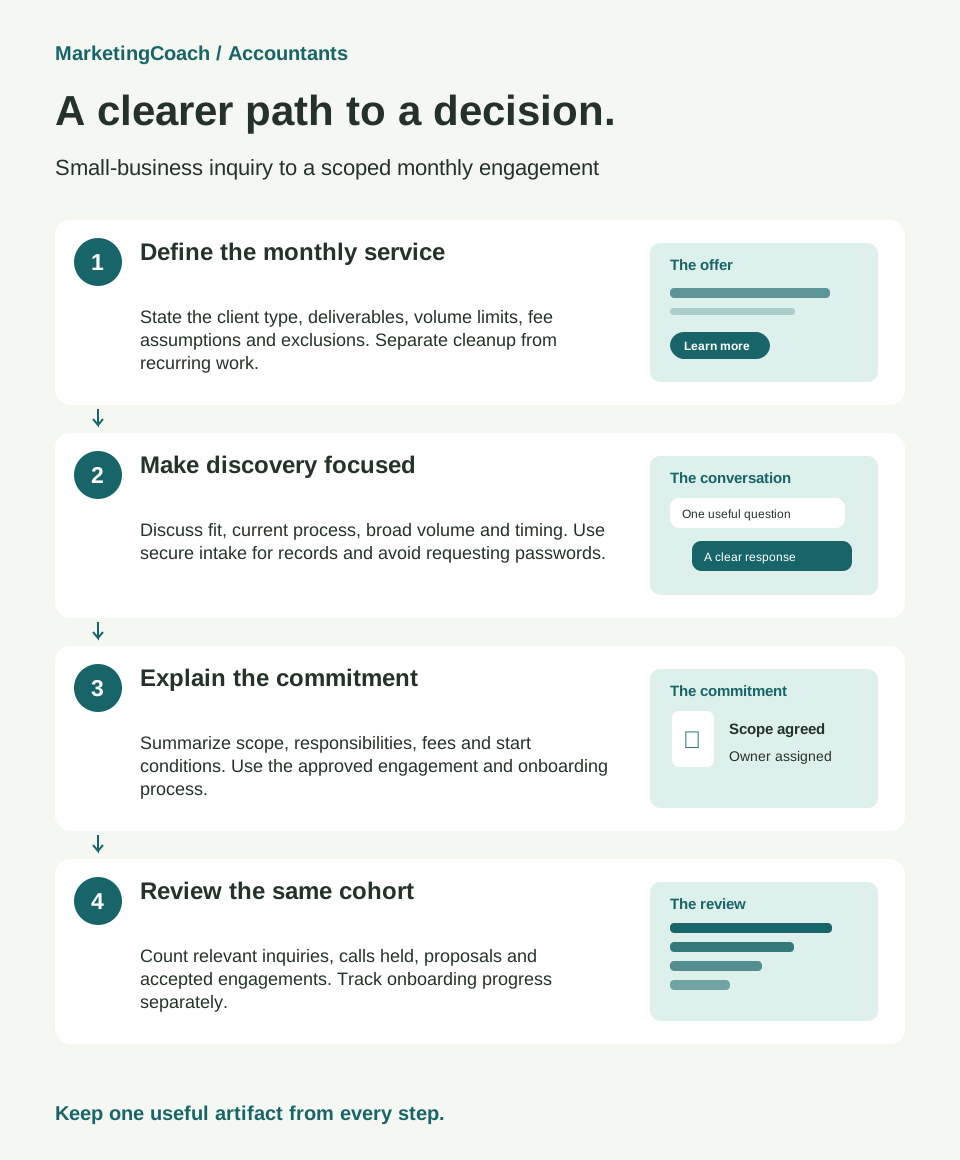
Write a one-paragraph offer with client type, recurring deliverables, limits, price assumptions and the three most important exclusions.
You are done whenSomeone unfamiliar with accounting can tell what is included, what costs extra and who the service fits.
Step 2 of 6
Turn the service page into a useful buying guide
Lead with the client’s operational need and the specific service. A headline about understanding the monthly scope is more useful than an unsupported promise of maximum savings. Show deliverables, pricing basis, boundaries and the first step near the top, then explain the reporting and onboarding process.
Use an actual team introduction and a sample report built with clearly fictional data. Annotate the sample to explain what a business owner can learn from it without presenting it as an audit opinion or a guaranteed business outcome. Verify credentials, designations and permissions for anything used as evidence.
Explain how discovery works, who joins the call and whether it has a fee. Make switching-provider questions easy to answer: when you assess the records, how you agree scope, what permissions you require and when a start date is confirmed. Direct documents to the approved portal, with no request for bank passwords or tax identifiers in a marketing form.
Put it to work
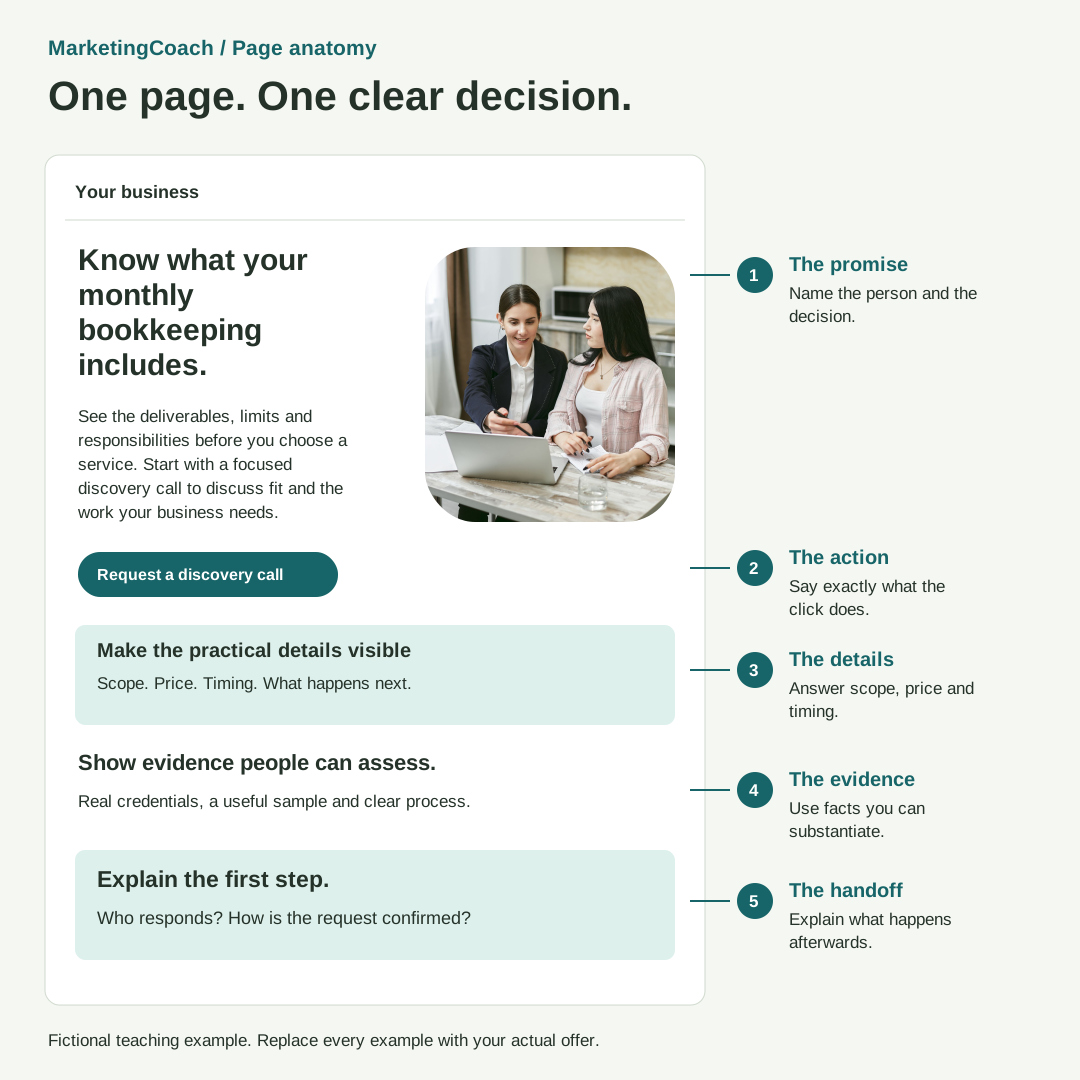
Use the annotated page graphic to check the promise, action, details, evidence and handoff. Build a draft with your own scope and booking route.
You are done whenThe page answers what is included, what is excluded and what the owner must do first.
Step 3 of 6
Use discovery to establish fit and scope
Give the call a short agenda. Ask about the business model, number of entities, current accounting process, broad account and transaction volume, reporting needs and desired timing. Discuss the situation at a high level. Move any sensitive record review into the practice’s secure and authorized process.
Clarify who currently owns bookkeeping, who approves access, how far records are up to date and which other professionals are involved. Separate the owner’s desired start date from a commitment the practice can actually make. If there is an approaching filing or payroll deadline, use the practice’s approved escalation rather than a marketing sequence.
End with a clear outcome: a proposal, an authorized scoping step, a request for appropriate information, or a decision that the service is not a fit. Do not issue a proposal just to improve conversion metrics. A well-explained non-fit saves both parties time and protects delivery capacity.
Put it to work
Adapt the discovery agenda in the swipe file and add a secure route for any later record review.
You are done whenEach call ends with an owner, a documented scope question or decision, and an agreed follow-up date.
Step 4 of 6
Make the proposal and onboarding handoff explicit
A useful proposal summary lets the owner compare the service with the problem they described. Include recurring deliverables, volume assumptions, cleanup work, exclusions, fees, client responsibilities, communication cadence and the conditions needed to begin. Avoid a menu of unexplained accounting terms.
Use the practice’s approved engagement letter and acceptance process. The marketing template is a communication aid, not a substitute for engagement terms or professional judgment. Explain how changes in entities, transaction volume or service needs will be assessed, and how additional work is authorized.
Once accepted, assign an onboarding owner and confirm the authorized access method, required records, opening issues and expected reporting timetable. Confirm the first reporting date only when the prerequisites support it. Keep onboarding completion separate from engagement acceptance so a signed client does not disappear into an administrative gap.
Put it to work
Rewrite the first page of one proposal in plain language and test the accepted-client handoff with the onboarding owner.
You are done whenThe client understands the scope and the team knows exactly what is needed before work starts.
Step 5 of 6
Create one practical article and one referral resource
Publish a focused guide such as “What should monthly bookkeeping include?” or “What to prepare before switching bookkeeping providers.” Explain the service decision, typical scope categories and questions to ask. Keep examples educational, with clearly fictional numbers and no personalized tax or financial recommendation.
Create a one-page service overview for appropriate existing business contacts. State the client type, offered services, boundaries and discovery route. If any referral fee, commission or reciprocal arrangement is involved, have the responsible professional review the rules and disclosures that apply before introducing it.
Use the same language on the article, service page and proposal. A reader should recognize the offer when they move between them. Begin with existing traffic and relationships, then review whether the practice can handle more suitable inquiries before considering paid promotion. Avoid refund or tax-savings promises as acquisition hooks.
Put it to work
Publish one service-scope article and share the factual overview with an appropriate existing referral contact when permitted.
You are done whenEvery resource leads to a clear service page with a working discovery request.
Step 6 of 6
Measure engagement quality and delivery readiness
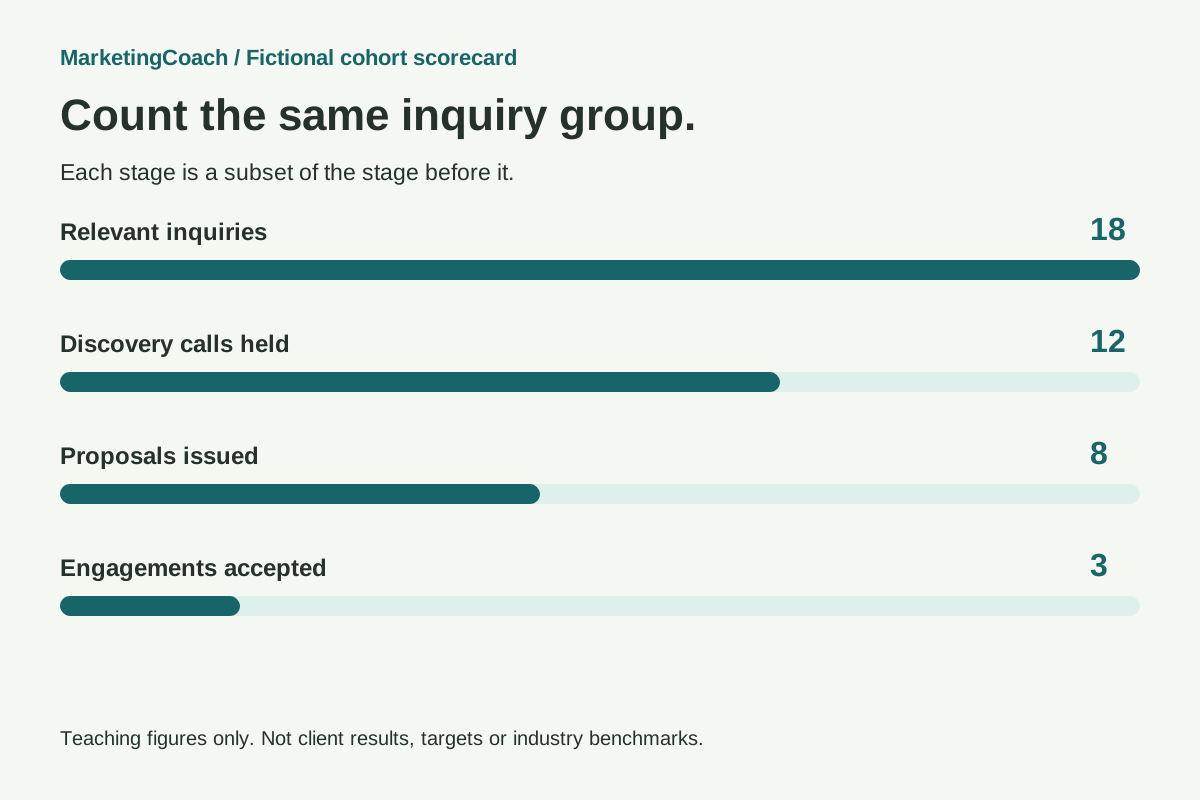
Define a relevant inquiry using your client segment, offered service and capacity. Track one cohort through discovery held, proposal issued and accepted engagement. Leave pending proposals open until a reasonable review date instead of classifying every unaccepted proposal as lost.
Calculate stage conversion only when the denominator is available and the counts describe the same group. Separate inquiries from website clicks, accepted engagements from cash collected, and monthly contract value from earned revenue. The scorecard is a process aid, not an accounting or revenue-recognition system.
Review anonymous reasons for non-fit, delay or scope changes alongside the counts. If calls rarely produce proposals, inspect positioning and qualification. If proposals stall, inspect scope clarity and decision timing. If accepted clients struggle to start, inspect the onboarding requirements. Make one change and review comparable cohorts without claiming that a small sample proves the cause.
Put it to work
Review aggregate counts weekly and add a separate onboarding list in your approved practice system.
You are done whenThe team improves one visible service or handoff issue while keeping client financial information secure.
Worked example · fictional
Harbor Ledger (fictional)
This example shows how the pieces fit together. The business, offer, budget and counts are invented for teaching; they are not client results or recommended targets.
- Audience
- Owner-led service businesses seeking monthly bookkeeping and clearer reporting
- Offer
- A 20-minute discovery call at no charge. An illustrative monthly service is $650 for one entity, up to two bank or card accounts and 150 transactions, with reconciliation and a monthly report review. Cleanup, payroll, tax returns and assurance are excluded.
- Capacity
- Twelve discovery calls and three new monthly client starts available over four weeks
- Budget
- $0 new media spend; reserve four staff hours for service-page and proposal improvements
- First channel
- Your service page and existing business referral relationships
Start with the page
Know what your monthly bookkeeping includes.See the deliverables, limits and responsibilities before you choose a service. Start with a focused discovery call to discuss fit and the work your business needs.
Support the offer with accurate professional designations, a clearly labeled sample report, a transparent service scope and a realistic onboarding process. Then use “Request a discovery call” as the primary action and explain what happens after someone clicks.
Read the numbers carefully
Follow the same group of 18 inquiries through a defined review window. Here are illustrative counts for that cohort:
| Stage | Count | From prior stage |
|---|---|---|
| Relevant inquiries | 18 | — |
| Discovery calls held | 12 | 66.7% |
| Proposals issued | 8 | 66.7% |
| Engagements accepted | 3 | 37.5% |
Eight of twelve discovery calls produced proposals; check fit and missing scope information before assuming the others were lost. Three of eight proposals were accepted. Review exclusions, cleanup scope and start conditions with the remaining prospects; do not count pending decisions as permanent losses.
Decision: review the actual questions and operational constraints before choosing a change. These percentages describe a tiny fictional sample; they do not tell you what your conversion rate should be.
Your first 30 days.
Use the sequence as a starting point. Assign one owner and a realistic review date to each week.
Define the monthly offer
Choose the client segment; document deliverables, volume assumptions, exclusions, fee basis and capacity.
Keep: A clear service pageImprove discovery
Use the call agenda; assign inquiry coverage; adapt the scope and fee replies.
Keep: Each discovery call has a defined outcomeClarify proposals
Revise the proposal summary; test secure onboarding; publish one service-scope article.
Keep: Proposal and handoff testedReview and refine
Compare the same inquiry cohort; inspect pending decisions and onboarding readiness; improve one bottleneck.
Keep: One measured service improvementUse AI as an editor for your plan.
Copy the prompt below into your preferred AI tool with approved, non-confidential business details. Review its output before using it.
Act as a critical marketing editor for a accountants business. Review my audience, offer, landing page, follow-up and measurement plan. Identify missing facts, unclear scope and unsupported claims. Do not invent prices, results, credentials, availability or customer evidence. Ask for missing information. Suggest one specific improvement to the largest visible gap and explain what evidence would show whether it helped.
Keep tax returns, bank details, account numbers, payroll records and client identities out of this workbench and AI prompts. Use approved secure systems. Verify professional designations and service claims; do not promise tax savings, refunds, audit outcomes or financial results.
Choose and adapt an original messageReferences and review notes
The workflows and templates are original editorial recommendations, not industry benchmarks. The references below support the advertising, privacy and profile guidance. Check requirements that apply to your own business before launch.
- AICPA Code of Professional Conduct: advertising and solicitation, section 1.600
- IRS: practitioner advertising and solicitation FAQ
- IRS Publication 4557: Safeguarding Taxpayer Data
Reviewed November 13, 2026.