
Start here
Write the program in concrete terms: who it helps, the skill or practice being developed, session format, participant effort, full price and what is outside scope.
Step 1 of 6
Replace a broad transformation with a clear practice
Start with what a participant will do during the program. 'Become your best self' is difficult to evaluate. Preparing for a management conversation, practicing a presentation or building a weekly planning routine is easier to understand and demonstrate.
Choose a specific audience and the situation that makes the practice useful. Describe readiness in practical terms: time to attend, willingness to practice and a goal within your scope. Explain who needs a different kind of support instead.
Define session count, duration, delivery format, between-session work, communication boundaries and full price. If payment plans are offered, show the total and schedule. Make cancellation, refund and renewal terms available before someone commits.
Put it to work
Write a program card with audience, focus, sessions, practice, support, full price and exclusions.
You are done whenA prospective client can picture an ordinary week in the program.
Step 2 of 6
Build a program page that answers real questions
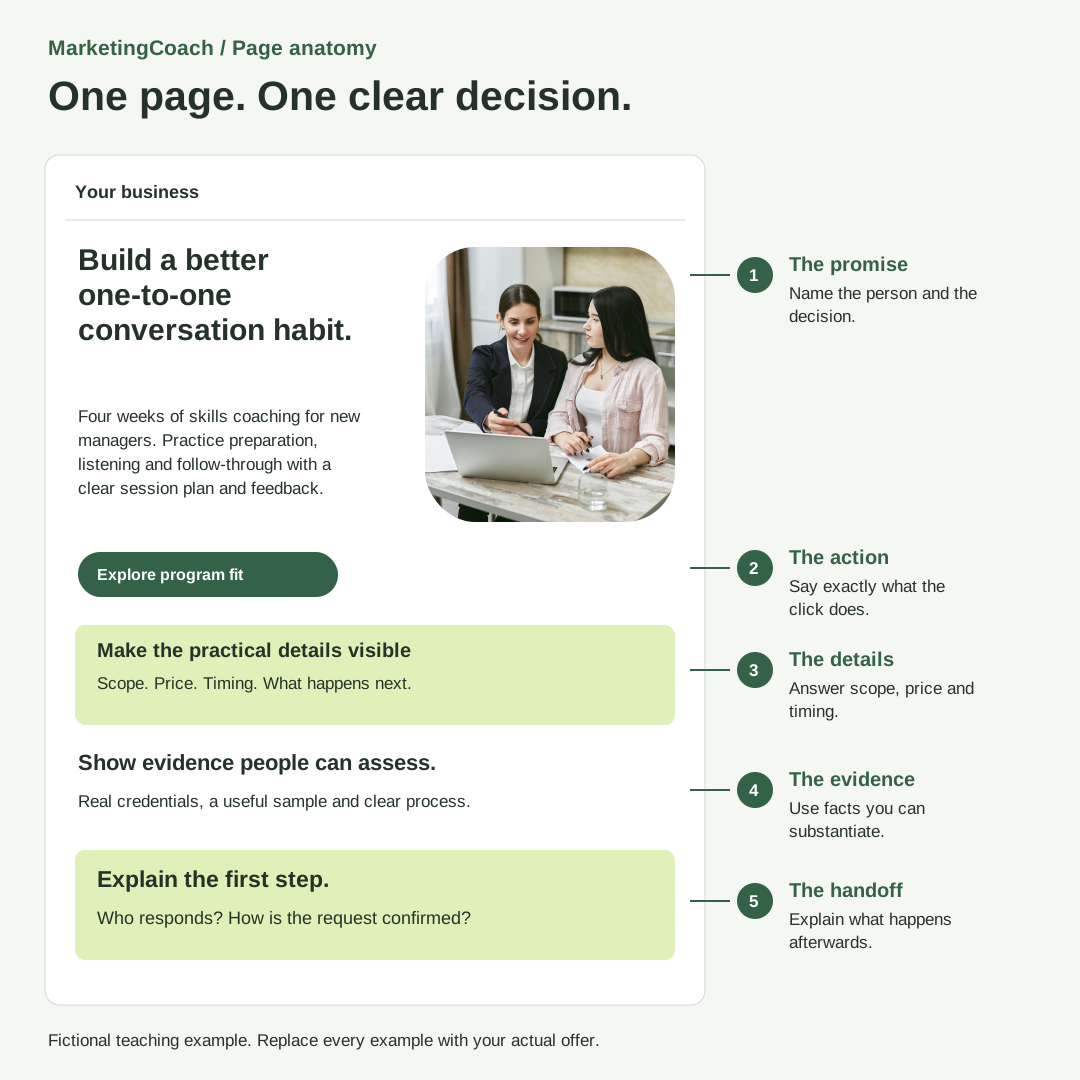
Lead with the practice and the people it is designed for. Show the program structure with a simple week-by-week outline. A real photograph can establish a human tone, while a sample worksheet makes the work tangible. Do not present a stock model as a client or use invented testimonials.
Explain your experience and qualifications accurately, including the boundaries of your work. Show what is included, what the participant contributes and how to ask about fit. If your program requires an application, explain why and what happens after submission.
Place the price, schedule and support boundaries near the enrollment decision. A person should not need a sales call to discover fundamental restrictions. Describe outcomes as goals or skills to practice, and distinguish them from guaranteed external results.
Put it to work
Ask a trusted reader to identify the program format, total cost, time commitment and fit criteria from the page.
You are done whenThe reader understands both the opportunity and the responsibility involved.
Step 3 of 6
Offer a sample that reflects the paid experience
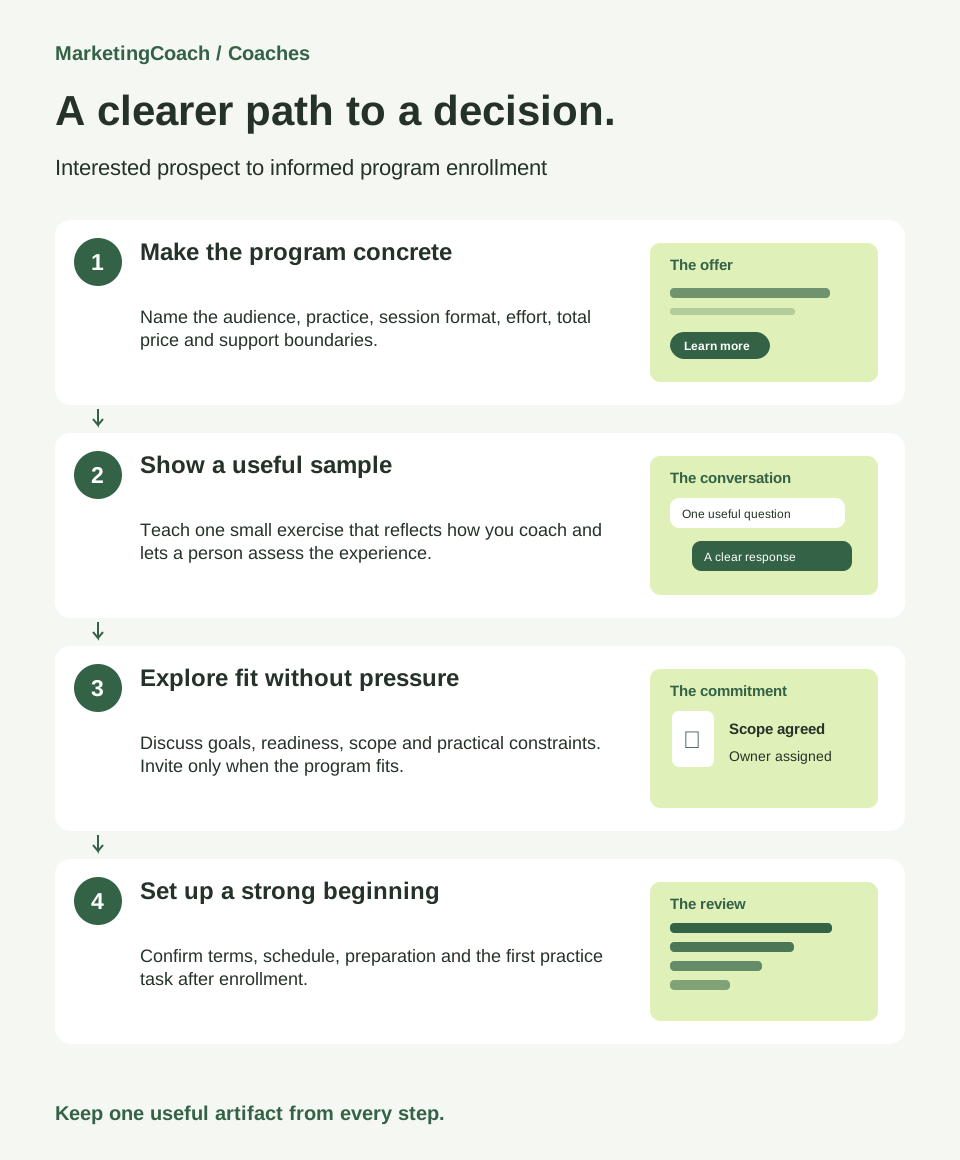
Choose one exercise from your actual coaching method. For the fictional new-manager program, a useful sample is a five-minute conversation preparation sheet: purpose, one open question, what to listen for and the follow-up action. Teach the exercise and allow time to try it.
A sample workshop should have value even for someone who never enrolls. Give participants a useful result, explain how it relates to the larger program and offer a clear optional way to explore fit. Do not withhold the promised lesson to force a sales conversation.
Use genuine dates and capacity. If the sample is recorded, describe it as recorded. If attendees can ask questions, state how that works. Obtain appropriate permissions before recording participants or using their comments in promotion.
Put it to work
Create a 20-minute sample session: five minutes to explain, ten to practice and five to reflect and offer an optional next step.
You are done whenA participant leaves with one completed exercise and an accurate impression of your style.
Step 4 of 6
Make the fit conversation a two-way decision
Start by asking what the person hopes to practice or change and what they have already tried. Explore whether the focus belongs within your coaching scope. Listen for practical constraints such as schedule, access needs and capacity for between-session work.
Explain the program in the same terms as the page. Invite questions about cost, effort and support. If the person needs a different service, say so. Avoid treating hesitation as an objection to overcome at any cost.
End with a clear summary: an invitation, a reason not to proceed or more information to consider. Give the person the written program terms and a reasonable opportunity to review them. Do not create false scarcity or claim that a decision must happen on the call.
Put it to work
Use the fit-call agenda and recap scripts, then record an anonymous fit reason rather than personal coaching notes in the marketing tracker.
You are done whenBoth parties understand why the program is or is not suitable.
Step 5 of 6
Make enrollment and the first session dependable
An expression of interest is not enrollment. Define confirmation using your actual agreement and payment process. Send the schedule, meeting links, support boundaries, preparation task and cancellation terms through the approved client workflow.
Keep the first task small enough to complete. For a skills program, ask the client to bring one real situation within scope. Avoid extensive forms that collect sensitive personal history unnecessarily. Keep private coaching records separate from marketing analytics and the toolkit.
Check that the client can access the material and knows how to contact you. A strong beginning reinforces the expectations established before purchase. If a person withdraws or cannot attend, apply the terms they agreed to and communicate clearly.
Put it to work
Test the complete enrollment path with sample details, including receipt, calendar invitation, materials and first-session instructions.
You are done whenA confirmed client knows where to be, what to bring and how support works.
Step 6 of 6
Measure fit and participation as well as enrollment
Follow one inquiry cohort through held fit calls, invitations and confirmed enrollments. Define a qualified inquiry using the program's practical fit criteria. An invitation is not payment, and payment is not attendance or completion.
Review the reasons people decline or are not invited. If the program is regularly mistaken for therapy or a done-for-you service, sharpen the scope. If the schedule is the barrier, consider whether a different format is viable before changing the promise.
After enrollment, review participation and feedback using your appropriate client process. Ask what parts of the experience were useful and where expectations did not match. Do not turn a single positive comment into a claim that everyone will achieve the same result.
Put it to work
Review inquiries, fit decisions, confirmed enrollments and first-session attendance separately each week.
You are done whenThe next improvement addresses either program clarity, access, fit or delivery quality.
Worked example · fictional
Steady Practice Coaching (fictional)
This example shows how the pieces fit together. The business, offer, budget and counts are invented for teaching; they are not client results or recommended targets.
- Audience
- New managers who want a repeatable way to prepare and run one-to-one conversations
- Offer
- A four-week skills-coaching program with four private sessions, a conversation planner and weekly practice, priced at $600 in this fictional example.
- Capacity
- Four new coaching clients over the next month
- Budget
- $0 new media spend; four hours to prepare one sample exercise, the program page and fit-call routine
- First channel
- An existing audience, referral partners and one practical sample workshop
Start with the page
Build a better one-to-one conversation habit.Four weeks of skills coaching for new managers. Practice preparation, listening and follow-through with a clear session plan and feedback.
Support the offer with a real sample exercise, accurate qualifications and scope, transparent program details, and permissioned client feedback without invented outcomes. Then use “Explore program fit” as the primary action and explain what happens after someone clicks.
Read the numbers carefully
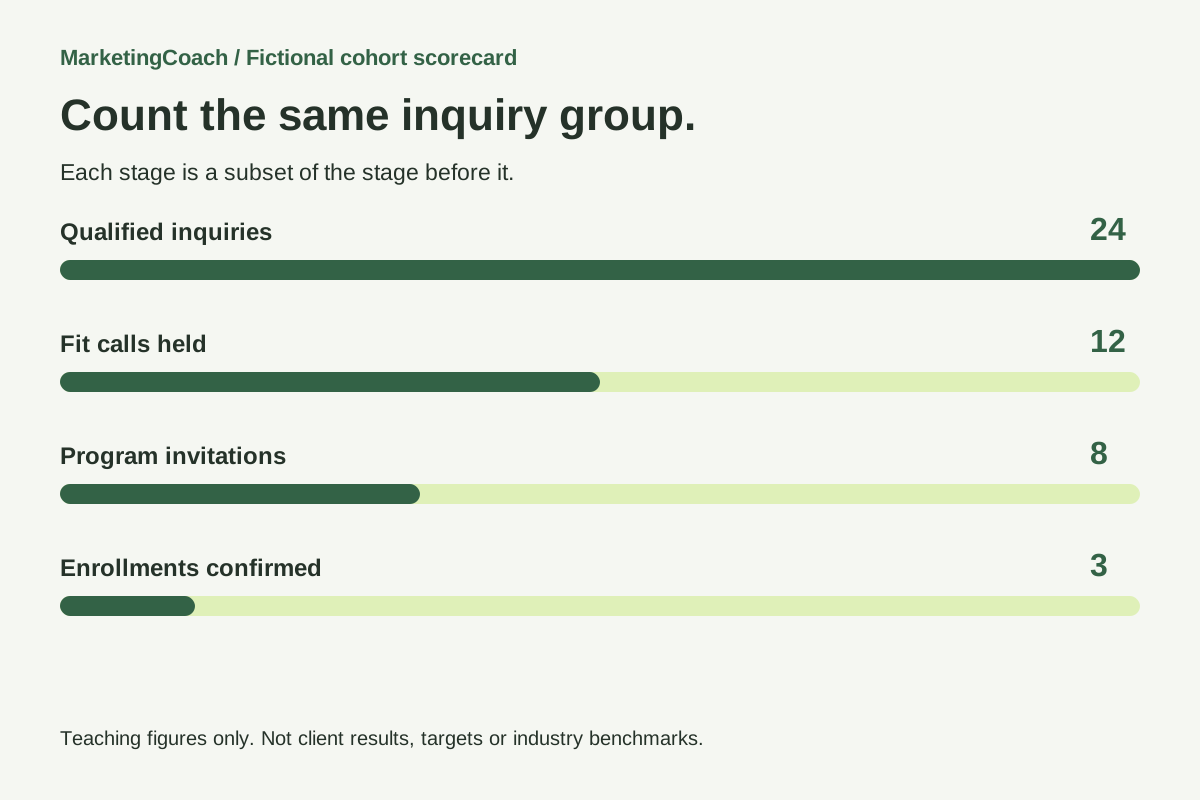
Follow the same group of 24 inquiries through a defined review window. Here are illustrative counts for that cohort:
| Stage | Count | From prior stage |
|---|---|---|
| Qualified inquiries | 24 | — |
| Fit calls held | 12 | 50.0% |
| Program invitations | 8 | 66.7% |
| Enrollments confirmed | 3 | 37.5% |
Three of eight invited prospects enrolled. Ask what remained unclear about effort, schedule, fit or cost. The four fit calls without an invitation may represent useful screening rather than lost sales.
Decision: review the actual questions and operational constraints before choosing a change. These percentages describe a tiny fictional sample; they do not tell you what your conversion rate should be.
Your first 30 days.
Use the sequence as a starting point. Assign one owner and a realistic review date to each week.
Clarify the program
Define audience, focus, sessions, practice, price and boundaries; write the program page.
Keep: A concrete program outlineShow the experience
Create one sample worksheet and a short workshop; share with a relevant existing audience.
Keep: A useful sample lessonGuide fit conversations
Use a consistent agenda; send written summaries and program details; invite suitable prospects.
Keep: Clear fit decisionsImprove the beginning
Test enrollment and first-session access; review questions and participation; adjust one confusing part.
Keep: A dependable onboarding pathUse AI as an editor for your plan.
Copy the prompt below into your preferred AI tool with approved, non-confidential business details. Review its output before using it.
Act as a critical marketing editor for a coaches business. Review my audience, offer, landing page, follow-up and measurement plan. Identify missing facts, unclear scope and unsupported claims. Do not invent prices, results, credentials, availability or customer evidence. Ask for missing information. Suggest one specific improvement to the largest visible gap and explain what evidence would show whether it helped.
Describe coaching within your competence. Do not present coaching as medical treatment, therapy, legal or financial advice, or promise income, employment, health or relationship outcomes.
Choose and adapt an original messageReferences and review notes
The workflows and templates are original editorial recommendations, not industry benchmarks. The references below support the advertising, privacy and profile guidance. Check requirements that apply to your own business before launch.
Reviewed November 13, 2026.