
Start here
Rewrite one broad service as a bounded engagement: a specific buyer, a costly problem, tangible deliverables, clear exclusions and a defined decision.
Step 1 of 6
Package the problem before the expertise
A list of capabilities asks the buyer to design the engagement. Start with a problem you can recognize and investigate: a broken handoff, unclear onboarding, reporting that does not support decisions or a launch without an agreed audience. Choose a buyer who owns that problem and can sponsor the work.
Describe the trigger that makes the work timely. A team adding a second location has a different reason to act than a team casually exploring efficiency. Use actual conversations to refine the language; do not assume that an impressive-sounding pain point is urgent.
Define tangible outputs, duration, client inputs, exclusions and the approval process. A diagnostic can be a legitimate first engagement when investigation is necessary. It should produce a useful artifact, not simply delay a proposal for work you already understand.
Put it to work
Write: For [buyer] facing [trigger], this [duration] engagement produces [deliverables] so the team can decide [decision].
You are done whenA prospect can explain the offer without repeating your job title.
Step 2 of 6
Build an offer page with useful proof
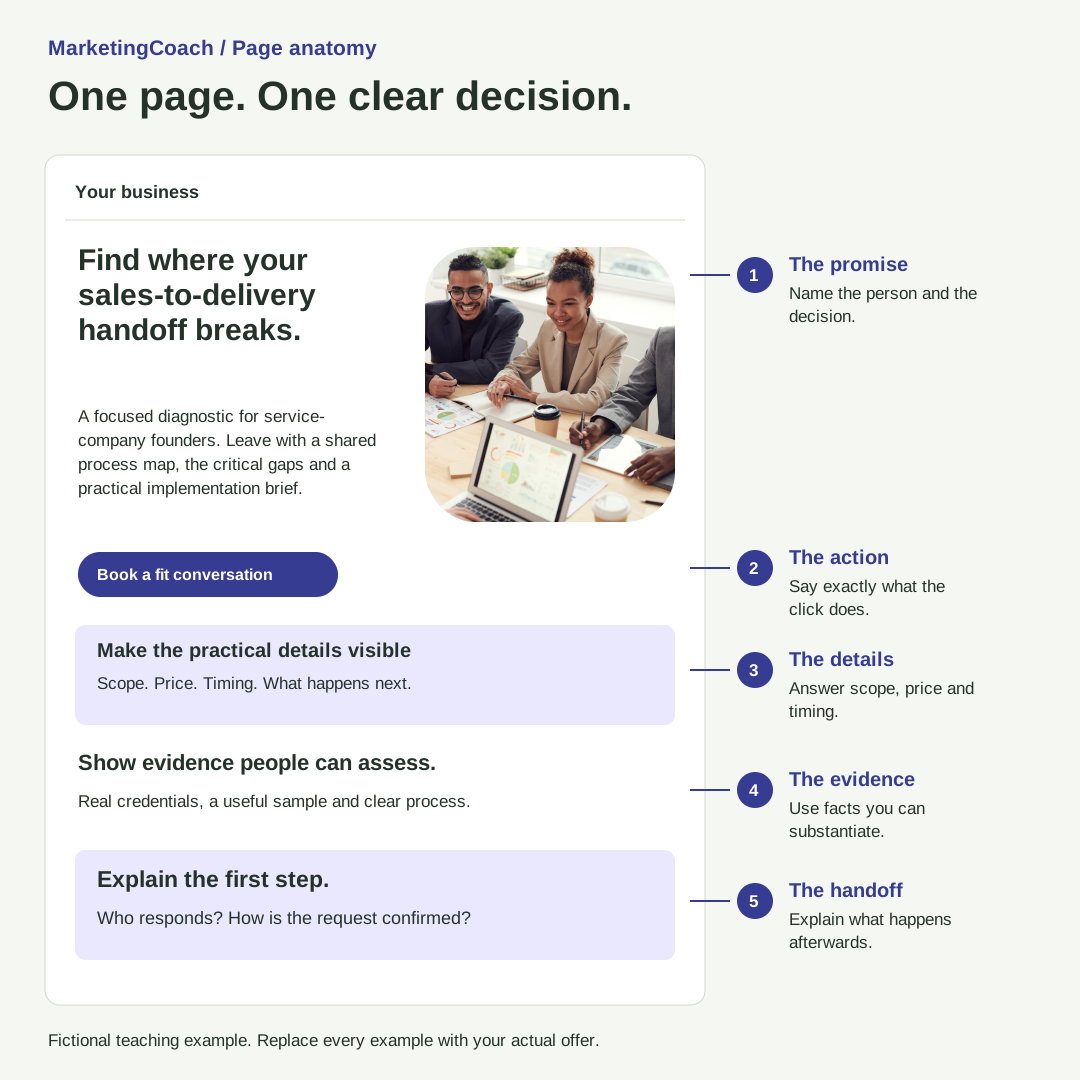
Lead with the buyer's problem and the bounded engagement. Show what the client receives using an annotated sample deliverable. An example process map or decision brief can make the work concrete even when you cannot publish client names. Label samples honestly.
Include the method, time commitment, price or scoping process, responsibilities and who the engagement is not suited for. Do not hide the client's required participation. If success depends on interviews or data access, explain that before the fit conversation.
Use proof that corresponds to the promise. A previous role establishes experience; it does not prove that this engagement produced a specific outcome. When using a case study, distinguish your contribution, the context, the observed result and the limits of attribution.
Put it to work
Add a sample deliverable and a clear 'what you bring / what I deliver' section to your offer page.
You are done whenThe page answers what is bought, how it runs, what it costs or how it is scoped, and how to explore fit.
Step 3 of 6
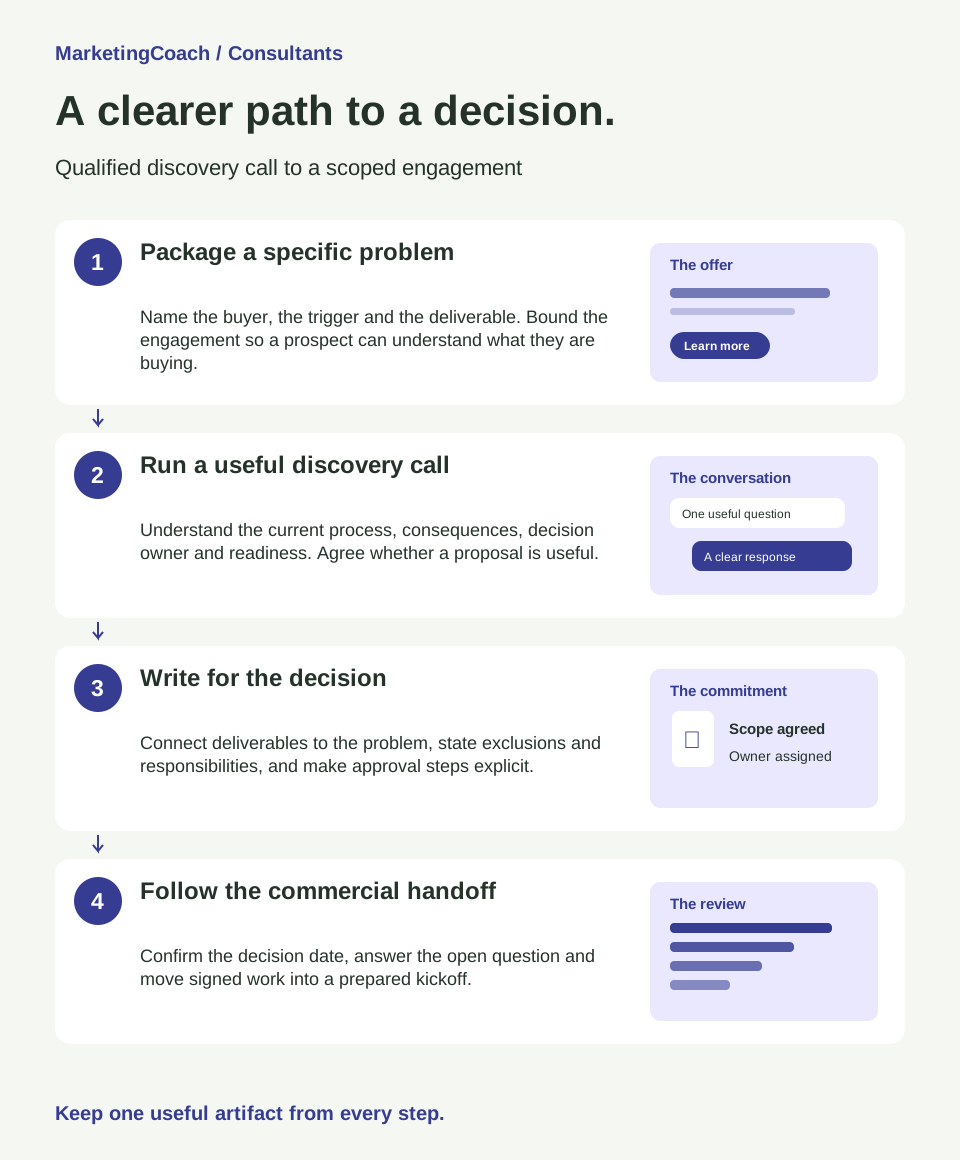
Use discovery to decide whether to proceed
Send a short agenda before the call. Begin with the current situation: what happens today, where the difficulty appears, who is affected and what has already been tried. Ask for examples rather than inviting a broad tour of the organization.
Explore consequences without inventing a financial value. If the prospect estimates time lost, label it as their estimate and ask what evidence could validate it. Understand the decision owner, stakeholders, available budget process and timing without turning the conversation into an interrogation.
End with a decision: no fit, more information, a paid diagnostic or a proposal for known work. Summarize what you heard and confirm the next action. A proposal should not be the automatic output of every friendly conversation.
Put it to work
Use the discovery agenda and recap templates. Ask the prospect to correct your summary before scoping.
You are done whenBoth parties understand why a proposal is or is not appropriate.
Step 4 of 6
Write a proposal someone can approve
Begin with the situation and desired decision in the client's language. Then define deliverables, work sequence, acceptance criteria, exclusions, client responsibilities, timing, price and payment milestones. Include how scope changes are agreed rather than burying the issue in a vague promise of flexibility.
Separate outputs you control from outcomes influenced by implementation and market conditions. You may commit to delivering an agreed analysis; you cannot promise a revenue result without a sound basis. Spell out where the client team must make decisions or do work.
Confirm who needs to review the proposal and how approval works. A clear signature and payment process is more useful than a generic 'let me know your thoughts.' Use appropriate professional contracts for legal terms; this kit provides marketing structure, not a substitute for them.
Put it to work
Check every deliverable against a definition of done and every responsibility against an owner.
You are done whenThe buyer can circulate the proposal internally without needing to reinterpret the offer.
Step 5 of 6
Publish expertise around one buying question
Choose a question your target buyer asks before they are ready to hire. For the fictional handoff diagnostic, a useful article might show how to spot unclear ownership between sales and delivery. Show a small sample, explain a tradeoff and connect it to the diagnostic offer.
Share the article through a channel where you already have relevant relationships. Ask a few trusted contacts for feedback or an appropriate introduction, without expecting them to endorse work they have not seen. Follow community rules and disclose your role as the creator.
A useful content sequence is problem recognition, a worked example, and an explanation of the engagement. Reuse the same core insight in a short post and a brief video. Do not turn every interaction into a cold pitch or automate messages without appropriate permission.
Put it to work
Create one practical article, one sample deliverable and one personal introduction request.
You are done whenEach piece helps a specific buyer recognize the problem and understand the offer.
Step 6 of 6
Review decisions, capacity and delivery together
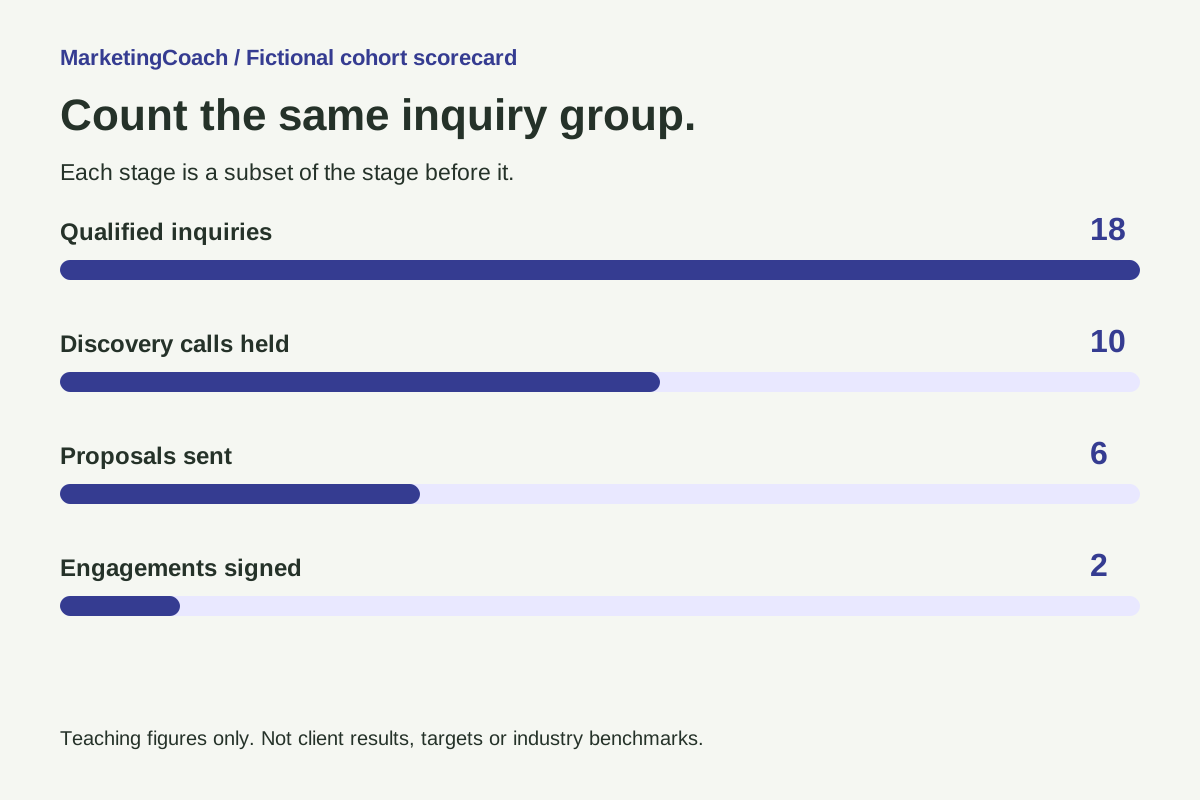
Track the same inquiry cohort through held discovery calls, proposals and signed engagements. Record why a prospect does not advance. A deliberate no-fit decision is useful when it prevents an unsuitable engagement; it should not be treated as a sales failure to erase.
Track signed work, delivered work, invoiced amounts and collected payments separately. Keep your available delivery capacity visible before expanding outreach. Two projects with conflicting access requirements can exceed capacity even if the sales funnel looks healthy.
At the weekly review, inspect proposal questions and decision delays. If scope is repeatedly misunderstood, improve the offer page. If the buyer lacks authority, adjust qualification. If delivery is overloaded, improve scheduling rather than generating more demand.
Put it to work
Review one recent win, one loss and one stalled opportunity with the same questions.
You are done whenThe following week's change addresses an observed commercial or delivery problem.
Worked example · fictional
Northline Operations (fictional)
This example shows how the pieces fit together. The business, offer, budget and counts are invented for teaching; they are not client results or recommended targets.
- Audience
- Founders of 10-30-person service companies with slow sales-to-delivery handoffs
- Offer
- A two-week handoff diagnostic: three stakeholder interviews, one process map and a prioritized implementation brief, priced at $2,500 in this fictional example.
- Capacity
- Two diagnostic engagements in the next month
- Budget
- $0 media spend; six hours for an offer page, one useful article and relationship follow-up
- First channel
- LinkedIn and permission-based introductions from existing relationships
Start with the page
Find where your sales-to-delivery handoff breaks.A focused diagnostic for service-company founders. Leave with a shared process map, the critical gaps and a practical implementation brief.
Support the offer with an anonymized work sample with permission, relevant experience, a clear method and verifiable client evidence where available. Then use “Book a fit conversation” as the primary action and explain what happens after someone clicks.
Read the numbers carefully
Follow the same group of 18 inquiries through a defined review window. Here are illustrative counts for that cohort:
| Stage | Count | From prior stage |
|---|---|---|
| Qualified inquiries | 18 | — |
| Discovery calls held | 10 | 55.6% |
| Proposals sent | 6 | 60.0% |
| Engagements signed | 2 | 33.3% |
Two of six proposals were signed. Review whether the buyer, decision process and scope were confirmed before writing. Four calls without a proposal may be correct disqualification, not failure.
Decision: review the actual questions and operational constraints before choosing a change. These percentages describe a tiny fictional sample; they do not tell you what your conversion rate should be.
Your first 30 days.
Use the sequence as a starting point. Assign one owner and a realistic review date to each week.
Shape the engagement
Choose one buyer and trigger; define deliverables, exclusions and client inputs; build a sample artifact.
Keep: A bounded consulting offerExplain it clearly
Publish the offer page and one buyer-focused article; ask existing contacts for relevant feedback.
Keep: A page and useful proofImprove discovery
Use the call agenda; confirm decision ownership; write proposals only for qualified work.
Keep: Consistent discovery summariesReview the decisions
Analyze proposal questions, signed work and delivery capacity; revise one part of the commercial path.
Keep: An evidence-led offer revisionUse AI as an editor for your plan.
Copy the prompt below into your preferred AI tool with approved, non-confidential business details. Review its output before using it.
Act as a critical marketing editor for a consultants business. Review my audience, offer, landing page, follow-up and measurement plan. Identify missing facts, unclear scope and unsupported claims. Do not invent prices, results, credentials, availability or customer evidence. Ask for missing information. Suggest one specific improvement to the largest visible gap and explain what evidence would show whether it helped.
Use sample or anonymized business information. Do not put client secrets in public AI tools or claim revenue, savings or client results you cannot substantiate.
Choose and adapt an original messageReferences and review notes
The workflows and templates are original editorial recommendations, not industry benchmarks. The references below support the advertising, privacy and profile guidance. Check requirements that apply to your own business before launch.
Reviewed November 13, 2026.