
Start here
Take one unanswered consultation inquiry. Explain what the appointment includes, state the fee and scheduling options, and offer one clear booking link.
Step 1 of 6
Choose a consultation promise you can deliver
Start with the appointment people can reasonably agree to. A consultation is a useful offer when someone wants to understand options but does not yet know what is appropriate. Build the page around that decision. Avoid turning a clinical question into a promise of a cosmetic result.
Ask the front desk which questions recur before someone books. Common categories to check in your own records are price, provider, location, time, preparation and what happens if the person chooses no treatment. Use anonymous themes rather than copying patient conversations into a marketing brief.
Write a one-sentence offer with the provider type, duration, fee and purpose. List what is included and what requires a separate visit or payment. Confirm that the clinical team agrees with the wording and that the calendar can support it.
Put it to work
Complete this sentence: Our [duration] consultation with [provider] costs [fee] and helps you understand [scope]. [Treatment, tests or products] are separate.
You are done whenA front-desk team member can explain the appointment consistently without promising an outcome.
Step 2 of 6
Build the page around the first decision
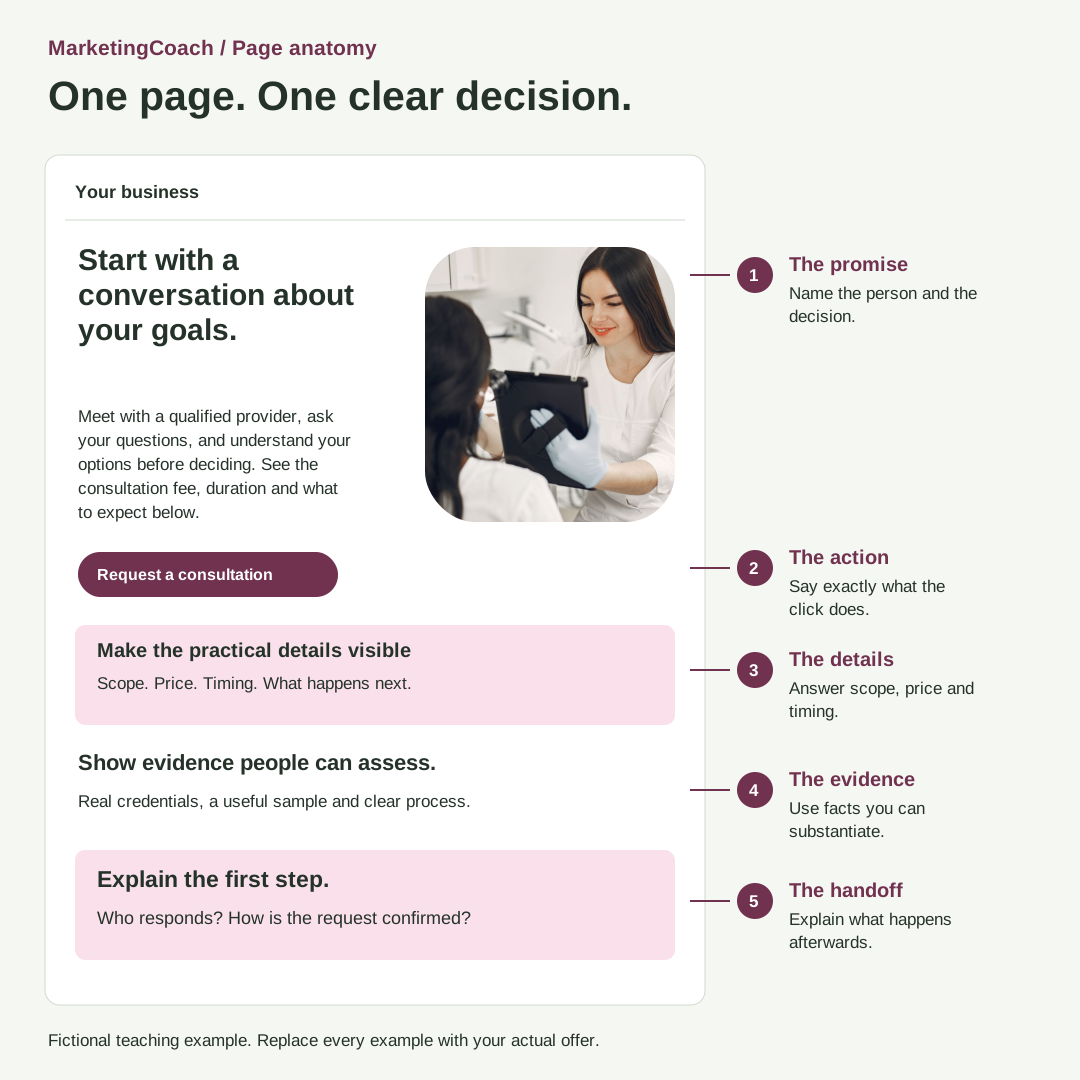
Use a real photograph of your premises or team when you have permission. Stock photography can establish a visual tone, but it cannot stand in for your provider or a patient result. Put the offer and request button beside the image, followed by the fee and practical appointment details.
Place provider credentials, the consultation process, location, accessibility information and cancellation terms close to the booking action. Answer what happens after a request: who responds, during which staffed hours, and whether the time is confirmed instantly or by the team.
Keep the initial marketing form short. Request only the contact and scheduling information your approved process needs. Direct health questions and clinical intake to the appropriate secure workflow. Do not add health conditions, treatment names or free-text patient content to advertising audiences or analytics events.
Put it to work
Read the page on a phone. Find the fee, provider, location, booking action and cancellation information without opening another website.
You are done whenThe request confirmation tells the person exactly what happens next.
Step 3 of 6
Create a response routine that feels human
Assign a person to own new requests during staffed hours and a backup for absences. Choose a response target your team can actually keep; write the target down and measure it before promising it publicly. If someone asked for a specific callback time, use that preference.
The first reply should answer the question asked and make scheduling easy. A second reply should resolve one remaining uncertainty, not repeat a generic check-in. Stop the sequence when the person replies, declines, books or asks you to stop. Do not treat a request for information as permission for an ongoing promotional campaign.
Use the templates as drafts for individual conversations. A message about suitability belongs with qualified clinical staff. Route it through your approved process instead of having an AI tool improvise a recommendation.
Put it to work
Use the inquiry, question and close-the-loop drafts on the swipe-file page. Replace every bracket and review the recipient's contact preference.
You are done whenEach open request has an owner, a status and a sensible review date.
Step 4 of 6
Help booked clients arrive prepared
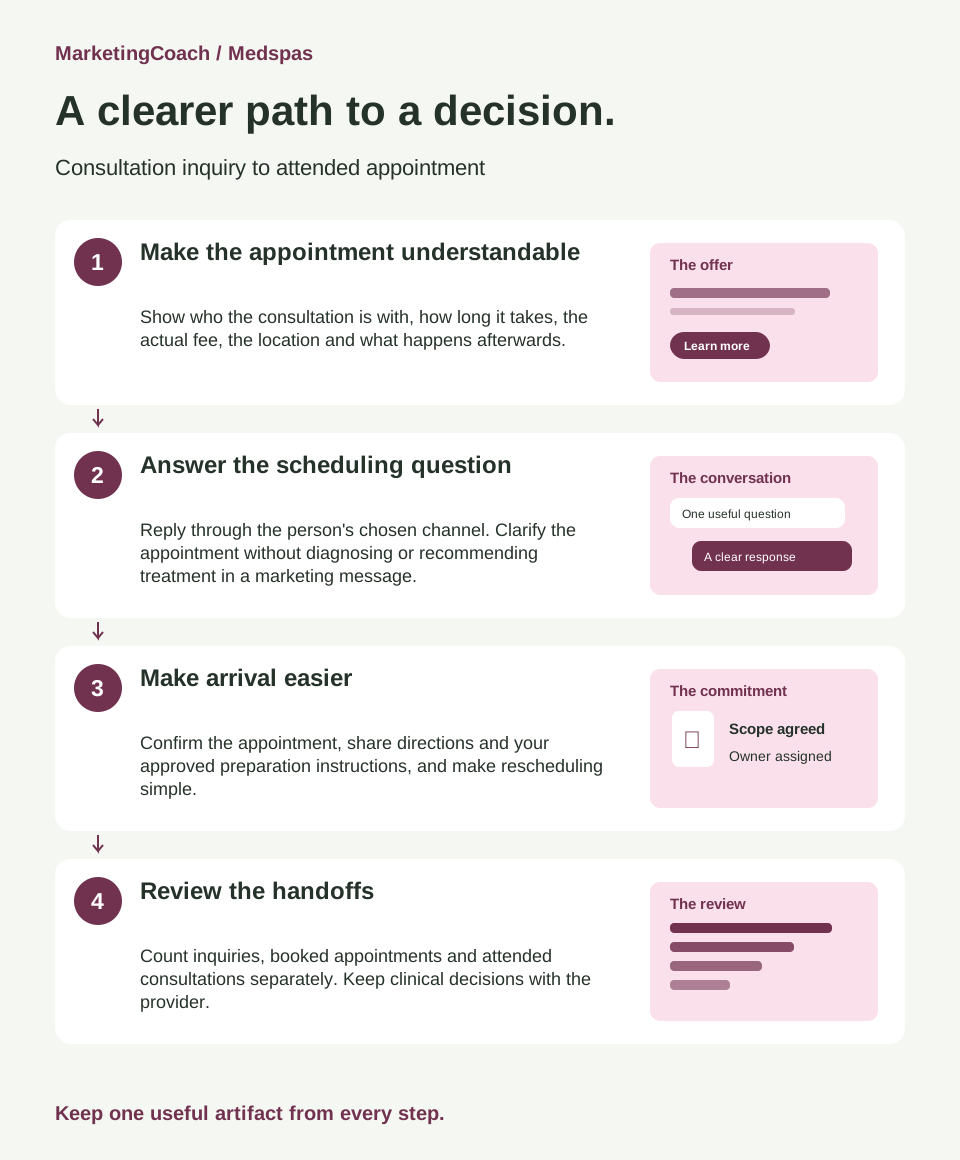
A booked consultation and an attended consultation are different events. Review the confirmation people receive: date, time zone, address, parking or arrival instructions, fee, approved preparation information and a clear way to change the appointment.
Ask the team which logistical problems actually cause missed appointments. Improve the relevant instruction rather than adding more reminders by default. If a person misses the visit, use a neutral rescheduling message without assumptions about why they did not attend.
After the consultation, marketing staff should follow the provider-approved next step. That may be more time to decide, another discussion or no treatment. Keep the patient experience separate from a campaign conversion target.
Put it to work
Walk through a test booking with a staff member. Check confirmation, reminder and rescheduling on a phone.
You are done whenA person can change an appointment without having to explain private health details in a marketing form.
Step 5 of 6
Run one local discovery experiment
Begin where existing interest already arrives: your consultation page, a relevant service page and your business profile. Keep business details, staffed hours and the destination link accurate. Create one educational post explaining the consultation rather than advertising a treatment outcome.
Use a short video with an actual team member: what the appointment covers, who it is for, and how to request one. The footage can show reception, the conversation area and directions. Do not substitute stock models for your team or use generated before-and-after results.
Keep promotion small enough for the team to respond well. Track the tagged source of the request, not sensitive details. If inquiries rise but attendance does not, investigate scheduling and preparation before increasing promotion.
Put it to work
Publish one consultation explainer and link it to the same page from one appropriate existing channel.
You are done whenEvery campaign link leads to a page with matching language and a working request path.
Step 6 of 6
Use the weekly review to improve the experience
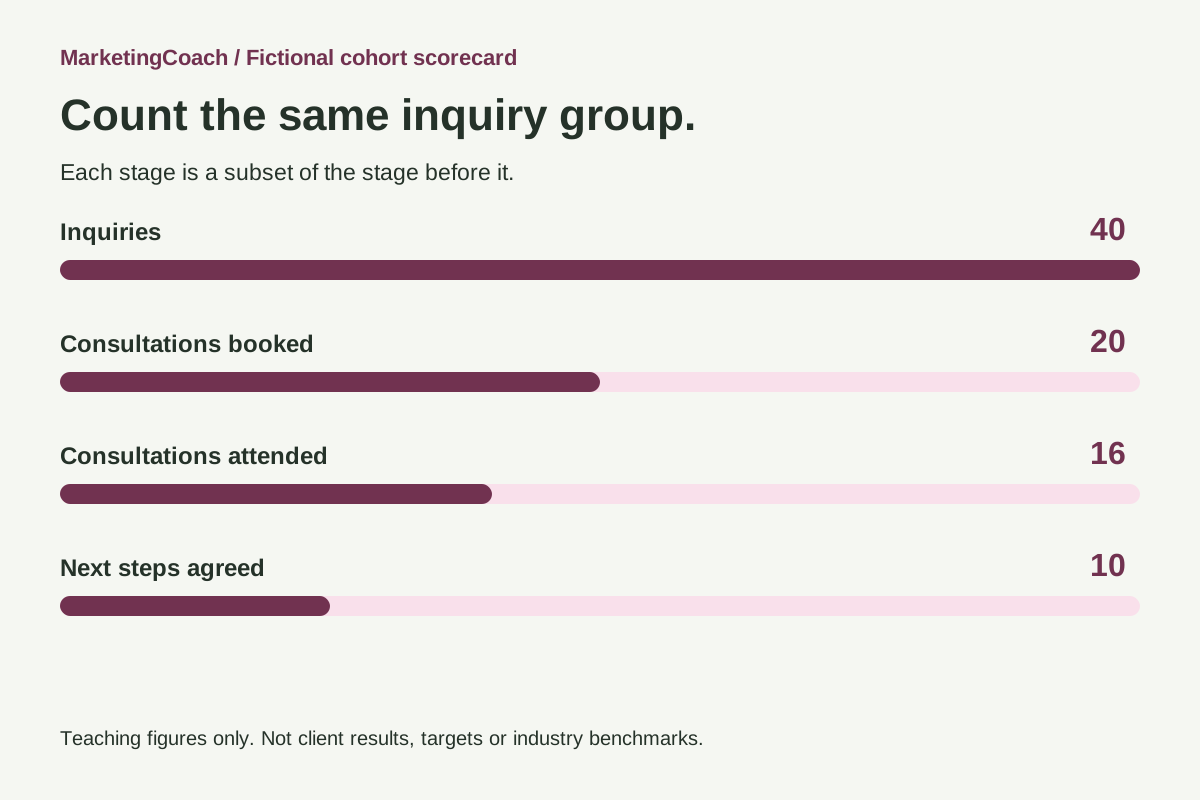
Choose one inquiry cohort, such as requests received in a specific week, and follow those same requests through the stages. Do not divide this week's appointments by this week's inquiries if they refer to different people. Late bookings remain open until the review window closes.
Record aggregate inquiries, booked appointments, attended appointments and agreed next steps. Define an agreed next step consistently without treating treatment purchase as the only useful outcome. Record service revenue only from your accounting system, separately from appointments or deposits.
Read the unanswered questions alongside the numbers. If many people ask about the consultation fee, make that information easier to find. If the next action is unclear, rewrite the confirmation. Change one meaningful part, record the date and compare like periods without claiming a small test proves causation.
Put it to work
Hold a 15-minute weekly review with reception and the clinical lead using aggregate counts and anonymous question themes.
You are done whenThe team chooses one specific improvement and an owner for the following week.
Worked example · fictional
Harbor Aesthetics (fictional)
This example shows how the pieces fit together. The business, offer, budget and counts are invented for teaching; they are not client results or recommended targets.
- Audience
- Local adults asking how to start a conversation about aesthetic care
- Offer
- A 30-minute provider consultation with a clearly displayed $75 consultation fee; treatment is a separate decision.
- Capacity
- Twenty-four consultation appointments available over the next four weeks
- Budget
- $0 new media spend; reserve three staff hours to improve the page and response routine
- First channel
- Your existing website and Google Business Profile
Start with the page
Start with a conversation about your goals.Meet with a qualified provider, ask your questions, and understand your options before deciding. See the consultation fee, duration and what to expect below.
Support the offer with named provider credentials, an accurate description of the consultation, real facility photographs, and a clear contact route. Then use “Request a consultation” as the primary action and explain what happens after someone clicks.
Read the numbers carefully
Follow the same group of 40 inquiries through a defined review window. Here are illustrative counts for that cohort:
| Stage | Count | From prior stage |
|---|---|---|
| Inquiries | 40 | — |
| Consultations booked | 20 | 50.0% |
| Consultations attended | 16 | 80.0% |
| Next steps agreed | 10 | 62.5% |
Half the inquiries booked. Review what people need to know before scheduling; separately investigate the four missed consultations. An agreed next step can be no treatment, more time, or a clinical follow-up.
Decision: review the actual questions and operational constraints before choosing a change. These percentages describe a tiny fictional sample; they do not tell you what your conversion rate should be.
Your first 30 days.
Use the sequence as a starting point. Assign one owner and a realistic review date to each week.
Clarify the consultation
Audit five anonymous inquiry themes; confirm fee, provider, duration and capacity; publish the updated page.
Keep: Page and intake path testedImprove replies
Assign response coverage; adapt the first reply and question follow-up; record the inquiry cohort.
Keep: Every open inquiry has an ownerSupport attendance
Test confirmations and rescheduling; share one consultation explainer through an existing channel.
Keep: Attendance and logistics reviewedReview and refine
Compare the same cohort through booking and attendance; improve the largest observed source of confusion.
Keep: One evidence-based page or process changeUse AI as an editor for your plan.
Copy the prompt below into your preferred AI tool with approved, non-confidential business details. Review its output before using it.
Act as a critical marketing editor for a medspas business. Review my audience, offer, landing page, follow-up and measurement plan. Identify missing facts, unclear scope and unsupported claims. Do not invent prices, results, credentials, availability or customer evidence. Ask for missing information. Suggest one specific improvement to the largest visible gap and explain what evidence would show whether it helped.
Keep health history, symptoms, treatment details and patient photographs out of this toolkit and analytics. Use your approved clinical systems. A booking inquiry is not evidence of clinical suitability.
Choose and adapt an original messageReferences and review notes
The workflows and templates are original editorial recommendations, not industry benchmarks. The references below support the advertising, privacy and profile guidance. Check requirements that apply to your own business before launch.
Reviewed November 13, 2026.