Plan and interpret an A/B test with AI
A pre-written experiment plan with a primary metric and stop rule.
Bring these inputs
Baseline conversion rate, traffic estimate, minimum worthwhile effect and a reliable experiment platform.
Tools for this exercise
Your experiment platform and analytics, with AI assisting the brief and interpretation. Use MarketingCoach’s experiment builder.
Work through it, step by step
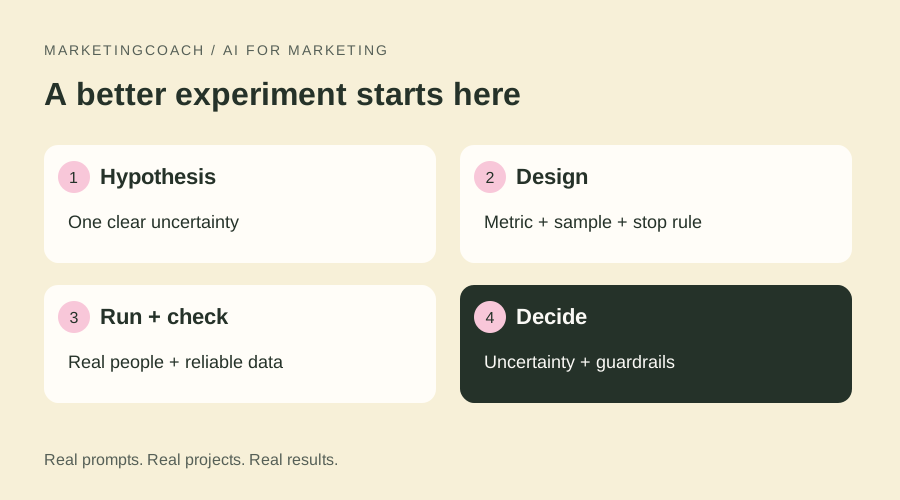
Write one hypothesis connecting a change to behavior. Choose a primary metric, guardrails, randomization unit and eligible population.
Ask a qualified analyst or reliable calculator to size the test using baseline, minimum detectable effect, power and significance settings. AI should explain inputs, not invent sample size.
Randomize comparable visitors concurrently. Validate assignment, exposure events and conversions; check for sample-ratio mismatch. Set the duration and stopping method before launch.
Report counts, denominators, absolute and relative change, uncertainty and guardrails. Do not stop a fixed-horizon test when it first looks positive. If evidence is insufficient, say inconclusive.
A prompt you can reuse
Replace the brackets with your real context. Remove personal or confidential data unless you have permission and an appropriate workspace.
Draft an A/B test plan for [change]. Baseline: [rate]. Traffic: [estimate]. Minimum worthwhile effect: [effect]. Specify hypothesis, unit of randomization, primary metric, guardrails, required sizing inputs, QA, duration and stopping method. Do not invent sample sizes or significance. Explain how to report an inconclusive result.
Example in practice
A 4% to 5% observed conversion change is +1 percentage point and +25% relative lift; without sample sizes and uncertainty it is not evidence of a winning variant.
Human review checkpoint
Sequential methods require an appropriate design. Avoid unplanned repeated peeking and many uncorrected comparisons. Low traffic may be better served by interviews and usability testing first.
Your finished deliverable
A pre-written experiment plan with a primary metric and stop rule. Save the source material, your draft, the corrections you made and the next decision. Ask a colleague to explain what the work recommends; if they cannot, simplify it before moving on.
- Evidence and assumptions are clearly separated.
- The output matches the brief and has an accountable owner.
- Facts, links, accessibility and relevant permissions have been checked.
- The next step has a metric or observable acceptance criterion.