Identify personas from customer evidence
Two evidence-based audience hypotheses and an interview plan.
Bring these inputs
Anonymized interviews, support questions, sales notes and behavioral data you have permission to use.
Tools for this exercise
Claude or ChatGPT for synthesis; your CRM and analytics remain the source of record.
Work through it, step by step
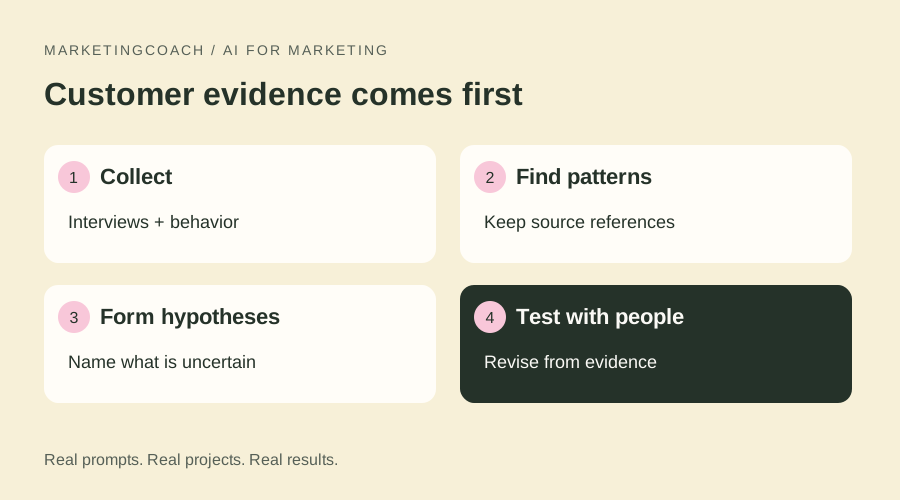
Collect examples from buyers, non-buyers and lost deals. Keep source IDs so you can trace each finding.
Ask AI to group buying triggers, desired outcomes, objections, alternatives and decision criteria. Do not ask it to invent a typical customer.
Build a segment card for each recurring need: situation, job to be done, barrier, proof needed and channel. Mark weak evidence.
Interview people from each proposed segment. Ask about their last real purchase, what they tried and what changed their mind. Revise the cards.
A prompt you can reuse
Replace the brackets with your real context. Remove personal or confidential data unless you have permission and an appropriate workspace.
Analyze only these anonymized records: [records]. Return a table of recurring needs, buying triggers, objections, exact supporting excerpts and source IDs. Distinguish observed patterns from hypotheses. Propose two provisional personas and five neutral interview questions. Do not invent quotes or demographics.
Example in practice
For a bookkeeping service, separate owners struggling to catch up on overdue records from owners needing monthly visibility; their urgency and objections differ.
Human review checkpoint
A synthetic persona is a hypothesis, not a research participant. Check contradictory evidence and avoid inferring sensitive traits.
Your finished deliverable
Two evidence-based audience hypotheses and an interview plan. Save the source material, your draft, the corrections you made and the next decision. Ask a colleague to explain what the work recommends; if they cannot, simplify it before moving on.
- Evidence and assumptions are clearly separated.
- The output matches the brief and has an accountable owner.
- Facts, links, accessibility and relevant permissions have been checked.
- The next step has a metric or observable acceptance criterion.