AI leadership
How to improve marketing leadership with AI
Use AI to prepare clearer decisions, coach your team, and remove recurring obstacles without outsourcing accountability.
In this guide
- The useful starting point
- Prepare a decision, not a status recital
- Use AI as a rehearsal partner
- A worked example: the campaign review keeps expanding
- Make expectations visible
- A prompt for your next leadership meeting
- Try this over the next two weeks
- Continue with a related guide
- Apply this with a practical template
- Questions you might be asking
- Sources and further reading
The useful starting point
Use AI to prepare evidence, challenge a proposal, and rehearse a conversation. The leader remains responsible for the decision, the context employees receive, and whether the process helps the team.
The useful question for a marketing leader is not how many tasks AI can take away. It is which leadership task would improve if you arrived with clearer evidence, better questions, and more time to listen. A faster summary helps only when it improves the conversation that follows.
Begin with one recurring moment: the weekly priorities meeting, a campaign review, or a one-to-one. Avoid making AI adoption itself the performance target. A team can use a tool every day and still be unclear about its goal.
Prepare a decision, not a status recital
Before the weekly meeting, assemble the agreed goal, current commitments, observed results, and unresolved questions. Ask AI for a short decision brief with separate headings for facts, interpretations, and choices. Require source references for numerical claims. If a dashboard and a sales report disagree, carry that disagreement into the meeting.
A useful brief might say that lead volume increased while sales acceptance remained unclear because qualification fields were incomplete. It should not turn that observation into a confident recommendation to increase spend. The leadership task is to decide whether the evidence is sufficient and who can resolve the gap.
Use AI as a rehearsal partner
You can practice explaining a priority change, asking for feedback, or responding to disagreement. Give the model a fictionalized scenario and ask it to challenge an unclear expectation. Do not use generated dialogue as evidence of what an employee thinks.
For a difficult conversation, write the observation, its impact, and the question you want to ask. Rehearse two ways of opening the discussion. Then talk to the person and allow their explanation to change your interpretation. Avoid uploading private performance records to a tool that your organization has not approved.
A worked example: the campaign review keeps expanding
Imagine a hypothetical team whose Monday review consumes two hours and ends without priorities. The leader uses AI to organize approved campaign notes into three decisions: what to continue, what to investigate, and what to stop. Each decision has a named owner and a missing-evidence field.
The team tests a shorter meeting with this brief for three weeks. It records decisions made, commitments missed, and how much preparation and correction time the brief requires. A shorter meeting alone is not success: if people leave confused or important objections disappear, the process needs revision.
Make expectations visible
Tell the team which work AI may draft, what needs review, and where employees can challenge an output. Ask each person to bring one example where the tool helped and one where it created extra work. Reward good judgment, including the decision not to use AI for a particular task.
Agree on what happens to any time saved. It might support customer interviews, learning, or a smaller backlog. Quietly filling every saved hour with more tasks can make an adoption program feel like a monitoring program.
A prompt for your next leadership meeting
Prepare a decision brief from these approved notes. List the goal, observed evidence with source references, unresolved disagreements, options, and consequences. Separate missing information from poor performance. Suggest three questions I should ask the team before deciding. Do not infer motives or rank employees. End with a proposed decision log for human review.
Try this over the next two weeks
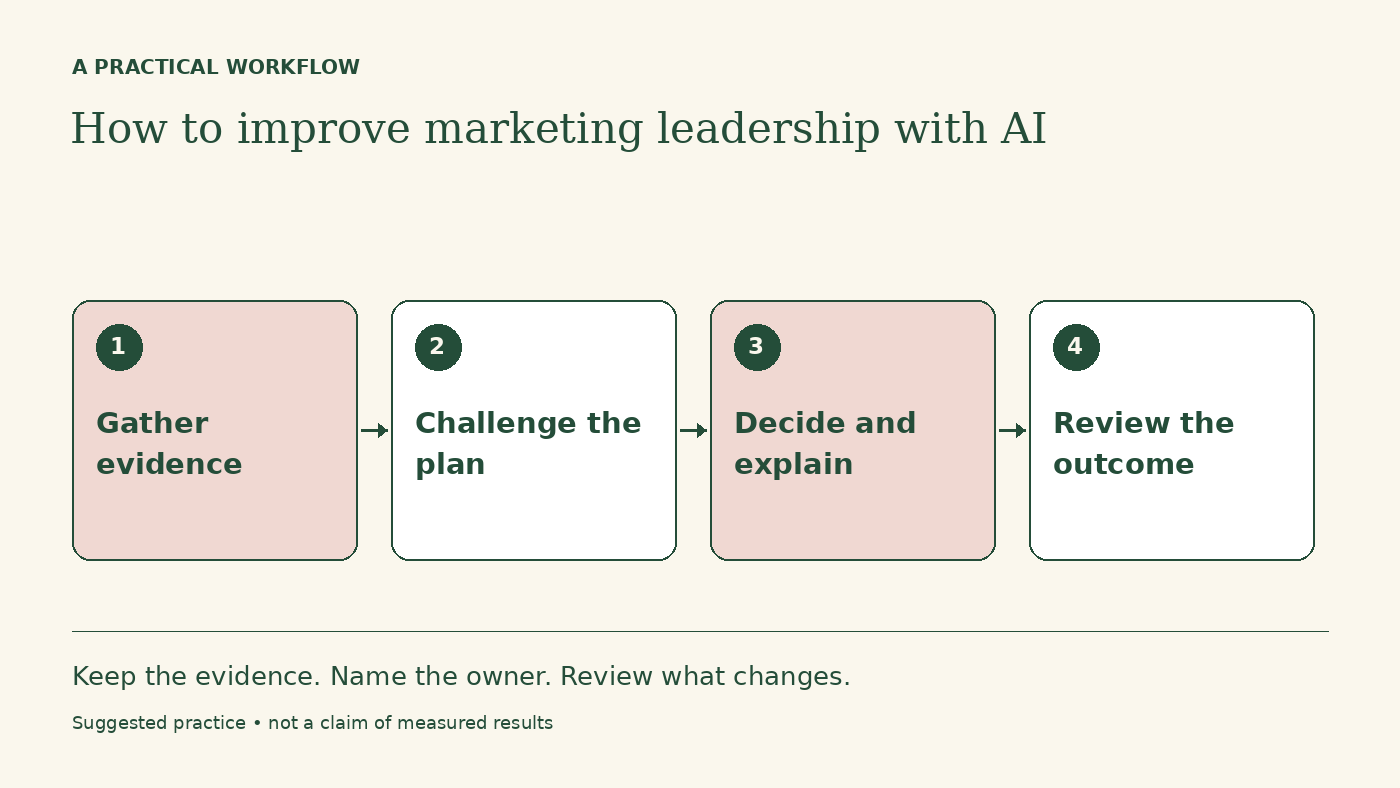
Choose one leadership moment, keep the original inputs, and compare the reviewed AI brief with your previous approach. Ask participants whether priorities and responsibilities became clearer. Track corrections and preparation effort alongside meeting length. Keep the practice only if it improves the team's ability to decide and follow through.
Anthropic's agent guidance favors starting simply. Applying that idea here is an editorial recommendation: one useful briefing routine is enough to begin. Leadership still happens through attention, judgment, and the commitments you keep.
Continue with a related guide
- Evaluate your marketing process before you automate it
- Build your own AI marketing team around real responsibilities
Apply this with a practical template
A weekly AI leadership review your marketing team can actually use
Questions you might be asking
Can AI give feedback to my team for me?
It can help draft and rehearse feedback. You should verify the observations, have the conversation, and own what you say.
What should I measure first?
Whether decisions, owners, and next actions are clearer, plus total preparation and correction time.
Sources and further reading
Sources checked October 16, 2026. Tool features and plan availability can change; review the linked publisher documentation before connecting an account.
Put one idea to work
Choose one recurring marketing task and define the inputs, review, and next action before connecting tools.
Plan an AI marketing workflow →Explore more from MarketingCoachKeep practicing
 Freelance work
Upwork MCP for marketers: find projects that fit the evidence in your portfolio
A practical Upwork MCP workflow for marketers building a freelance pipeline: project fit, honest proposals, bid review, portfolio evidence, and a small side-work test.
October 20, 2026 · 4 min read AI commerce
Use Shopify AI and MCP to answer a real marketing question
A practical Shopify guide for marketers building a freelance pipeline: Sidekick, native AI, MCP roles, integrations, and one useful store experiment.
October 20, 2026 · 4 min read