AI leadership
A weekly AI leadership review your marketing team can actually use
A practical agenda, decision log, and briefing prompt for clearer marketing priorities and accountable follow-through.
In this guide
- The useful starting point
- Before the meeting: assemble a small evidence pack
- A suggested 30-minute agenda
- Copy this decision log
- A briefing prompt to adapt
- Example: more leads, uncertain quality
- Evaluate the routine after three reviews
- Build on the earlier guides
- Questions you might be asking
- Sources and further reading
The useful starting point
Use AI to prepare a source-linked brief, then spend the meeting deciding what changes. Record the owner, reason, next action, and review date for each decision.
A weekly review should change what the team does next. If everyone reports activity but nobody resolves a tradeoff, a faster AI summary will not fix the meeting. Start by choosing the decisions the review exists to support: which campaign needs attention, which commitment is at risk, and where the team needs help.
This is an original operating template for a small marketing team. Adapt the timeboxes to your situation. It is not a tested promise that a particular meeting length will improve performance.
Before the meeting: assemble a small evidence pack
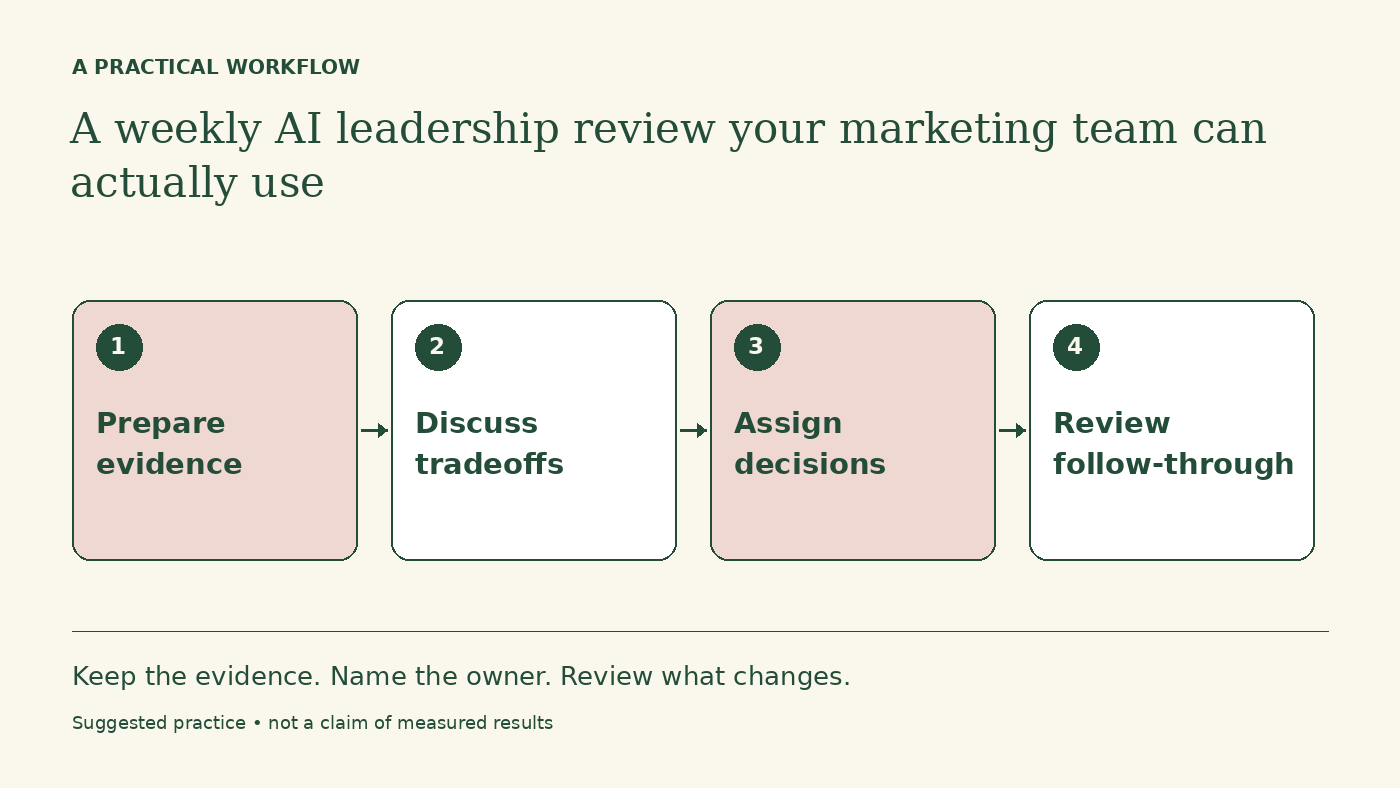
Choose a cutoff time and ask each owner for the same four inputs: the agreed objective, the observed result, the obstacle, and the decision needed. Include a link to the dashboard, customer note, or campaign record behind each observation. Use the same reporting period across channels and flag incomplete attribution.
Give AI these approved inputs and ask it to organize them. Keep the source links beside the claims. A missing answer should remain missing; the brief should never quietly turn an estimate into a reported result. Let contributors correct the draft before the meeting.
A suggested 30-minute agenda
- Minutes 0–5: agree on the evidence. Resolve material errors and identify numbers that remain provisional. Do not spend this section reading the whole report aloud.
- Minutes 5–15: decide the main tradeoff. Discuss one choice that affects the customer or business goal. Compare continuing, changing, and stopping the work.
- Minutes 15–23: remove an obstacle. Name the dependency, the person who can resolve it, and the next conversation needed.
- Minutes 23–28: confirm commitments. Read back the decisions, owners, and review dates. Ask whether the workload is feasible.
- Minutes 28–30: check the meeting. What remains unclear? What evidence would make next week's decision easier?
Move detailed troubleshooting into a separate working session with the people who need to be there. Urgent customer or operational issues should use an immediate escalation path, not wait for the weekly agenda.
Copy this decision log
- Decision and date: What are we changing, continuing, or stopping?
- Customer or business objective: Which outcome should this support?
- Evidence: What did we observe, where is the source, and what is uncertain?
- Options considered: What alternatives did we reject, and why?
- Accountable owner: Who makes sure the next step happens?
- Next action and due date: What concrete work follows the decision?
- Review trigger: When, or after what new evidence, will we reconsider?
Keep the log somewhere the team already works. A polished document nobody revisits adds administration without improving leadership.
A briefing prompt to adapt
Organize these approved updates into a one-page leadership brief. Separate observed facts, interpretations, and decisions needed. Preserve source links and reporting periods. Identify conflicting evidence and missing information. Suggest the two most consequential tradeoffs for discussion. Do not infer employee motives, invent results, or make the final decision. End with a draft decision log for the team to correct.
Example: more leads, uncertain quality
Imagine a hypothetical team seeing more demo requests after a campaign change. Sales acceptance data is incomplete. The brief should surface that gap rather than recommend a larger budget from lead volume alone. The team might keep spending steady, assign an owner to reconcile qualification records, and review the result after a defined sample is available.
The useful output is a bounded decision with an evidence plan. The model does not need access to every employee's messages or every CRM record to help prepare it.
Evaluate the routine after three reviews
Track total preparation and correction time, decisions with an owner and review date, and commitments that repeatedly carry over. Ask team members whether they understand the priorities and can raise objections. These are local learning signals, not a score for ranking employees.
If preparation expands while decisions remain unclear, reduce the brief and tighten the agenda. Anthropic's guidance to begin with simple workflows supports a modest starting point; this leadership routine is our suggested application of that principle.
Build on the earlier guides
- How to improve marketing leadership with AI
- Evaluate your marketing process before you automate it
- Build your own AI marketing team around real responsibilities
Questions you might be asking
Should AI attend every leadership meeting?
No. A reviewed briefing document may be enough. Choose the least complicated method that helps the team make and revisit decisions.
Can this replace one-to-one conversations?
No. Use the team review for shared priorities and dependencies. Individual support and sensitive conversations still need direct attention.
Sources and further reading
Sources checked October 16, 2026. Tool features and plan availability can change; review the linked publisher documentation before connecting an account.
Put one idea to work
Choose one recurring marketing task and define the inputs, review, and next action before connecting tools.
Plan an AI marketing workflow →Explore more from MarketingCoachKeep practicing
 Freelance work
Upwork MCP for marketers: find projects that fit the evidence in your portfolio
A practical Upwork MCP workflow for marketers building a freelance pipeline: project fit, honest proposals, bid review, portfolio evidence, and a small side-work test.
October 20, 2026 · 4 min read AI commerce
Use Shopify AI and MCP to answer a real marketing question
A practical Shopify guide for marketers building a freelance pipeline: Sidekick, native AI, MCP roles, integrations, and one useful store experiment.
October 20, 2026 · 4 min read