AI teams
Build your own AI marketing team around real responsibilities
Create a practical research, drafting, and review workflow with shared context, clear handoffs, and one accountable human owner.
In this guide
- The useful starting point
- Define three jobs before adding more
- Give every pass the same source brief
- A worked example: a service landing page
- Write a small operating agreement
- A prompt for assigning the work
- Know when to expand
- Continue with a related guide
- Apply this with a practical template
- Questions you might be asking
- Sources and further reading
The useful starting point
Start with one marketing deliverable. Define research, production, and review responsibilities, give each step a shared source brief, and keep publication and budget decisions with a named person.
An AI marketing team is a way of organizing assistance around work. Naming five chat windows after executive roles does not create five independent experts. The useful design is a sequence of responsibilities with clear inputs, outputs, and acceptance criteria.
Start with one deliverable you already understand, such as a landing-page brief. You can perform the first version in one AI tool using separate passes. Add multiple tools or agents only when the handoffs solve a concrete problem.
Define three jobs before adding more
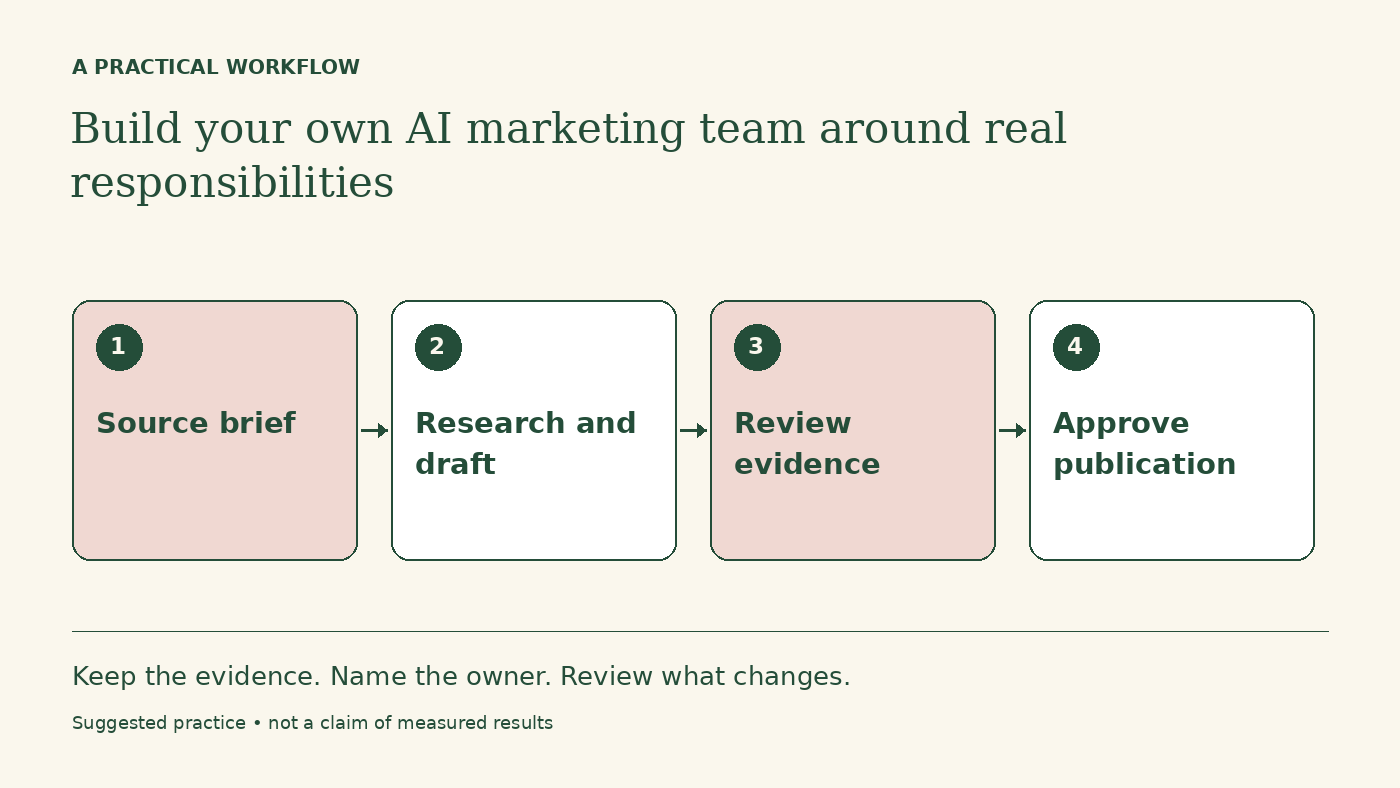
The researcher gathers approved evidence and records its source. The producer proposes a message and drafts the requested asset. The reviewer checks the result against the evidence, audience, and delivery constraints. A person decides whether the work is ready and what to do next.
These are responsibilities, not claims that the model has professional qualifications. Asking the same model to critique itself can catch inconsistency, but it does not provide independent verification. Check factual claims against original material and important strategic choices with people who know the business.
Give every pass the same source brief
Include the audience situation, product facts, customer evidence, tone, offer terms, prohibited claims, and desired action. Add a version date. Distinguish observed customer language from ideas generated during brainstorming.
Each handoff should preserve the brief and attach only what the next step needs. An enormous transcript can bury the decision. A summary without source references can erase the evidence. Use a short handoff record: work completed, evidence used, unresolved issues, and the next requested action.
A worked example: a service landing page
Imagine a hypothetical bookkeeping firm introducing a monthly review service. The researcher assembles approved scope, pricing conditions, and recurring customer questions. The producer drafts a page organized around what a client needs to understand before requesting a call.
The reviewer flags a promise to eliminate tax mistakes because the source brief never supported it. A human removes the claim and confirms the offer with the service owner. A separate check tests the form and the confirmation message on the actual page.
The team measures qualified inquiries and form completion alongside review time and corrections. It does not count the number of generated headlines as business progress. If the brief repeatedly omits an important condition, fix the source brief rather than relying on the reviewer to rediscover it every time.
Write a small operating agreement
- Research may read approved material and propose questions.
- Drafting may create working copy, with unsupported claims marked.
- Review must list evidence gaps and specific required changes.
- A named owner approves public copy, spending, and customer communications.
- Failed or ambiguous tasks return to that owner with the original input.
A prompt for assigning the work
Design a three-pass workflow for this deliverable: [task]. Use this approved brief: [context]. Specify the input, output, source references, acceptance criteria, and handoff for research, drafting, and review. Identify decisions a human must make. Keep the first version manual and explain what evidence would justify automating it later.
Know when to expand
Anthropic distinguishes predefined workflows from agents that choose their own steps. For a repeatable marketing deliverable, the former may be sufficient. More autonomy adds decisions to supervise and more ways for context to drift.
After a few runs, inspect where people spend time correcting or reconnecting the work. Add a specialist pass only when it addresses that bottleneck. A small AI team earns its place by producing work you can use and explain.
Continue with a related guide
Apply this with a practical template
A weekly AI leadership review your marketing team can actually use
Questions you might be asking
Do I need several AI subscriptions?
No. Start with separate passes in a tool you already have and evaluate whether another tool solves a specific gap.
Can an AI reviewer approve publishing?
Treat its review as input. A named person should own publication and verify important claims against their sources.
Sources and further reading
Sources checked October 16, 2026. Tool features and plan availability can change; review the linked publisher documentation before connecting an account.
Put one idea to work
Choose one recurring marketing task and define the inputs, review, and next action before connecting tools.
Plan an AI marketing workflow →Explore more from MarketingCoachKeep practicing
 Freelance work
Upwork MCP for marketers: find projects that fit the evidence in your portfolio
A practical Upwork MCP workflow for marketers building a freelance pipeline: project fit, honest proposals, bid review, portfolio evidence, and a small side-work test.
October 20, 2026 · 4 min read AI commerce
Use Shopify AI and MCP to answer a real marketing question
A practical Shopify guide for marketers building a freelance pipeline: Sidekick, native AI, MCP roles, integrations, and one useful store experiment.
October 20, 2026 · 4 min read