Process improvement
Evaluate your marketing process before you automate it
Map the journey from campaign request to customer follow-up, find waiting and rework, and select one useful automation pilot.
In this guide
- The useful starting point
- Follow five recent cases
- Classify the friction before choosing a tool
- A worked example: inquiry to sales handoff
- Measure the complete cost
- Use this process-review prompt
- Decide what to keep
- Continue with a related guide
- Apply this with a practical template
- Questions you might be asking
- Sources and further reading
The useful starting point
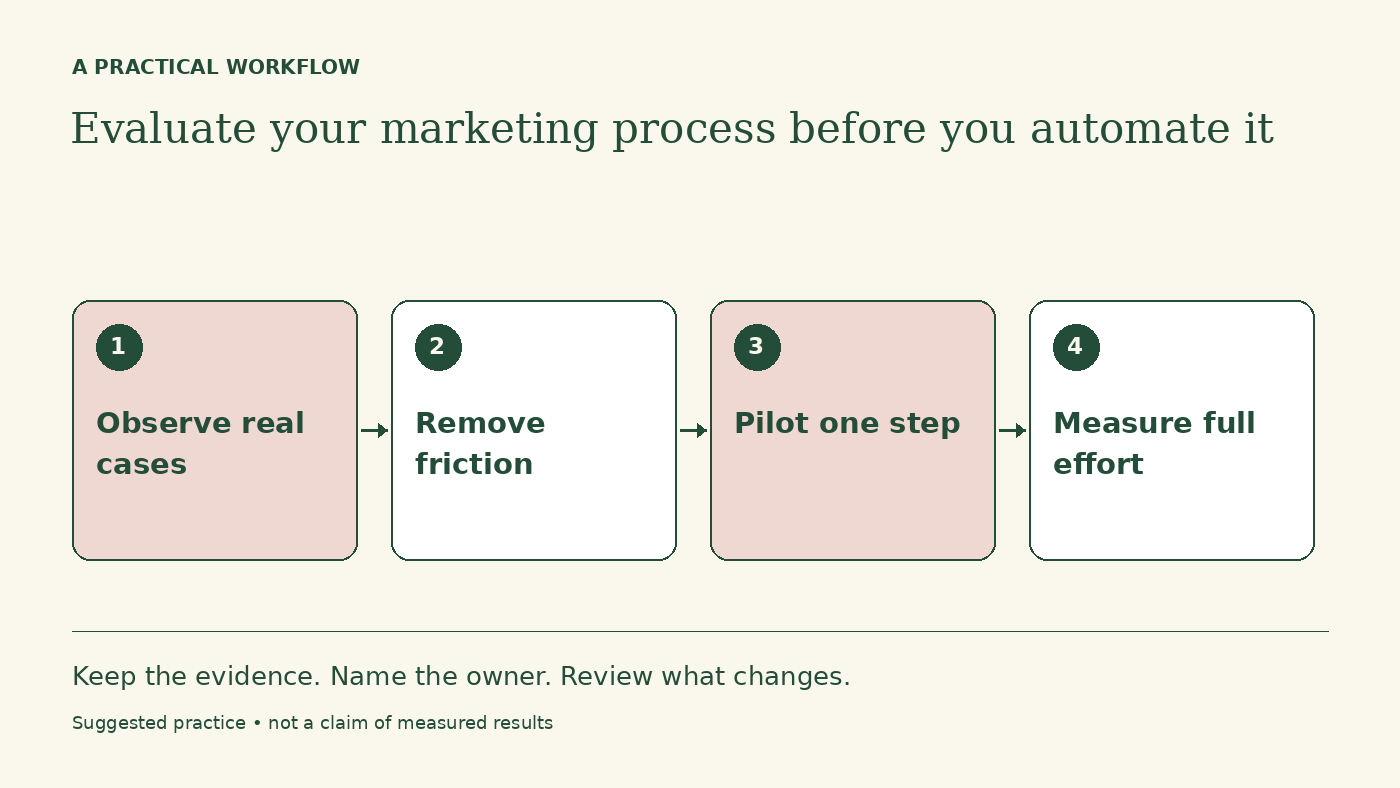
Observe real cases, map handoffs, separate work time from waiting, remove unnecessary steps, and automate only a stable task with an owner and a measurable result.
A campaign can move quickly through a writing tool and still spend four days waiting for an approval. Automating copy production would increase the pile in front of the reviewer. Process evaluation begins with the whole journey, including the moments when nobody appears to be doing anything.
Pick a process with a recognizable beginning and ending. A useful example is campaign request to approved launch, or qualified inquiry to an agreed sales next step. Avoid mapping the entire marketing department in your first session.
Follow five recent cases
Ask the people doing the work to walk through recent examples, including one that went badly. Record the input, action, system, owner, handoff, and decision at each step. Write down the actual sequence rather than copying the official procedure.
Separate hands-on work from waiting. Record rework and the reason it happened. Five cases will not establish a reliable population average, but they can expose questions worth investigating with a larger sample. Include difficult cases so the map does not describe only the easiest route.
Classify the friction before choosing a tool
- Missing information: the request arrives without a customer, offer, or deadline.
- Conflicting decisions: two reviewers apply different standards.
- Queueing: one person must approve every small change.
- Repetition: people copy the same approved information between systems.
- Exceptions: an unusual case has no clear owner.
Each problem suggests a different intervention. Improve the request form when inputs are incomplete. Agree on review criteria when approvals conflict. Use a simple rule for a stable transfer. Consider AI when interpreting varied language is the actual difficulty.
A worked example: inquiry to sales handoff
Imagine a hypothetical training business. Marketing receives inquiry forms, manually checks the company, and forwards a summary to sales. Sales sends the record back when the requested workshop date or audience size is missing.
The first improvement is to ask for those details at intake and explain why they matter. The second is a shared definition of a qualified inquiry. Only then does the team pilot AI-assisted summarization of the free-text request. The summary includes the original record link and leaves missing facts blank.
During the pilot, a person approves each handoff. Duplicated forms, unclear dates, and requests outside the offer go to an exception queue. The team does not automatically enroll a prospect in a new marketing sequence merely because an AI classifier labeled them promising.
Measure the complete cost
Track elapsed time, human handling time, corrections, failed transfers, and whether sales receives enough information to take the next action. Include review and maintenance effort. If a task used to take 20 minutes and the new draft takes 3 minutes plus 12 minutes of checking, the saving is 5 minutes, not 17.
That arithmetic is an illustrative example, not a performance claim. Cost per usable handoff is often more informative than the number of automated executions. Also watch for downstream work that moves from marketing to sales without disappearing.
Use this process-review prompt
Review this process map and these anonymized cases. Identify missing inputs, queues, rework, duplicate entry, and unclear decisions. For each issue propose removing, simplifying, standardizing, or automating a step. State the evidence and what remains unknown. Recommend one small pilot with an owner, exception path, and measures that include review time.
Decide what to keep
Run the pilot through ordinary and difficult cases. Keep a manual fallback and a named person who can stop it. At the review, decide whether to expand, revise, or retire it. A successful process improvement may involve less software and a clearer agreement between two people.
Continue with a related guide
- How to improve marketing leadership with AI
- Build your own AI marketing team around real responsibilities
Apply this with a practical template
A weekly AI leadership review your marketing team can actually use
Questions you might be asking
Should I automate the slowest step first?
Investigate why it is slow. Waiting for an unclear decision may need a better agreement rather than automation.
When is AI appropriate?
When variable language or judgment support is central and the result can be checked. Stable rules often suit conventional automation.
Sources and further reading
Sources checked October 16, 2026. Tool features and plan availability can change; review the linked publisher documentation before connecting an account.
Put one idea to work
Choose one recurring marketing task and define the inputs, review, and next action before connecting tools.
Plan an AI marketing workflow →Explore more from MarketingCoachKeep practicing
 Freelance work
Upwork MCP for marketers: find projects that fit the evidence in your portfolio
A practical Upwork MCP workflow for marketers building a freelance pipeline: project fit, honest proposals, bid review, portfolio evidence, and a small side-work test.
October 20, 2026 · 4 min read AI commerce
Use Shopify AI and MCP to answer a real marketing question
A practical Shopify guide for marketers building a freelance pipeline: Sidekick, native AI, MCP roles, integrations, and one useful store experiment.
October 20, 2026 · 4 min read