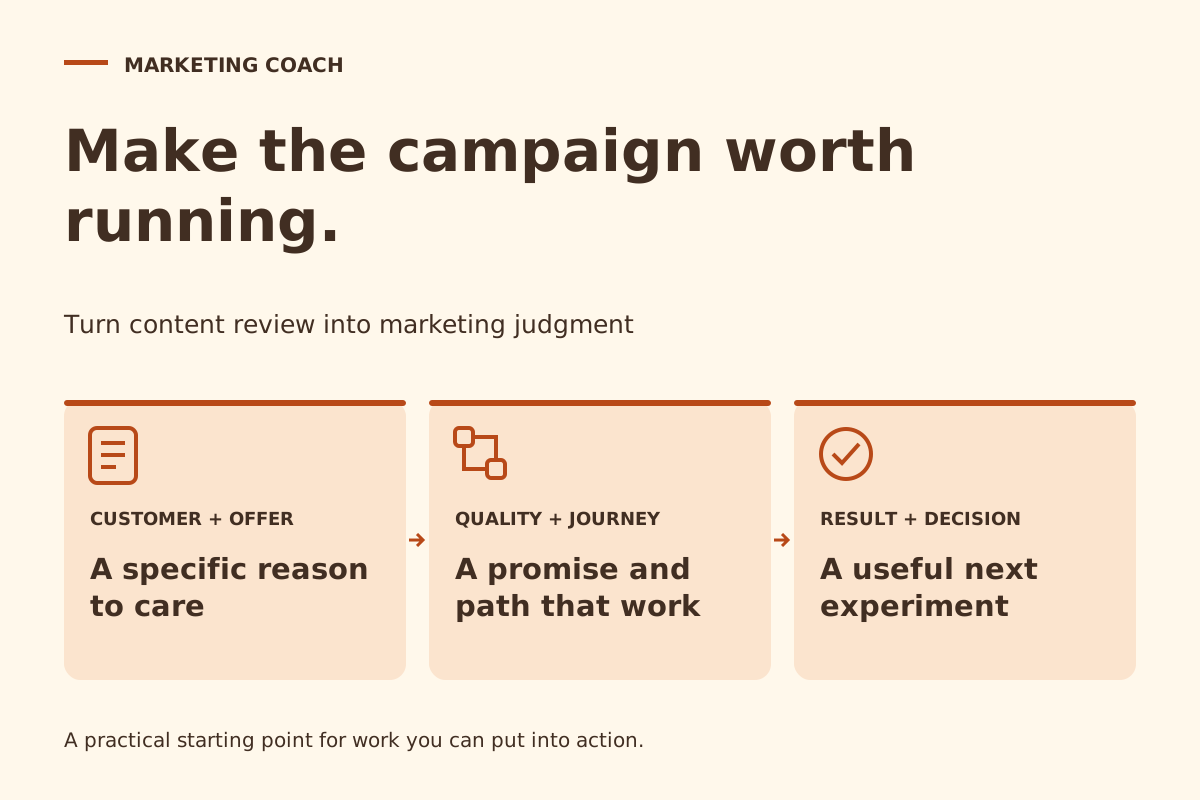
Give review a business purpose
Indeed’s 2024 article prompted this practical look at changing work.
Consider a team that can produce ten landing-page drafts by lunch but still cannot agree on the offer. Reviewing grammar will not solve its central problem. Someone needs to check that the message addresses a specific customer, makes a supportable promise, and leads to an action the business can fulfill.
You can start with responsibilities you already understand: editing, campaign planning, customer research, analytics, or conversion improvement. Add AI to parts of the process you can inspect. Then make your contribution visible in the decisions and deliverables, rather than measuring your value by the number of drafts produced.
Use four questions before anything goes live
Does the message match a real customer problem? Compare the draft with approved customer interviews, support questions, or sales notes. Replace broad claims with language that helps someone recognize their situation. A person with unanswered enquiries needs a clearer follow-up process; they may not be shopping for an 'AI transformation.'
Can we support the promise? Verify prices, inclusions, deadlines, product details, and any result claims. Keep the supporting source beside the claim while reviewing. Google's guidance on generative AI content emphasizes accuracy, quality, and relevance. A readable draft still needs someone who understands what the business can honestly deliver.
Does the action work? Open the page on a phone, follow the button, submit a test where appropriate, and inspect the confirmation. Finally, decide what the campaign should teach you. Choose one primary action—such as a qualified enquiry—and identify what evidence would justify another iteration.
Your four-step starting plan
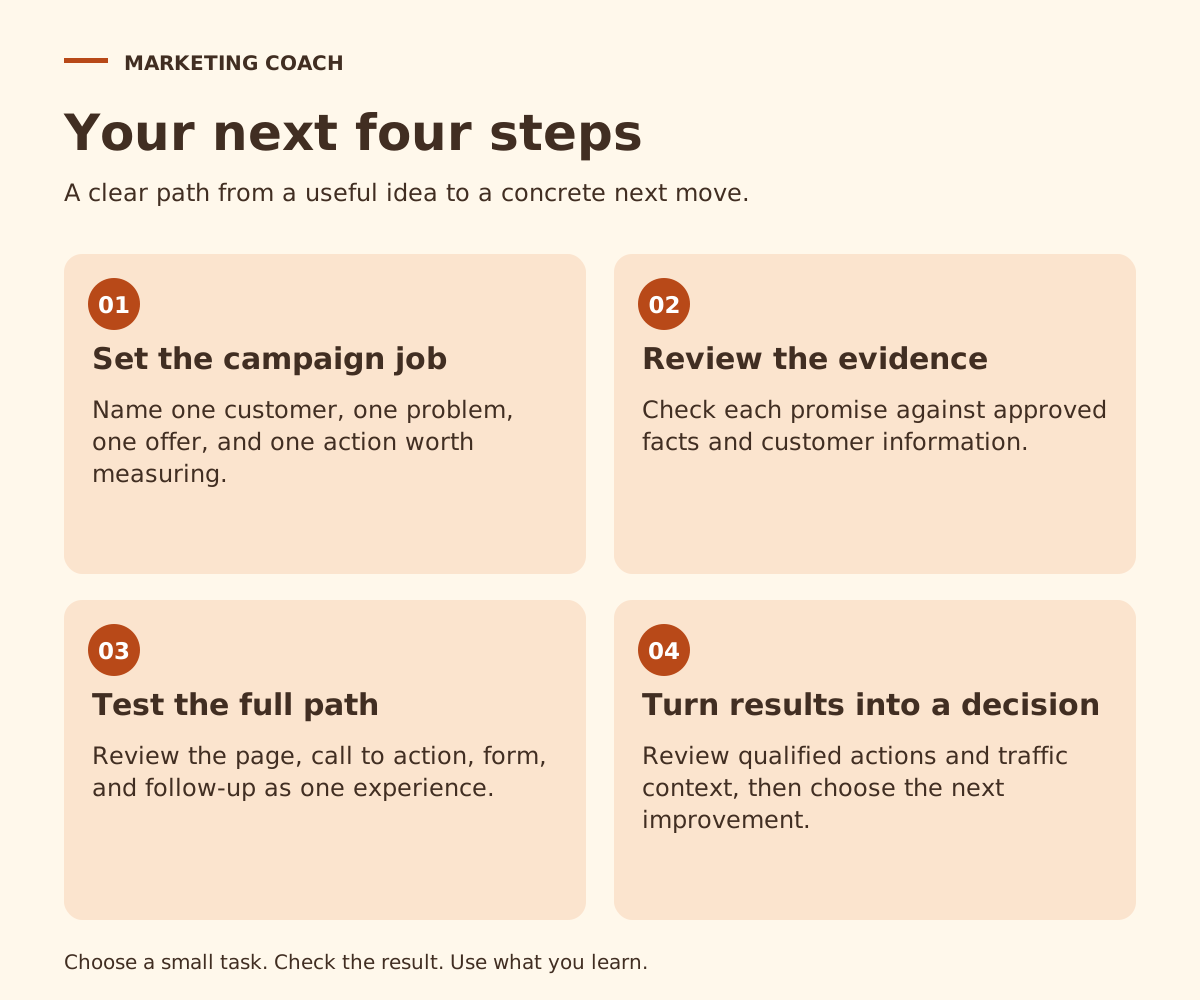
- Set the campaign job
Name one customer, one problem, one offer, and one action worth measuring.
- Review the evidence
Check each promise against approved facts and customer information.
- Test the full path
Review the page, call to action, form, and follow-up as one experience.
- Turn results into a decision
Review qualified actions and traffic context, then choose the next improvement.
A worked example: a service page with plenty of words and little direction
Imagine an AI-written page for a local bookkeeping service. It opens with a broad promise to transform finances, lists twelve capabilities, and sends every visitor to a generic contact form. The review starts by asking the owner which customer and problem the page is meant to serve.
Suppose the owner chooses solo service businesses that struggle to keep their books current. The revised page explains the monthly work included, the records needed to get started, and what happens after an enquiry. The call to action becomes a conversation about bookkeeping support. The owner confirms the scope and approves the language.
Before release, check the form and its response email. After release, log enquiries and how many fit the intended service. Record the change date and traffic sources. If enquiries remain scarce, investigate whether enough suitable visitors reached the page before deciding the copy failed. This is a learning process, not evidence that a particular headline always converts better.
Package the responsibility so someone can buy or assign it
A useful first scope is one offer, one page, and one follow-up message. Deliver a reviewed brief, revised copy, a list of corrections, and a short measurement plan. Agree who approves claims, who implements changes, and what happens after the review. Keep paid media management and a full website rebuild outside that scope unless they are explicitly included.
For a team role, ask to own a recurring campaign review and report the decisions it enables. For freelance work, show a short walkthrough of a page you improved and explain how you checked the result. Avoid selling an open-ended promise to make all content 'human.' Buyers can understand a page that presents the right offer clearly.
Our recommendation: develop judgment about customers and offers alongside your AI workflow. Save the checklist after you use it, and improve it when a mistake reveals a missing check. If your team has drafts but needs direction, bring one campaign to an AI marketing workflow session and leave with a process you can repeat.
Sources and further reading
- Indeed: Future-Proofing Your Workforce (updated October 31, 2024)
- Google Search Central: Guidance on generative AI content
Sources reviewed November 11, 2026. The practical examples and service ideas are editorial recommendations, not verified vacancies.
Keep exploring
Your website needs to answer the questions an AI assistant asks before a lead arrives
Build a campaign plan with Claude that your team can actually use