
Start with one service, a small area and the capacity you actually have. For a small residential cleaning company, a useful marketing plan connects a local enquiry to a clear quote, a first clean and an optional recurring booking. More social posts alone do not complete that journey.
This worked example is for a business already able to deliver a good clean but receiving inconsistent enquiries or losing people after the quote. If you do not yet have enquiries, begin with the local campaign in week two. If you already receive enquiries, start by reviewing the quotes you sent.
The example: a small Palm Beach County cleaning company
Fictional business, illustrative assumptions: Palm Grove Home Cleaning has one small team, serves two neighboring areas, and can add four recurring households without reducing service quality. Its chosen audience is households seeking help maintaining kitchens, bathrooms and floors. It offers an initial assessment and, when appropriate, a separately priced first deep clean.
Its promise is specific: “A clear cleaning scope and a dependable maintenance schedule for your home.” It does not promise to be the cheapest or to remove every stain. The same plan can work in another town; replace the location, scope and availability with your real details.
1. Write the plan on one page
| Decision | Example to adapt |
|---|---|
| Audience | Households in two adjacent neighborhoods that want ongoing maintenance cleaning. |
| Problem | They need a reliable routine and want to know what the price includes. |
| Offer | A scoped first clean plus an optional every-two-weeks maintenance quote. |
| Primary channel | An accurate local profile, supported by one permitted neighborhood post and customer referrals. |
| Next action | Request a quote using service area, home size, condition and preferred frequency. |
| Capacity | At most four new recurring households; stop promotion when the schedule is full. |
| Measure | Qualified enquiries → quotes → booked first cleans → accepted recurring bookings. |
Keep the enquiry form short. Start with a contact route, neighborhood or ZIP code, approximate home size, service type and preferred frequency. Collect access codes or sensitive household details only through an appropriate private process after booking, not in a public comment or this kit.
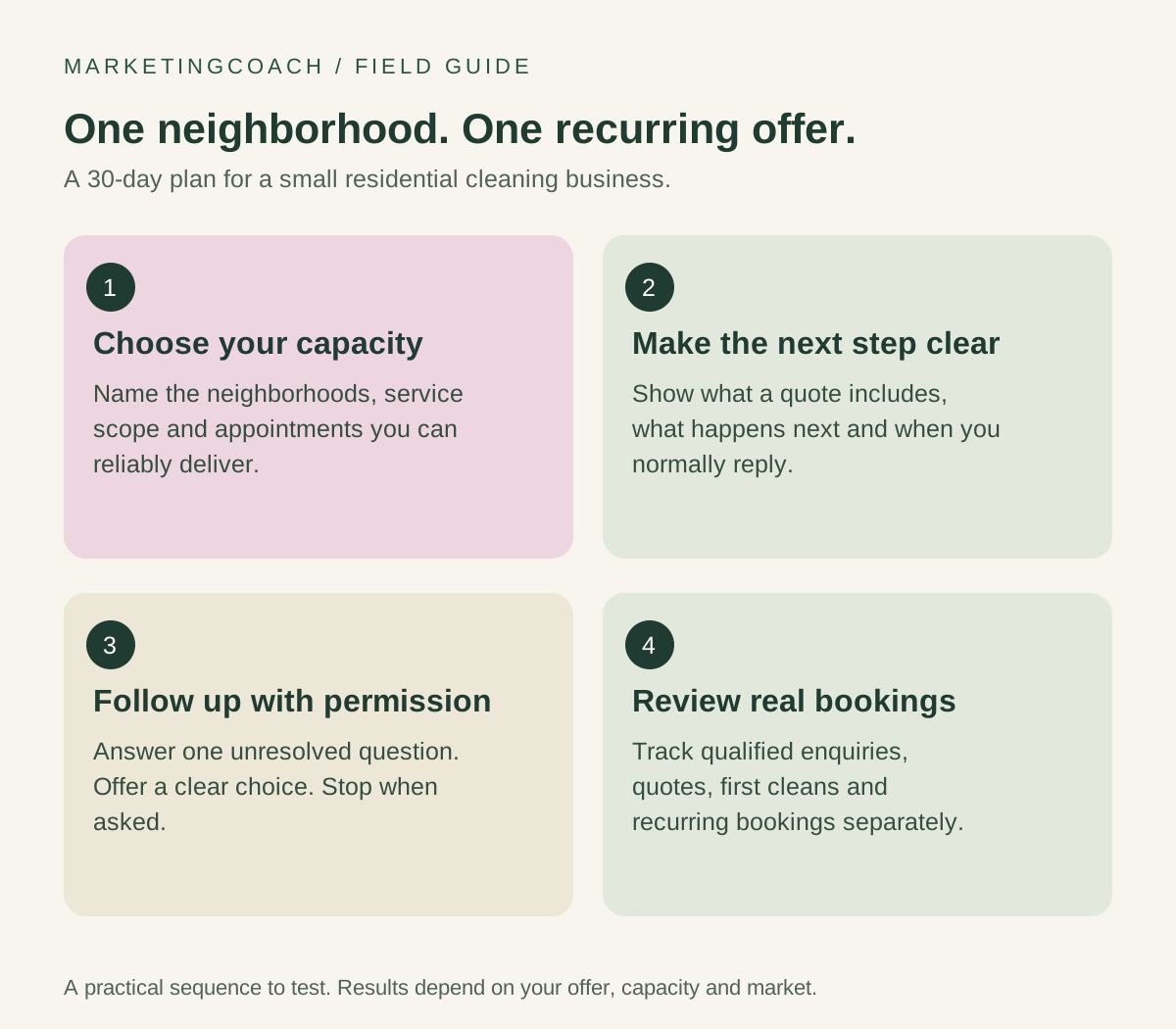
2. Give each week a deliverable
| Week | Actions | Finished when |
|---|---|---|
| 1: Make the offer clear | Review five recent enquiries. List repeated questions. Define scope, exclusions, availability and reply hours. Test the quote form on a phone. | A person can understand the offer and request a quote without asking how the process works. |
| 2: Reach the right area | Check your local profile. Publish one useful service explainer. Share one approved neighborhood post. Ask existing customers if they know someone seeking this service. | Links work, the service area is accurate, and each enquiry has a recorded source. |
| 3: Help people decide | Use the scope-confirmation message and a restrained follow-up. Record why prospects book, decline or remain undecided. | Every current quote has an owner, a status and a next action. |
| 4: Review and repeat | Compare enquiry quality, quotes, bookings and time spent. Ask first-visit customers about their experience. Offer recurring service when it fits. | You choose one next change and check available capacity before promoting again. |
3. Use a budget you can explain
Start with a no-paid-media version if you can reach relevant people through your current profile and relationships. As an illustrative spending cap, set aside $100 for a small batch of local materials and $50 for contingencies, plus an explicitly recorded four hours of owner time. This is not a price quote or a recommended minimum. Check local print costs and permission before distributing anything. Record labor separately; free posting still consumes time.
Do not buy software just to run this plan. A working inbox, calendar and the free tracker are enough for the first manual test. Consider advertising only after checking that enquiries can be answered and bookings can be fulfilled.
4. Read the funnel without inventing a success story
Suppose a fictional 30-day test records 20 qualified enquiries, 10 quotes, four booked first cleans and two accepted recurring bookings. Quote-to-first-booking rate is 4 ÷ 10 = 40%; first-booking-to-recurring rate is 2 ÷ 4 = 50%. These are example calculations, not benchmarks or expected results. Count completed visits and money collected separately from booked appointments.
If $150 was actually spent to acquire those four new first bookings, cash cost per first booking would be $37.50, excluding owner time. A booked appointment can cancel, so review completed and paid work before deciding whether the campaign is profitable.
5. Make the next decision from the evidence
- Few qualified enquiries: examine where you shared the offer and whether the area and service are clear.
- Enquiries but few quotes: simplify information collection and check your response process.
- Quotes but few bookings: ask about scope, timing and price clarity before discounting.
- First cleans but no recurring interest: review the service experience and whether ongoing cleaning suits these customers.
Review after 30 days or when you have enough conversations to spot a repeated question. A tiny sample supports a useful next experiment, not a claim that the whole market has been proven.
Continue the cleaning-business series
- Cleaning quote follow-up: 5 templates for a clear next step
- How to turn one-time cleaning into recurring clients
- Local cleaning marketing: a neighborhood campaign you can copy
Sources and scope
These are original MarketingCoach examples, reviewed November 11, 2026. They are not customer case studies or forecasts. Platform guidance: Google service-area guidance and Google review guidance. Industry context: Jobber’s cleaning-client guide. Platform settings can change.