By Ashley Kays. Worked examples use fictional inputs; expected results are illustrations for testing, not performance claims.
The repetitive part of a campaign often starts before the copy: explaining the audience, the offer, the evidence and the next action. A focused skill can assemble that context consistently, so you can spend your time choosing the message and judging whether it will resonate.
What you will build
A one-page brief, three message angles and a source check for every factual claim.
Gather the inputs
An approved offer sheet; audience notes; real proof or testimonials you may use; brand voice; channel; CTA; exclusions. Include dates and prices explicitly.
1. Choose one deliverable
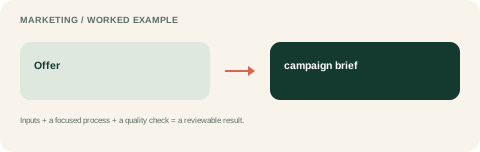
Start with the campaign brief. Keep ad buying, publishing and performance reporting outside this first skill.
2. Create a source pack
Label the offer sheet O1 and audience notes A1. Keep approved claims together so the skill can cite them.
3. Write the message rules
Require one audience, one primary problem and one next action. Separate facts, proposed language and unverified claims.
4. Request alternatives
Ask for three distinct angles: problem, outcome and process. Each must use the same approved offer facts.
5. Review before use
Check every price, deadline, testimonial and promise. Pick one angle, edit the voice, and approve a final draft.
A worked example
Fictional input O1: $350 working session; map one repetitive admin task; create one reusable draft workflow; no quantified savings promise. A1: small service-business owners. Channel: LinkedIn. CTA: book a fit call.
Audience: service-business owners repeating admin tasks. Problem angle: "Still rewriting the same instructions?" Process angle: "Bring one recurring task. Build a workflow you can reuse." Claim check: $350 and session scope supported by O1; any percentage time saving is unsupported.
Copyable skill instructions
Use this focused template in the skill-creation flow described in the starter guide. Review and adapt it to your own work before saving. It is not installed by downloading this article.
---
name: offer-to-campaign-brief
description: >-
  Create a campaign brief from approved offer and audience sources. Use for campaign
  planning, not campaign publishing or ad spending.
---

# Offer to campaign brief
Require audience, offer, evidence, channel and CTA. If price or proof is absent, label it missing. Extract facts with source labels. Return audience, problem, promise, proof, CTA, three distinct angles and a claim-check table. Treat testimonials as exact evidence; do not invent customers, numbers or scarcity. Flag conflicting prices. Draft only; do not publish, spend money or send messages.

Required output: A one-page brief, three message angles and a source check for every factual claim.
Three tests to run
| Test prompt | Pass condition |
|---|---|
| Normal: complete offer and audience notes | A focused brief with three different angles and traceable claims. |
| Missing: no results or testimonial supplied | Useful copy without invented statistics or customers. |
| Conflict: offer sheet and web page disagree on price | Flag the conflict and request the authoritative price. |
How to judge whether it helps
Track minutes spent assembling the brief, factual corrections and whether the output is usable after review. Evaluate sales or conversion outcomes separately; a faster brief does not prove a stronger campaign.
What to build next
Next skills: campaign repurposing, email QA, landing-page message review, lifecycle experiment briefs.
Return to the illustrated setup guide and official sources.
Bring a real task.
Leave with a working AI-assisted process. Ashley and the Waymaker team can help you choose the workflow, create the skill, test it and make it useful for your team.
Book a 15-minute fit callExplore the six-part skills series
Keep exploring
Social Proof That Persuades: How to Collect and Use Testimonials Honestly