A good pocket product starts with a question you keep answering. When a consultant, coach or service business explains the same small task repeatedly, that answer may be useful as a standalone template or workbook. The opportunity is to make a specific job easier—not simply to put advice into a PDF.
This guide adapts the content-business approach discussed in Codie Sanchez’s video to a service-business marketing funnel. It connects one useful demonstration, one sample and one relevant next step. Our Be an Influencer evaluation separates the practical framework from the creator’s self-reported results.
1. Listen for the task behind the question
Look through five recent, permitted client questions or notes from your own work. Record what the person was trying to finish, what they already tried and where they got stuck. Remove identifying or confidential details before using the material in a public example.
“How do I market my business?” is a broad topic. “What should I send after a discovery call when the client has not chosen a next step?” is a concrete task. A small product can help with the second. The first needs more diagnosis.
| Repeated question | A narrow product to test | Visible result |
|---|---|---|
| What should I send after the call? | Meeting follow-up mini toolkit | A checked summary, open questions and a proposed next action. |
| How do I brief a designer? | One-page creative brief and filled example | A brief with audience, message, assets and review criteria. |
| What should my service page say? | Service-page scope worksheet | An audience, problem, deliverables, exclusions and clear CTA. |
These are illustrative concepts, not evidence of demand. Choose the task where you can supply a credible example and recruit suitable testers.
2. Draw the boundary before you create the files
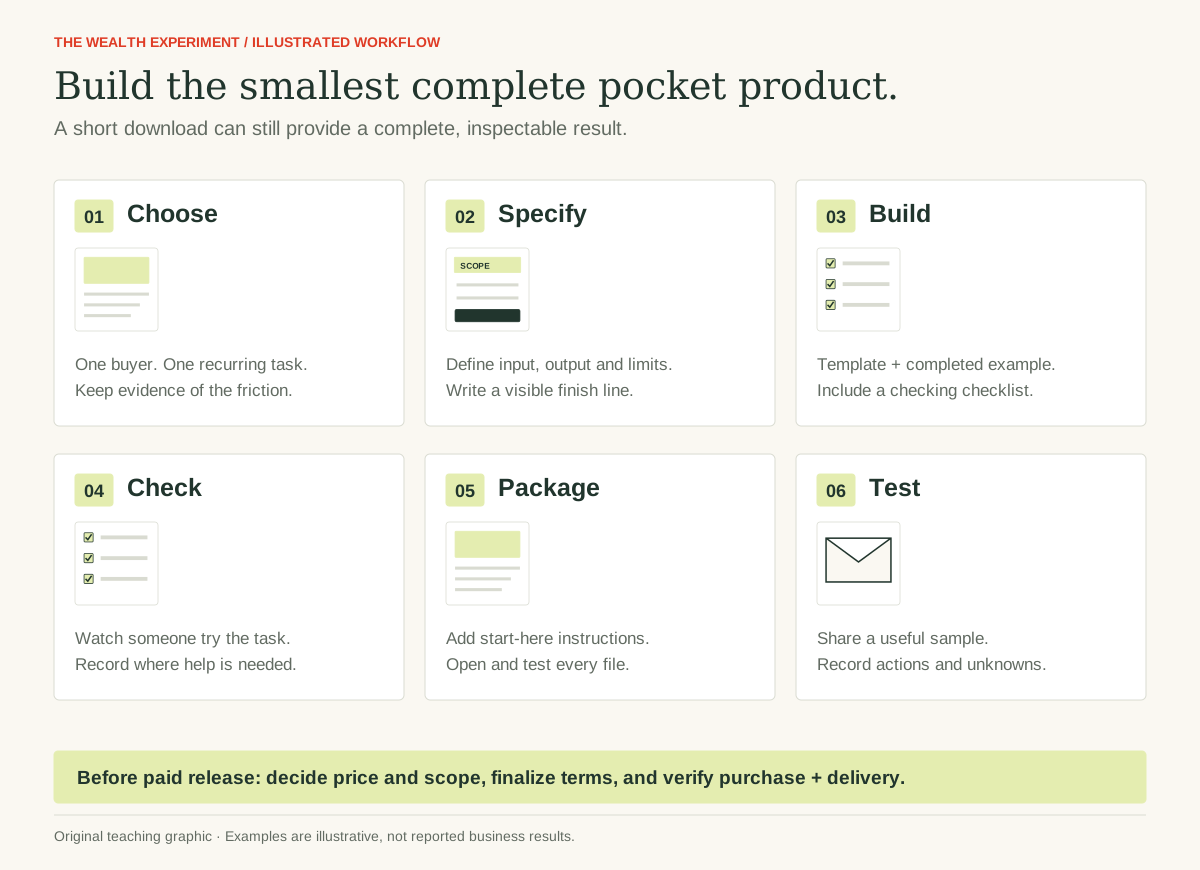
Write one sentence: “This helps [specific person] finish [one task] using [resource], so they can [observable result].” Then list what it does not cover. A follow-up toolkit can organize information; it cannot decide a prospect’s budget or guarantee a sale.
For a first version, include a short start-here guide, a filled example, an editable blank and a completion checklist. A long collection of unrelated prompts makes the buyer do the work of discovering a process. Give them the process.
3. Make one useful sample
A sample should let someone experience part of the result. Share one filled example and one blank page rather than an introduction that only says how helpful the full product will be.
For the follow-up example, show fictional call notes and their translation into a concise recap. Include fields for confirmed facts, open questions, owner and date. If a date was never agreed, mark it “to confirm.” The user should understand which information is known and which still needs a decision.
Two resources are being prepared at Wealth Experiment: the Content-to-Client Kit and the Pocket Product Launch Kit. Both have free samples. Pricing is to follow and paid sales are inactive.
Try the free Pocket Product sample (PDF)
4. Connect the sample to a useful content sequence
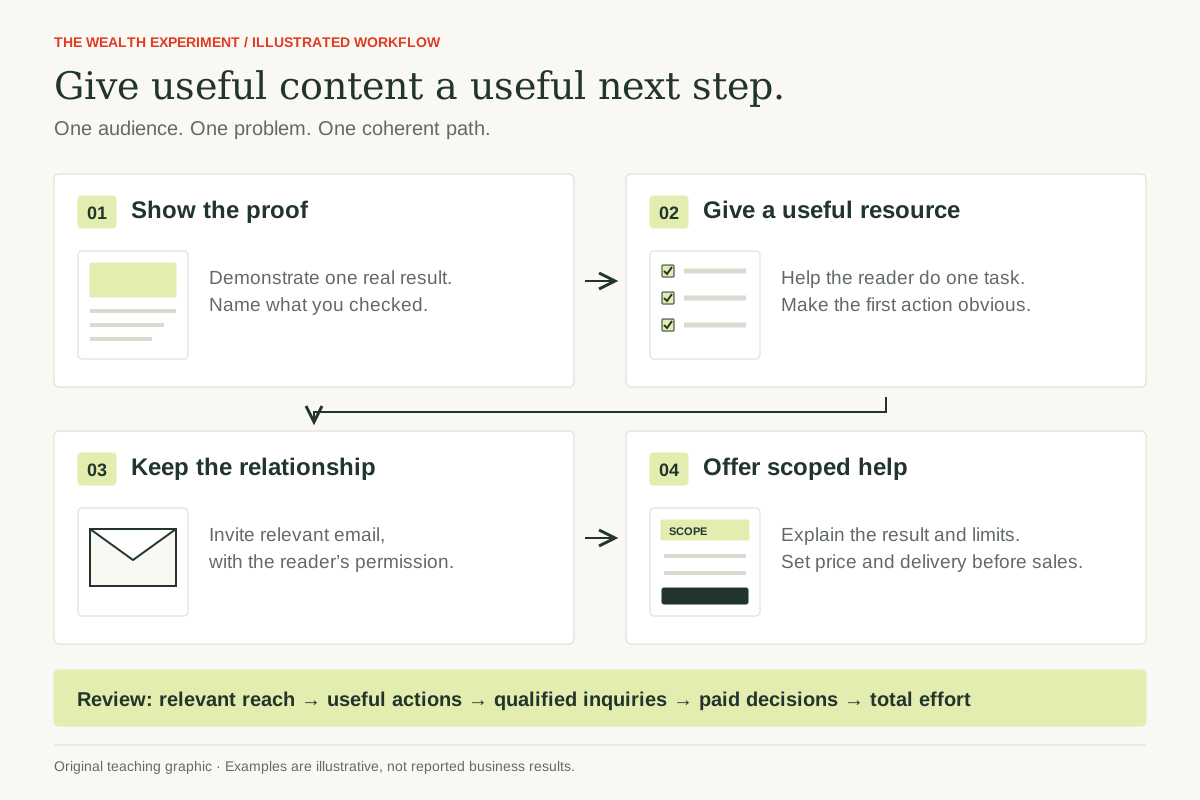
Publish content that demonstrates the problem, decision or task. A three-post starting sequence can be enough to learn which part people understand:
- Show the friction. Explain why a vague meeting recap leaves the next action unclear. Use a fictional example or an anonymized example you have permission to share.
- Show the method. Demonstrate how to separate facts, questions and commitments. Explain why each field is present.
- Invite a small action. Offer the sample to someone who wants to try the worksheet on their own task.
Use one primary channel where suitable buyers already interact with your work. Link each post to the same destination, with a consistent source tag for attribution. Keep the promise on the page consistent with the post. Do not scatter the first test across every platform.
5. Follow up with permission and a specific question
If the sample is ungated, let people download it without requiring an email address. If you separately invite an email subscription, explain what will be sent, obtain the appropriate consent and test delivery and unsubscribe behavior. A download alone does not grant permission to add someone to a mailing list.
A useful message to someone who has agreed to follow-up might read:
Thanks for trying the worksheet. Were you able to turn your notes into a clear next action? If you got stuck, which field needed more explanation? I’m using feedback to improve the instructions.
Ask about the task before pitching a larger engagement. If their needs go beyond the template, explain the separate service scope and price. Keep the resource useful on its own.
6. Test usefulness before pricing
Ask three suitable people to attempt the task. That is a practical early testing target, not statistical proof. Observe whether they can start, complete the task and explain how they would use the output. Record the help you had to give: it may belong in the instructions.
| Day | Action | Keep as evidence |
|---|---|---|
| 1–2 | Choose the question, define the scope and build the example. | Original audience wording and a one-page product specification. |
| 3–4 | Create the editable file, instructions and sample. Test all links. | A complete task performed from the instructions. |
| 5–6 | Invite suitable testers and publish a useful demonstration. | Completion notes, relevant visits, questions and objections. |
| 7 | Fix the main gap and choose the next test. | A written continue, change or pause decision. |
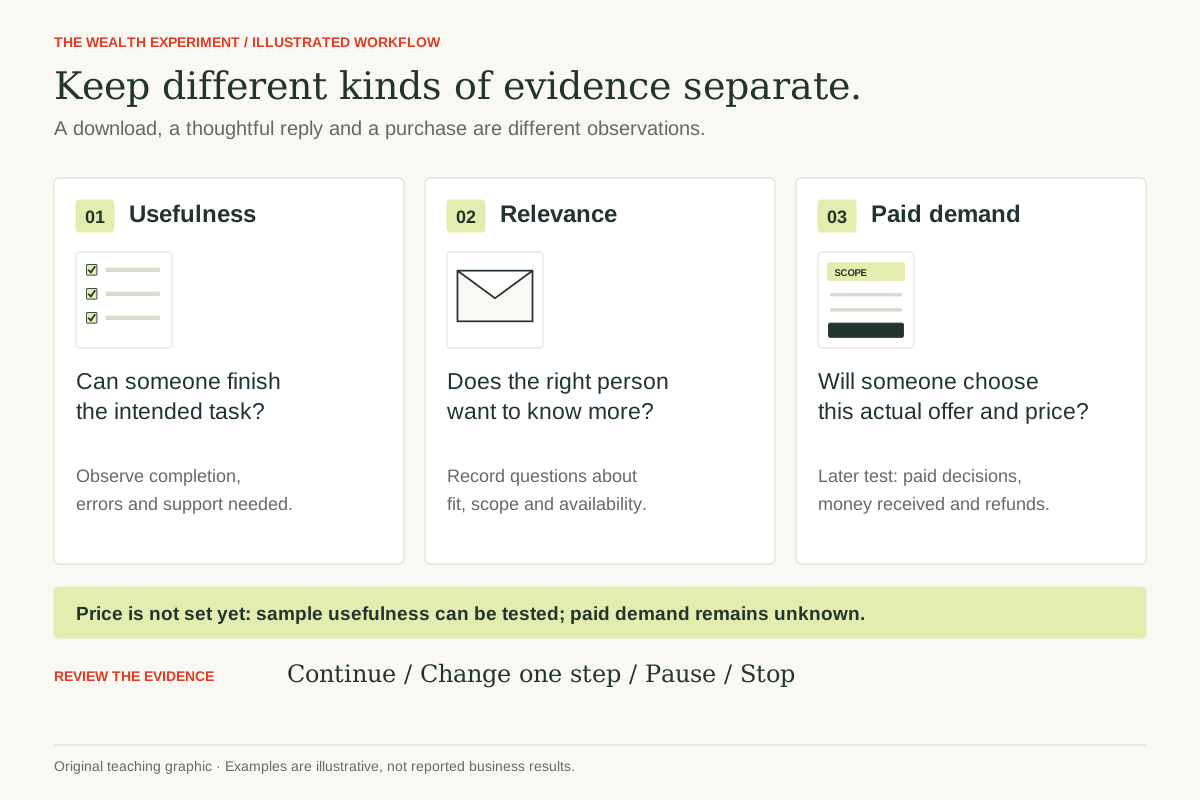
When you are ready to price, consider the result, alternatives, support burden, production cost and what buyers actually say and do. A statement of willingness to pay is weaker evidence than a completed purchase. For the two new Wealth Experiment kits, this decision remains open; the public pages offer samples only.
7. Use a scorecard that distinguishes interest from revenue
- Reach and visits: did suitable people encounter the content and arrive at the page?
- Sample use: did they complete the task, not merely request the file?
- Qualified replies: do they have the problem and want to discuss a relevant next step?
- Purchase intent: what scope, price or missing feature affects their decision?
- Sales: count only completed paid transactions and record refunds separately.
- Cost: include production, publishing and support time as well as cash expenses.
Show the underlying counts next to any percentage. Avoid treating email opens as a reliable reading measure: privacy features can inflate them, and bots can affect clicks too. Verify important outcomes with task feedback, qualified conversations and actual payment records.
Put it to work this week
Choose one client question, write the one-sentence outcome and build a filled example. Then ask one suitable person to use it. If you cannot explain the result without listing ten different topics, narrow the product again.
Explore both kit previews · Follow the 30-day Wealth Experiment plan · Use the free Marketing Reset
Sources: Codie Sanchez’s content-business video (framework reviewed from its transcript); Mailchimp’s privacy-protection guidance; Mailchimp’s bot-activity guidance. Examples and testing targets here are editorial recommendations, not reported customer results. Cover: AI-generated editorial illustration.