
Start here
Review one inquiry that stopped before a consultation. Check whether the person could find your practice area, jurisdiction, consultation fee and response process. Improve the missing detail before sending an approved reply.
Step 1 of 6
Choose one practice area and first decision
A small firm’s homepage often lists everything it can do. A campaign page should help one type of prospective client understand one sensible first step. Begin with a service the firm actually has capacity to provide. The example here is an estate-planning consultation, not urgent litigation, criminal defense or an open invitation to submit any legal problem.
Ask the intake owner which non-confidential questions repeatedly delay scheduling. Look for uncertainty about jurisdiction, practice fit, attorney availability, consultation price, meeting format and the distinction between a consultation and ongoing representation. Summarize themes without copying case narratives, names or documents into a general marketing tool.
Write an offer that identifies the responsible attorney, the consultation’s scope, duration and real fee. Describe what is excluded and what must happen before the firm confirms a meeting. A qualified lawyer should approve the language and decide which advertising, fee and solicitation rules apply in the jurisdictions involved. ABA Model Rules are a reference, not a substitute for those rules.
Put it to work
Write: For [audience] in [jurisdiction], our [duration] consultation with [attorney] covers [scope] for [fee]. [Excluded work] requires a separate agreement.
You are done whenThe attorney and intake owner can explain the same offer, capacity and acceptance process.
Step 2 of 6
Build a page that answers the first five questions
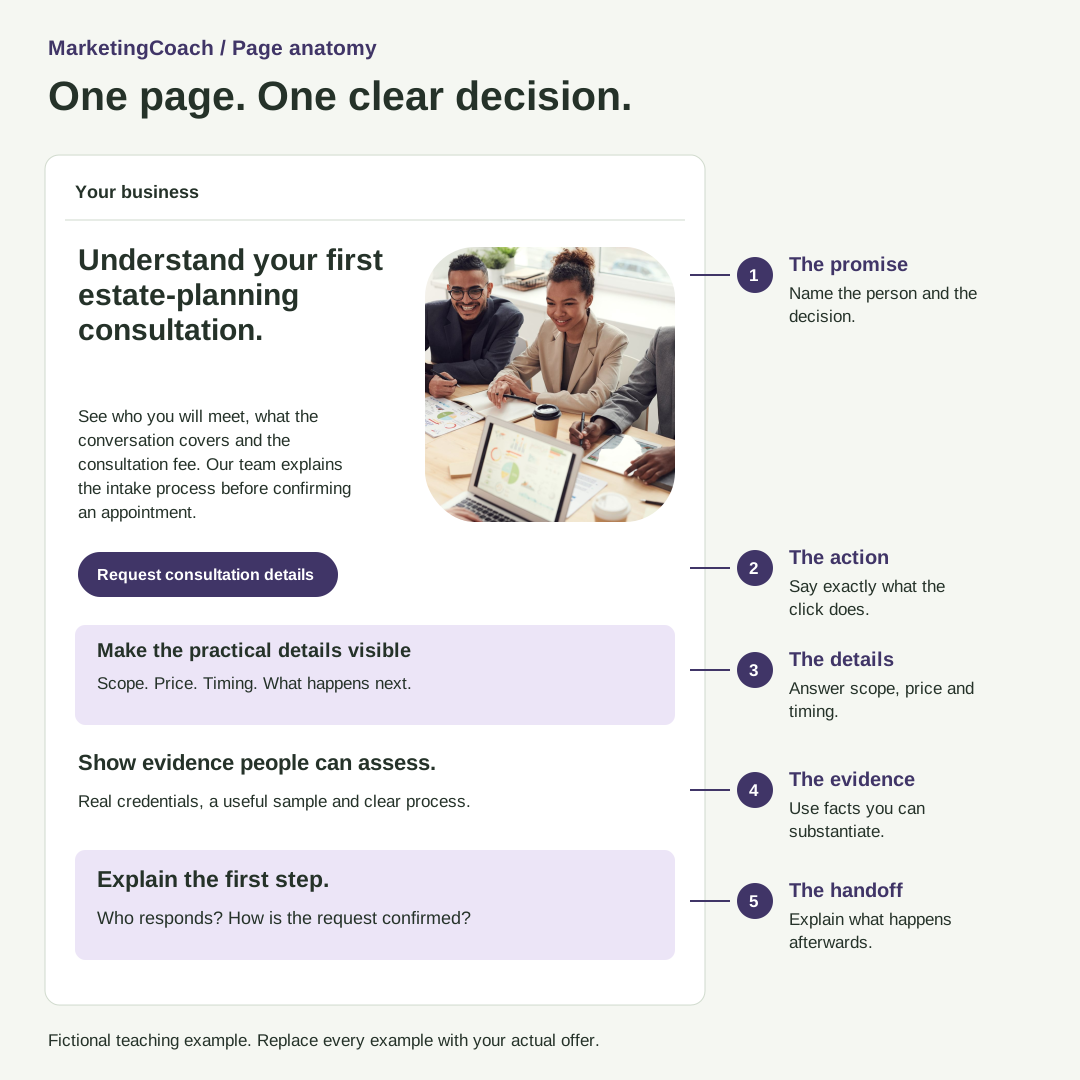
Place the practice focus, consultation purpose and action near the top. Then answer five questions: does this firm serve my location, who will I meet, what does it cost, what does the consultation cover, and how is a request confirmed? Use the attorney’s actual credentials and an accurate professional photograph when available.
Create a short practice-area explanation, a consultation details block, a process section and a practical FAQ. State whether the initial call is administrative screening or legal advice. Make contact options, staffed hours, accessibility and rescheduling information easy to find. Do not use stock models as attorney portraits or imply that a fictional example describes a real client result.
The marketing page should lead into the firm’s approved intake process. Avoid an open invitation to paste sensitive facts into a public form. The firm’s lawyer should set appropriate first-contact notices and instructions; a disclaimer does not by itself resolve confidentiality duties or relationship formation. Test the whole request and confirmation on a phone.
Put it to work
Use the annotated page graphic and landing-page builder. Replace every placeholder and have the responsible attorney approve the request route.
You are done whenA new visitor can identify the five practical details and understand what the button actually does.
Step 3 of 6
Give intake a useful and consistent response routine
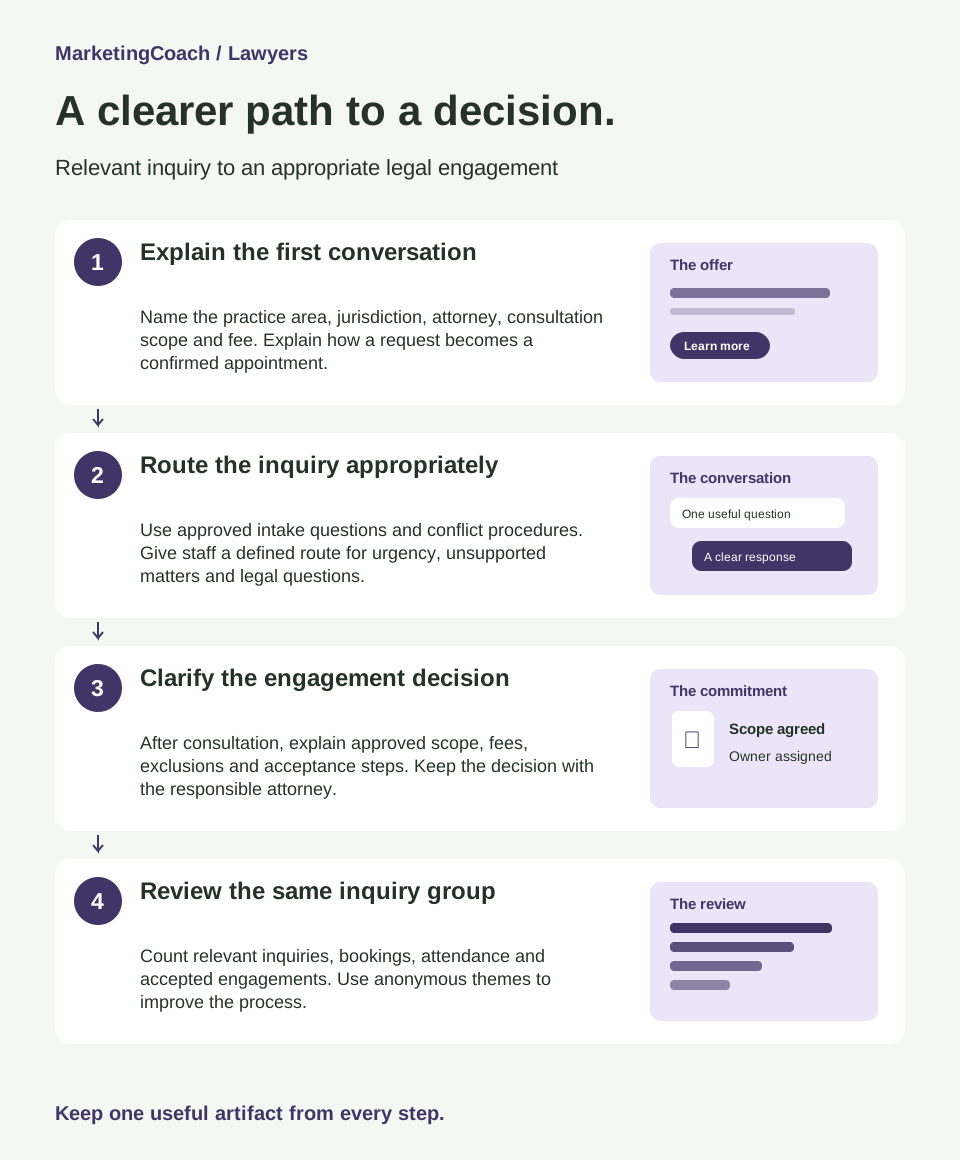
Assign one intake owner and a backup. Set a response target based on staffed hours and real capacity. Use an acknowledgement that explains the process and the next administrative step, without suggesting that the firm has accepted a matter. The lawyer should define the necessary conflict screening and information-handling procedures.
Train staff to distinguish logistics from legal advice. Staff can explain a published consultation fee, location or scheduling process. Questions about rights, remedies, filing dates or how to proceed require the firm’s approved legal escalation. Urgent matters need a specific routing procedure; they should not wait inside an ordinary marketing follow-up sequence.
The swipe file is intended for approved responses to people who contacted the firm, not unsolicited targeting of people with a known legal problem. Follow the contact preference and agreed timing. Pause the sequence when a person replies, books, declines or asks you to stop. Keep sensitive details in the firm’s system rather than message templates or campaign notes.
Put it to work
Adapt the inquiry acknowledgement, appointment details and scheduling follow-up. Assign an owner and escalation route for each.
You are done whenEvery open inquiry has an appropriate status, owner and response date in the approved system.
Step 4 of 6
Separate attendance from an accepted engagement
A confirmed consultation needs practical instructions: date, time zone, location or meeting link, attendee, fee and rescheduling route. Use the firm’s secure process for requested documents. Give the person only the preparation information the attorney has approved; do not add a broad document upload to a marketing form.
After the consultation, the responsible attorney decides whether the firm can offer an engagement and what it includes. A clear summary can identify scope, excluded work, fees, responsibilities and the required acceptance process. The marketing team should not improvise legal terms or turn a polite follow-up into pressure to retain the firm.
Record the actual outcome. Some consultations properly end without an engagement. If the firm declines or the person does not proceed, use the firm’s approved closing or non-engagement procedure, including any lawyer-determined deadline communication. A generic close-the-loop marketing message is not a substitute for that procedure.
Put it to work
Walk through a test appointment, an accepted engagement and a declined matter with the intake owner and attorney.
You are done whenEach outcome has an approved handoff and no one counts a consultation as a retained client.
Step 5 of 6
Publish one useful practice-area explainer
Create a practical article such as “What to expect at your first estate-planning consultation.” Explain the meeting format, questions a person may ask about the service, fee, documents requested through secure intake and the possible next steps. Keep legal substance within the attorney’s approved scope and jurisdiction.
Link the article from the relevant practice page and share it through an existing appropriate channel. Professional referral contacts can receive a factual service overview when permitted. State the types of matters the firm actually handles, location and intake route; do not imply an unapproved referral payment or reciprocal arrangement.
Use real process evidence: a named attorney introduction, the actual office, a plain-language fee explanation and an example meeting agenda. If the firm uses reviews, testimonials or case outcomes, have the lawyer review the applicable requirements and permissions. Do not assume a disclaimer fixes a misleading result claim.
Put it to work
Publish one attorney-approved consultation explainer and connect it to the same request page from one existing channel.
You are done whenThe article, practice page and intake response describe the same first step.
Step 6 of 6
Measure appropriate progress without exposing client information
Define a relevant inquiry before counting: for example, a request within the firm’s stated practice and geography. This is an operational filter, not a legal determination. Keep excluded inquiries visible in the firm’s operational review with broad reasons, so a lower count does not hide a broken request route or routing problem.
Follow the same inquiry cohort through booking, attendance and accepted engagement. Use a review window long enough for the actual decision cycle. Do not divide this week’s retainers by unrelated inquiries from this week. Accepted engagements must use the firm’s real acceptance definition, not a button click, verbal interest or unsigned document.
Use aggregate counts and anonymous question themes in this toolkit. Keep matter values, client identities, conflict details and legal facts elsewhere. If booking is low, investigate clarity and availability; if acceptance is low, inspect fit and scope. Make one change, record the date and review comparable cohorts without treating a small sample as proof of causation.
Put it to work
Hold a 15-minute weekly review of aggregate stages, response coverage and the most common unresolved practical question.
You are done whenThe team selects one specific service-page or intake improvement with an accountable owner.
Worked example · fictional
Harbor Planning Law (fictional)
This example shows how the pieces fit together. The business, offer, budget and counts are invented for teaching; they are not client results or recommended targets.
- Audience
- Adults in the firm’s licensed jurisdiction asking about a first estate-planning consultation
- Offer
- A 45-minute consultation at a disclosed $200 fee, subject to intake and conflict review. Drafting, filings and ongoing representation are separately scoped.
- Capacity
- Twelve consultation appointments available over four weeks
- Budget
- $0 new media spend; reserve four staff hours for the practice page and inquiry review
- First channel
- Your practice-area page and existing professional referral network
Start with the page
Understand your first estate-planning consultation.See who you will meet, what the conversation covers and the consultation fee. Our team explains the intake process before confirming an appointment.
Support the offer with actual attorney names and admissions, accurate practice descriptions, an understandable consultation process and permitted real office photography. Then use “Request consultation details” as the primary action and explain what happens after someone clicks.
Read the numbers carefully
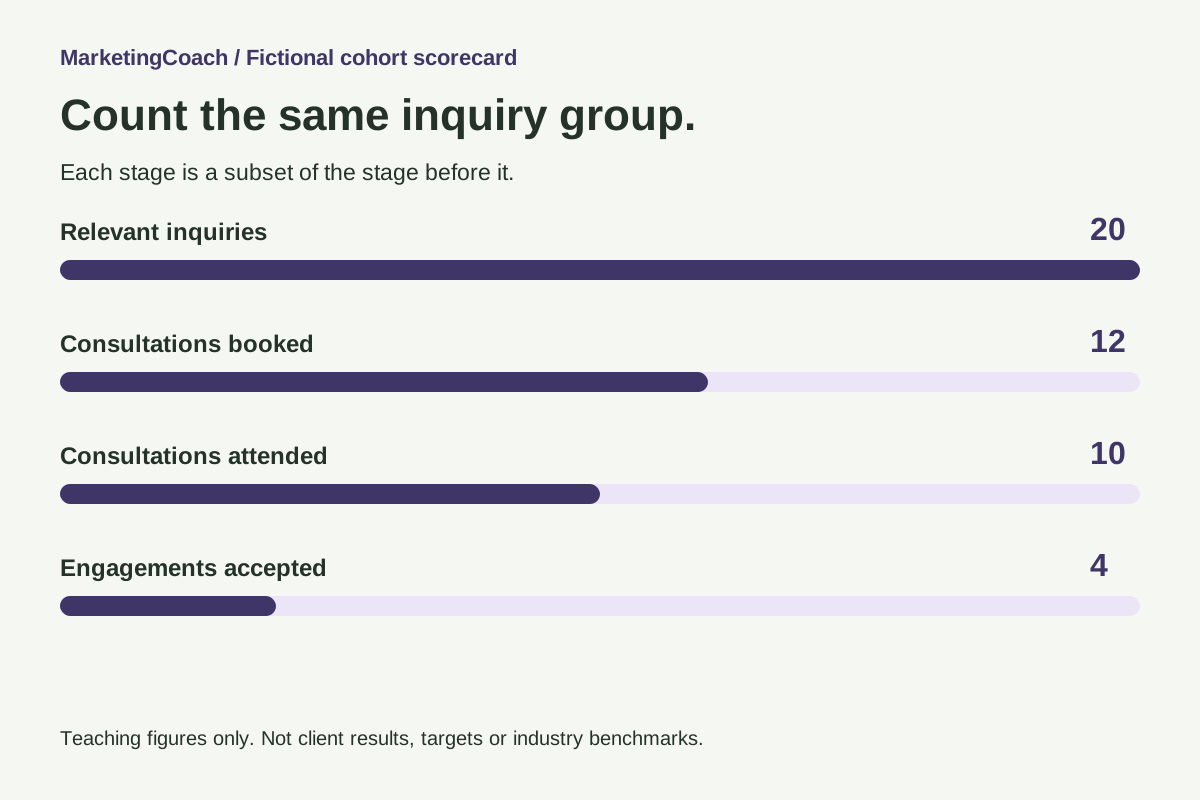
Follow the same group of 20 inquiries through a defined review window. Here are illustrative counts for that cohort:
| Stage | Count | From prior stage |
|---|---|---|
| Relevant inquiries | 20 | — |
| Consultations booked | 12 | 60.0% |
| Consultations attended | 10 | 83.3% |
| Engagements accepted | 4 | 40.0% |
Twelve of twenty relevant inquiries booked. Review missing fee and process information first. Four of ten attended consultations led to accepted engagements; record anonymous reasons for the others, including unsuitable scope, conflicts, timing or a decision not to proceed. Lower acceptance is not automatically a failure.
Decision: review the actual questions and operational constraints before choosing a change. These percentages describe a tiny fictional sample; they do not tell you what your conversion rate should be.
Your first 30 days.
Use the sequence as a starting point. Assign one owner and a realistic review date to each week.
Clarify the first meeting
Choose one practice area; confirm jurisdiction, fee, scope and capacity; revise the consultation page.
Keep: Attorney-approved offer and request routeImprove intake replies
Assign coverage; adapt three approved messages; test urgency and conflict-review handoffs.
Keep: Every inquiry has an ownerSupport the decision
Test confirmation and secure preparation; publish one consultation explainer.
Keep: Attendance and engagement steps reviewedReview the inquiry cohort
Compare booking, attendance and acceptance; identify one recurring question and improve its answer.
Keep: One measured process improvementUse AI as an editor for your plan.
Copy the prompt below into your preferred AI tool with approved, non-confidential business details. Review its output before using it.
Act as a critical marketing editor for a lawyers business. Review my audience, offer, landing page, follow-up and measurement plan. Identify missing facts, unclear scope and unsupported claims. Do not invent prices, results, credentials, availability or customer evidence. Ask for missing information. Suggest one specific improvement to the largest visible gap and explain what evidence would show whether it helped.
Keep names, case facts, conflicts, deadlines and documents in the firm’s approved intake system, never in this workbench or analytics. A lawyer must review local advertising and solicitation requirements. Do not promise outcomes or treat an inquiry as acceptance of representation.
Choose and adapt an original messageReferences and review notes
The workflows and templates are original editorial recommendations, not industry benchmarks. The references below support the advertising, privacy and profile guidance. Check requirements that apply to your own business before launch.
- ABA Model Rule 7.1: Communications about a lawyer’s services
- ABA Model Rule 1.18: Duties to prospective clients
- ABA Model Rule 7.3: Solicitation of clients
Reviewed November 13, 2026.