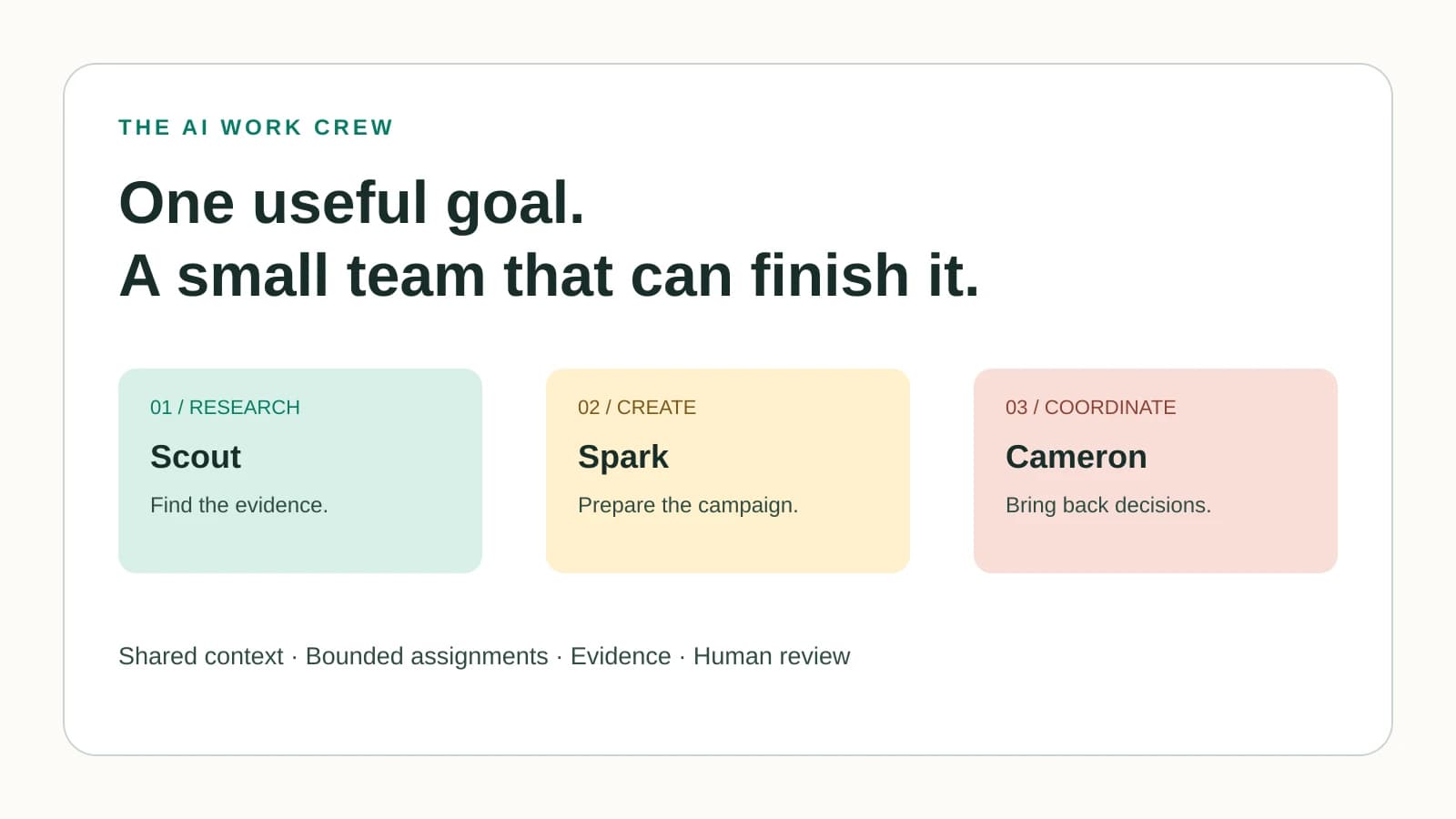
A lead generation agent becomes useful when it can explain why an account belongs in your pipeline. A marketing agent becomes useful when its campaign promises match an offer the business can actually deliver.
We would connect those jobs through a small team: Scout researches, Relay prepares outreach, Spark develops the campaign, Cameron coordinates review, and Gauge follows the result. The goal is a qualified customer conversation and a reliable handoff into delivery.
This guide walks through an illustrative booking-improvement service for local businesses. It is a teaching example, not a report of campaign results. Replace the offer, audience, budget, and eligibility rules with your own.
Read the animation steps
- You define the goal and limits.
- Cameron assigns a bounded task.
- Specialists return evidence and a draft.
- Cameron packages the proposed next action.
- You review and approve the defined action.
- Gauge records the result and feeds it back into the next brief.
1. Give the team one approved offer
Create a brief with the buyer, observed problem, included deliverables, exclusions, price, available capacity, and the next action you want a prospect to take. Link the current offer page and record when the details were checked.
For our example, the offer is a focused review and improvement of one booking path. A useful lead signal is an observable problem in that path, such as conflicting instructions between a service page and its booking destination. Do not tell the agent to invent a conversion loss or claim access to analytics it has not seen.
Spark can draft the positioning before any prospect list exists. Personalized outreach must wait for Scout's checked observations. Keeping those dependencies explicit prevents polished messages from outrunning the evidence.
2. Build Scout, the lead research agent
Start with five companies. Use permitted sources and connected tools, and require a source for every material fit claim. Have Scout return this record:
Open the detailed reference table
| Field | What belongs here |
|---|---|
| Company and website | The correct business and canonical domain |
| Fit evidence | A dated, public observation relevant to your offer |
| Contact route | A published business contact channel, with source |
| Existing relationship | CRM match, active opportunity, customer, or unknown |
| Eligibility and suppression | Review status, including exclusions and opt-outs |
| Confidence and unknowns | What was verified and what still needs checking |
| Suggested next step | Research further, exclude, or prepare a draft |
An email that passes a deliverability check is not automatically eligible for outreach. For US commercial email, review the FTC's CAN-SPAM guidance, including accurate identification, a postal address, and opt-out handling. Other jurisdictions and providers can impose different or stricter requirements.
3. Give Relay an evidence-based drafting job
Relay receives only eligible, reviewed records. It writes one message based on the observed problem, explains the specific help available, and uses a proportionate call to action. It should not claim a relationship, compliment an unread article, or imply knowledge of private business performance.
Here is a draft structure to adapt:
Hi [name], I noticed [specific observation] on [page, checked date]. We help [audience] improve [defined part of the booking process]. If this is a priority, I can share the issue I found and the scope of a small fix. Is that useful?
Before release, review the final recipients, copy, sender details, opt-out process, and follow-up limits. In the starter templates, external sending waits for approval. Future authorized routines should have a recorded scope, suppression checks on every send, and a way to stop.
4. Build Spark, the marketing agent
Give Spark one conversion objective and ask for a connected campaign pack: a landing-page outline, an email draft, two supporting posts, and a measurement plan. It should preserve the same promise, audience, price, exclusions, and next step across those assets.
Use a two-pass process. First approve the offer and message map. Then produce the assets. This avoids revising a whole funnel because the central claim was wrong.
Ask Spark to return a claim ledger alongside the campaign. Each factual claim gets a supporting source, owner, and checked date. A customer quote requires permission and accurate wording. An unproven benefit should become a hypothesis to test, not a statement of results.
5. Let Cameron coordinate a small swarm
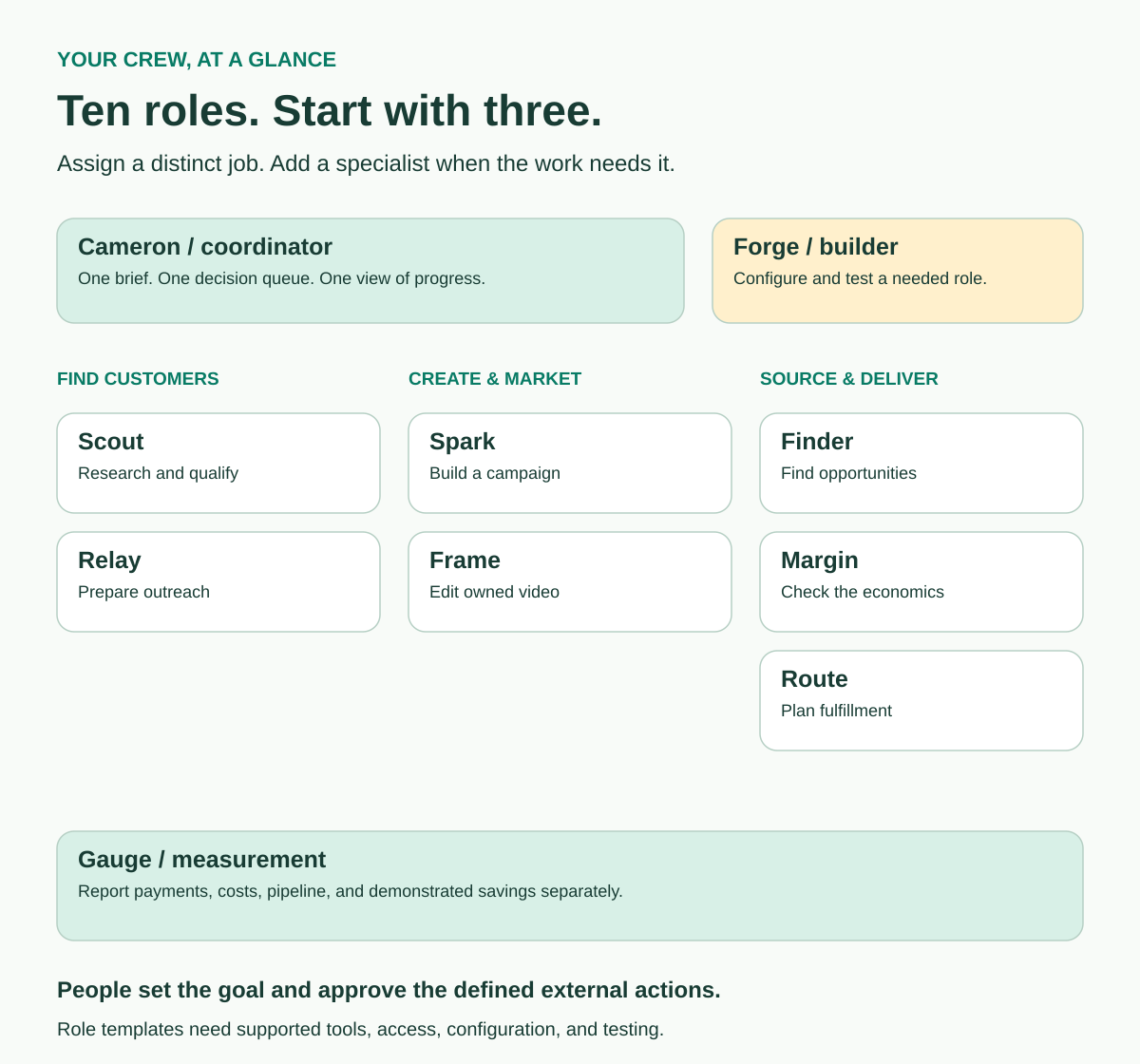
Parallel work is useful when the assignments are independent. One worker can inspect the public booking path while another checks the campaign's claims against the offer brief. A reviewer can assess the draft without seeing the writer's preferred conclusion first.
Dependent work stays sequential: finish qualification before personalized outreach; approve the destination before sharing its link; confirm capacity before selling a delivery date.
Give every worker a deliverable, permitted tools, source requirements, time and cost limits, and a stopping condition. Cameron should resolve conflicts and return one decision packet: recommendation, evidence, open questions, exact proposed action, and the person responsible for the next step.
6. Choose a platform around the work
Open the detailed reference table
| Platform | Relevant starting point | What to verify in your account |
|---|---|---|
| Grok Bot | A primary bot coordinating named specialists | Connected apps, bot creation, routines, and allowed actions |
| OpenAI dots / Work | Ongoing coordination and delegated background research | Available connectors, explicit delegation settings, and file handoffs |
| Claude Duet | Background preparation and follow-through | App access and approval points; do not assume a persistent bot factory |
| Claude Code | Building and testing the workflow with subagents | Configured tools, nested delegation limits, and deployment permissions |
The full comparison links the primary documentation checked on November 15, 2026. These products do not have identical orchestration controls. A prompt pack describes the work; it cannot supply missing integrations.
7. Test the complete journey
Open the campaign destination on a phone. Follow the booking path. Check form validation, the confirmation message, and where the enquiry appears. Confirm that the business receives enough context to follow up. Use a clearly labeled test record and remove it from revenue reporting.
Then test the agent process with a duplicate company, a suppressed contact, an outdated price, an unreachable source, and a prospect who is clearly outside the target audience. The expected result should be explicit: no duplicate send, no suppressed contact, no invented replacement fact, and no silent continuation past a blocking problem.
The downloadable templates include a shared contract, a run-record schema, and starter fixtures. Keep the first live batch small enough to review completely.
8. Have Gauge reconcile the results
Open the detailed reference table
| Measure | What it tells you |
|---|---|
| Reviewed leads and qualification rate | Whether research is finding the right accounts |
| Delivered messages, replies, and opt-outs | Whether the outreach is reaching and respecting its audience |
| Qualified calls and accepted proposals | Whether interest becomes a real opportunity |
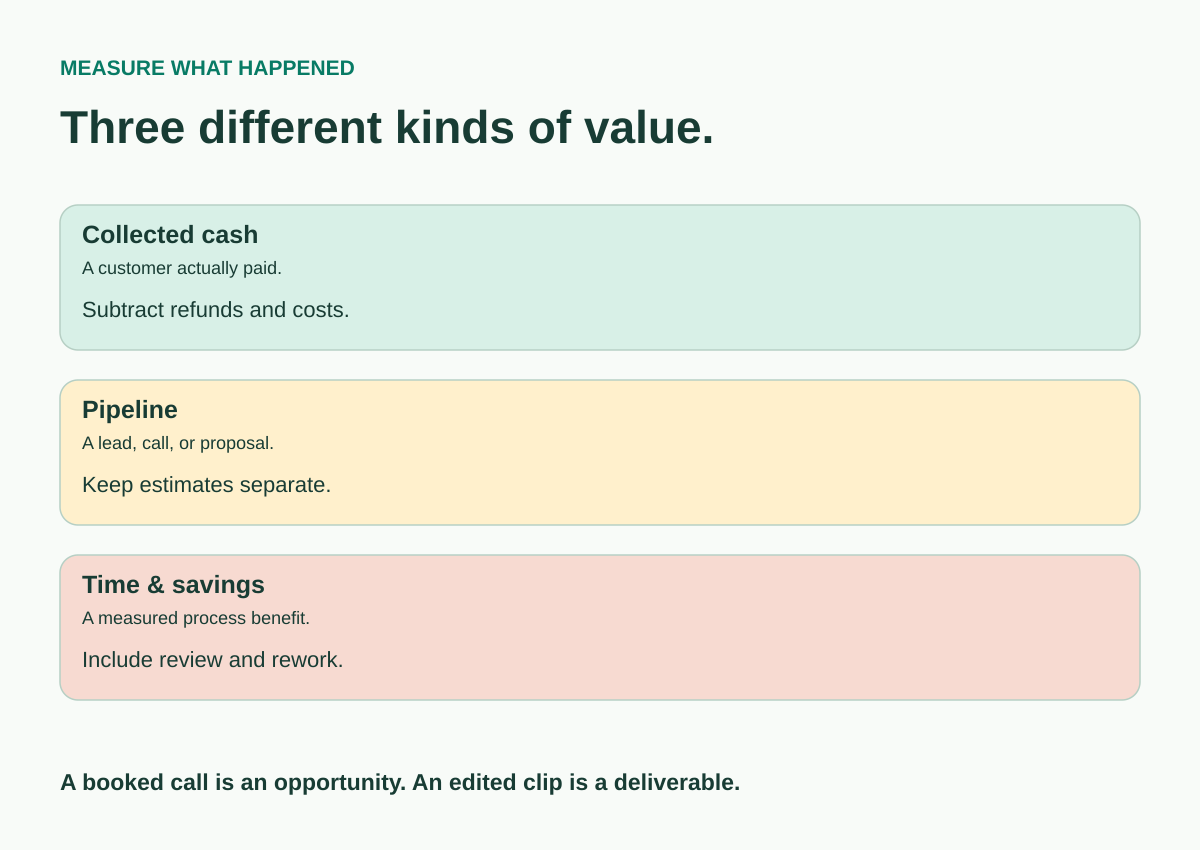
| Collected revenue, refunds, and delivery costs | Whether the work produces an economic result |
| Tool spend and human review time | Whether the process is worth repeating |
Use consistent dates and denominators. Deduplicate orders claimed by multiple platforms. A booked call remains pipeline until a customer buys, and a tool's estimated time saving needs comparison with the full process, including review and rework.
At the weekly review, change the weakest handoff first. Poor fit calls for better qualification. Replies without bookings may expose an unclear next step. Paid work with excessive revisions may expose a delivery problem. More messages will not fix every stage.
Copy this first assignment
Use our approved offer brief and public company sources.
Scout: return five candidate accounts with dated fit evidence and unknowns.
Check for existing customers, open opportunities, duplicates, and suppression.
Relay: prepare drafts only for reviewed eligible accounts.
Spark: prepare one campaign message map consistent with the offer.
Cameron: return one decision packet with sources and the exact proposed next action.
Do not send, publish, spend, or create a recurring job during this setup run.
Stop and report missing access rather than inventing a completed action.
Start with one offer, one audience, and one reviewable batch. Expand the workflow when the handoffs work and the results justify the effort.
Continue with the practical guides
Keep exploring
Give your marketing agent the evidence before you give it the controls