
Your marketing assistant can write a confident recommendation before it has seen the facts that make the recommendation useful. It may know the campaign name and yesterday’s clicks while missing the sales team’s definition of a qualified lead, the offer’s expiration date or the landing page that actually ran. Connecting more tools does not automatically close that gap. Designing a better evidence handoff does.
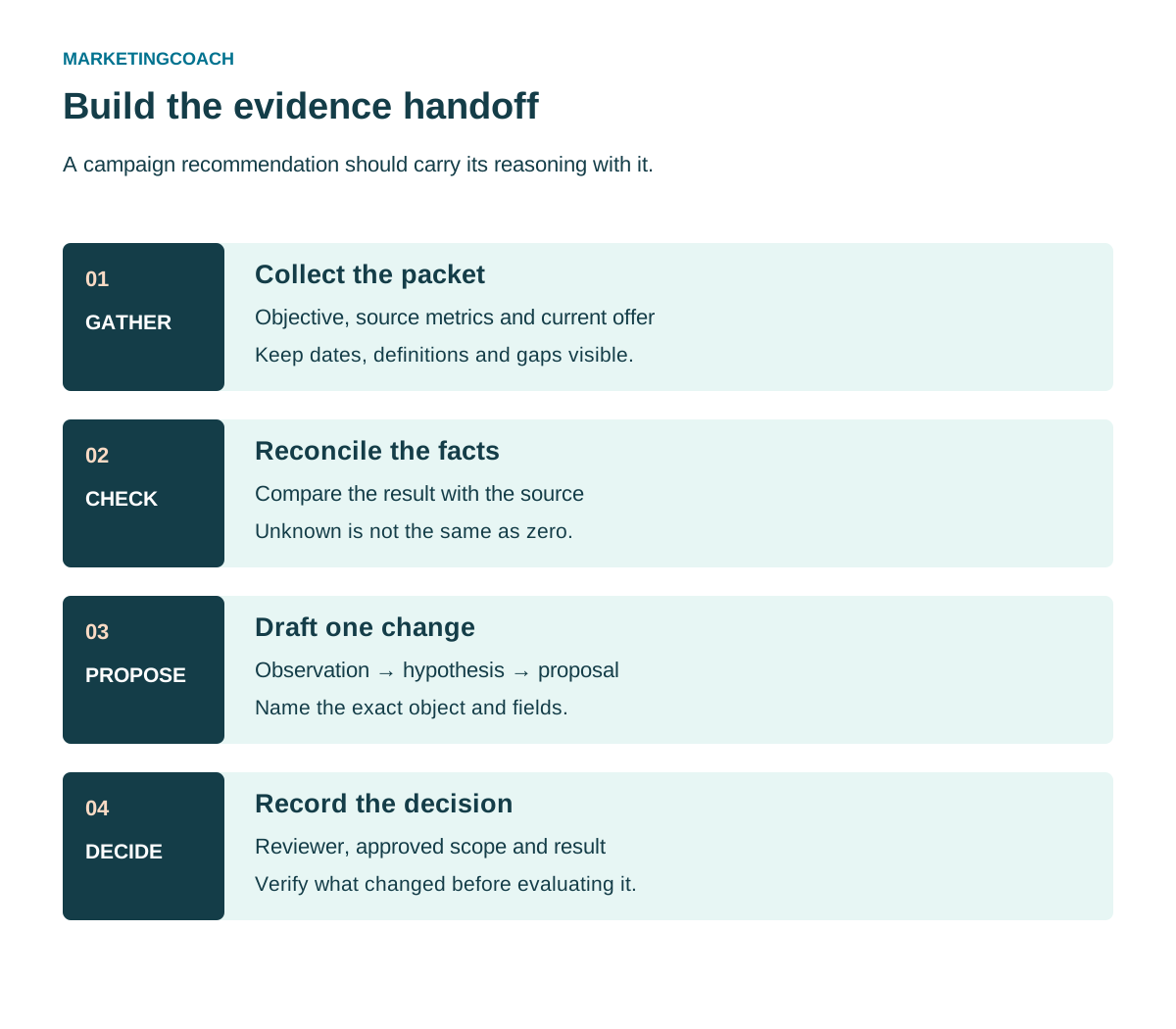
This guide builds a practical MCP-assisted campaign review: gather a small, traceable evidence packet, identify what is missing, draft a change and give a person a clear decision. The accompanying Campaign QA & Approval Pack turns that process into a reusable pocket product for a marketing lead, consultant or small agency.
Start with a marketing question that has an owner
“Improve our marketing” is too broad for a useful first integration. “Prepare Monday’s review of the consultation campaign, using last week’s spend and qualified inquiries” has a boundary. Someone can verify the result, and someone can decide what happens next.
Choose one recurring review that currently involves copying information between screens. Write its deliverable in one sentence: “A campaign review with source dates, comparable results, three uncertainties and one proposed change.” Then name the person who can approve that change. A useful assistant should reduce the work needed to reach that decision; it should not quietly redefine the campaign’s goal.
For a first pilot, use a completed reporting period. That avoids treating an incomplete day as a performance collapse. Keep the account, campaign IDs, currency, reporting timezone and conversion definition beside every export. These details are the difference between a persuasive chart and a decision someone can defend.
What MCP contributes to this workflow
Model Context Protocol lets an AI application discover and call tools exposed by an MCP server. In this workflow, a server might retrieve an approved campaign snapshot or look up the current offer brief. The underlying advertising platform or CRM still holds the data. MCP is a connection method, not a new source of truth.
A browser tool has a different role. Experimental WebMCP allows a webpage to expose structured actions to a browser agent. A campaign workspace could expose “read the selected review” or “prepare a draft change” while retaining its normal interface. Current Chrome documentation uses document.modelContext; availability depends on browser support. You do not need WebMCP to run the review described here.
If your marketing software already offers a well-scoped connector, start there. If the task is a monthly review with two exports, a controlled file workflow may be enough. Build an MCP server when repeated access, consistent inputs and a stable response format justify the maintenance.
Build the evidence packet before the prompt
Every review should carry five pieces of evidence. Think of them as the brief the assistant would need if it were a new colleague joining the campaign midweek.
| Evidence | What to capture | Why it matters |
|---|---|---|
| Business objective | Desired customer action and owner | Prevents optimizing clicks when the business needs qualified inquiries. |
| Performance snapshot | Campaign IDs, period, timezone, currency, spend and defined outcomes | Makes the comparison reproducible. |
| Offer and destination | Current terms, landing URL, CTA and eligibility | Connects the ad promise to the experience after the click. |
| Tracking context | Attribution settings, event changes, outages and reporting lag | Shows when a change in measurement may explain a change in results. |
| Qualitative evidence | Approved sales feedback or anonymized objections | Explains friction that a dashboard cannot describe. |
Each item needs a source reference, an observed date and a freshness rule. For example: “Offer terms must be checked against the current approved brief before a recommendation is delivered.” A date stamp alone does not prove freshness. A three-month-old brand guide may be current; a three-day-old promotion may already be wrong.
Step 1: connect a narrow, readable source
- Identify the source system and official integration documentation. Confirm that the documented server or connector supports the specific account and information you need.
- Connect the correct business account in your AI application. Review the available tools and use the smallest relevant scope.
- Request one completed-period snapshot. Name the campaign IDs, dates and required fields; do not ask the assistant to infer those boundaries.
- Compare the returned record with the source application. Check totals, dates, currency and the exact definition of the conversion column.
- Save the verified query pattern in the pack so next week’s review starts from the same contract.
An effective first prompt is: “Retrieve campaign 104’s completed reporting period from November 2–8 in the account timezone. Return spend, landing-page visits and qualified inquiries with definitions and source timestamps. Mark unavailable fields as unavailable. Do not propose changes yet.” The numbers and campaign identifier in this example are fictional.
Do not let a missing CRM field become a zero. Zero qualified leads is a business result. Unknown qualified leads is a data problem. Those require different actions.
Step 2: separate observation, interpretation and proposal
Ask for three short sections. Observation states what the sources actually show. Interpretation explains plausible reasons and competing explanations. Proposal names a specific change, its owner and a way to evaluate it.
This structure makes unsupported leaps visible. “The qualified-inquiry rate fell” is an observation only if the counts are comparable. “The form is too long” is a hypothesis until you inspect the form or test a shorter version. “Remove two optional fields for a defined test” is a proposal. Keeping these sentences separate makes the review easier to challenge without discarding all of it.
Require a short “cannot conclude” box. It should identify meaningful limits, such as incomplete qualification or a simultaneous offer change. It should not become generic legal language pasted under every chart.
A worked example: the cheap lead that costs more
Fictional example. A local consultation campaign compares two complete weeks with the same qualification definition. Week A spent $600 and produced 12 inquiries, of which six were qualified. Week B spent $540 and produced 15 inquiries, of which three were qualified.
| Metric | Week A | Week B |
|---|---|---|
| Cost per inquiry | $600 ÷ 12 = $50 | $540 ÷ 15 = $36 |
| Qualification rate | 6 ÷ 12 = 50% | 3 ÷ 15 = 20% |
| Cost per qualified inquiry | $600 ÷ 6 = $100 | $540 ÷ 3 = $180 |
An assistant looking only at inquiry cost could recommend increasing spend. The evidence packet supports a narrower conclusion: inquiry cost improved while the observed qualified-inquiry cost worsened. It does not prove why. The sample is small, and the reviewer still needs to check qualification timing, traffic mix and changes to the offer.
The proposed next step might be a review of the ad promise against the service eligibility language. If Week B attracted people outside the service area, a clearer location cue could be a reasonable experiment. If qualification is simply delayed, changing the campaign could be premature. The tool should help expose that distinction.
Step 3: turn the repeated query into a tool contract
Once the manual review is useful, define a tool such as get_campaign_review_snapshot. Its inputs could include an allowed campaign ID and explicit period boundaries. Its response should contain metrics, definitions, source references, data freshness and a list of missing fields.
The developer’s implementation sequence is concrete: validate the request, verify account access, call the provider’s API, normalize the response, preserve missing values and return the evidence packet. Keep the provider’s access rules on the server. A tool’s description or read-only annotation is helpful metadata, not a substitute for access control.
Use a stable result shape. For a metric that is unavailable, return a null value with an explanation such as “CRM qualification not connected,” rather than silently omitting it. If the source reports delayed attribution, carry that status into the result. This allows the reviewer to distinguish incomplete evidence from poor performance.
The pack includes a JSON example of this response contract. It is a design specimen with fictional data, not a ready-to-connect integration. Use it to agree on expectations before paying for custom development.
Step 4: make approval specific enough to be meaningful
A useful approval card names the exact object, current value, proposed value and expected consequence. “Approve optimization” is not enough. “Approve replacing the landing-page headline for campaign 104 while keeping budget, audience and offer unchanged” is reviewable.
Keep recommendation and execution as separate capabilities. The first pilot can stop after producing a draft change card. If you later introduce publishing or budget changes, define the approval and verification behavior for those actions explicitly. A person approving copy should not accidentally authorize a spend increase.
Every approved change needs a record of what actually happened. Capture the new version or provider response, the time of execution and a link to the destination. A conversational “done” message is not sufficient evidence that the ad or page changed successfully.
Step 5: run two review cycles and measure the work
Run one review manually and one with the connected workflow against comparable tasks. Record preparation time, time spent correcting errors, missing evidence and whether the decision owner could act on the result. A faster first draft may still create more review work.
For two weekly cycles, keep a compact defect log: wrong date range, inconsistent definition, unsupported explanation, stale offer, missing source or incorrect arithmetic. Fix the repeated cause before expanding to more accounts. This turns the pilot into a learning process instead of a one-time demo.
Choose a release rule before the second cycle. For example, require correct campaign identity, reconciled source totals, explicit missing fields and no unsupported publishing action in every tested case. Treat that as a local acceptance rule you set for the pilot, not a universal industry standard.
Three edge cases worth writing down
If qualified inquiries equal zero, cost per qualified inquiry is undefined; show that explicitly instead of dividing by zero or displaying a reassuring $0. If the account currency changes between exports, stop the comparison until the values are consistently expressed. If a tracking event was renamed, verify that the old and new columns represent the same customer action before combining them.
These are good acceptance cases for a custom tool because they test meaning, not just connectivity. Add them to the review worksheet alongside a normal result. A tool that handles an ordinary week but misrepresents a reporting exception is not ready to support a budget decision.
Use the Campaign QA & Approval Pack
The pocket product includes an evidence brief, a fictional snapshot contract, an approval card and a review-cycle worksheet. Start with the evidence brief, complete only the fields your team can verify and mark the rest as open questions. Use the approval card even when implementation remains manual.
The strongest first result is a review that another marketer can inspect without reopening every conversation. It should tell them which campaign was reviewed, what the evidence supports, what remains uncertain and what specific decision is needed. Once that handoff works, adding another connector becomes a purposeful improvement.
Sources and further practice
- Official MCP architecture documentation for the host, client and server model.
- Chrome’s WebMCP imperative API documentation for browser tool registration and current experimental usage.
- AI Teachers’ step-by-step MCP lab for a working local server and browser demonstration.
Explore another application
- The Wealth Experiment: From one useful AI connection to a pocket product people can evaluate
- AI Side Hustle: Build your first MCP-assisted client service in a seven-day sprint
- Waymaker: From idea to connected MVP: build one MCP tool people can use
- OutcomeDriven: Did the agent actually help? A practical MCP workflow experiment
- CodeTeachers: Build a resource-finder MCP server—and prove it works