Build your marketing, product, design and development agent team
A small team charter with explicit handoffs and review gates.
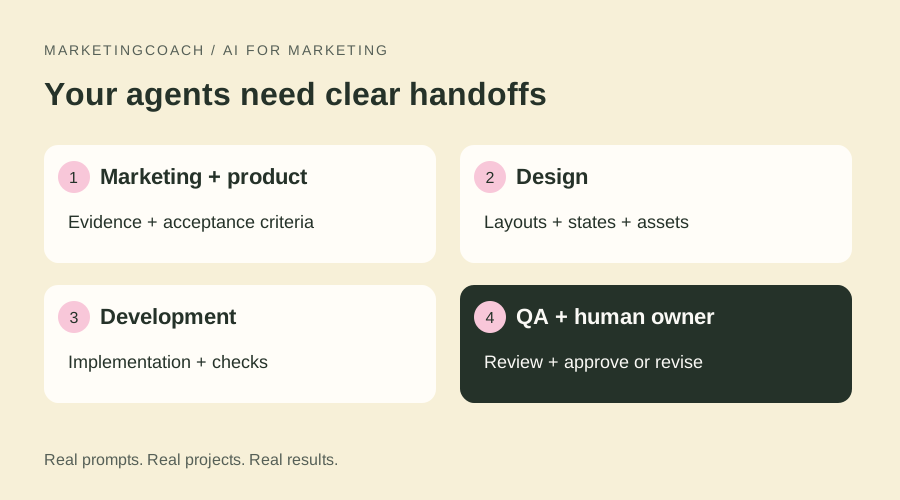
Bring these inputs
One approved campaign brief, shared evidence, brand system, implementation environment and a human owner.
Tools for this exercise
A supported agent workspace or orchestration system; Claude Code / Codex for code work; Figma for design collaboration.
Work through it, step by step
Start with an orchestrator, one producer and an independent reviewer. Add specialized roles only when a real bottleneck appears.
Give marketing responsibility for audience and messaging; product for user needs and acceptance criteria; design for accessible layouts; development for implementation and tests.
Use one handoff format: goal, source links, files produced, assumptions, acceptance criteria, open questions and next owner. A chat role does not automatically gain tool access.
Require the reviewer to check the actual artifact against evidence and criteria. Send failures back to the producing role. Keep publishing, customer messages, spending and production access behind explicit human authorization.
A prompt you can reuse
Replace the brackets with your real context. Remove personal or confidential data unless you have permission and an appropriate workspace.
Act as coordinator for [project]. Create role briefs for marketing, product, design, development and QA. For each give inputs, permitted tools, output files, acceptance criteria and next owner. Propose a dependency order. Pause at missing evidence and approval gates. Begin with a plan; do not perform external actions.
Example in practice
Marketing supplies an evidence-backed offer; product defines the booking flow; design prototypes it; development implements it; QA tests mobile, forms and analytics before the owner approves release.
Human review checkpoint
Reviewers inspect outputs rather than repeating the producer’s summary. Limit permissions and iteration count; define escalation and rollback.
Your finished deliverable
A small team charter with explicit handoffs and review gates. Save the source material, your draft, the corrections you made and the next decision. Ask a colleague to explain what the work recommends; if they cannot, simplify it before moving on.
- Evidence and assumptions are clearly separated.
- The output matches the brief and has an accountable owner.
- Facts, links, accessibility and relevant permissions have been checked.
- The next step has a metric or observable acceptance criterion.