Create campaign concepts with Claude Design and Figma
A responsive landing-page concept with an implementation handoff.
Bring these inputs
Approved messaging, logo and brand assets you may use, target device sizes and the desired customer action.
Tools for this exercise
Claude Design for visual exploration; Figma Design / Make for collaborative refinement and prototypes.
Work through it, step by step
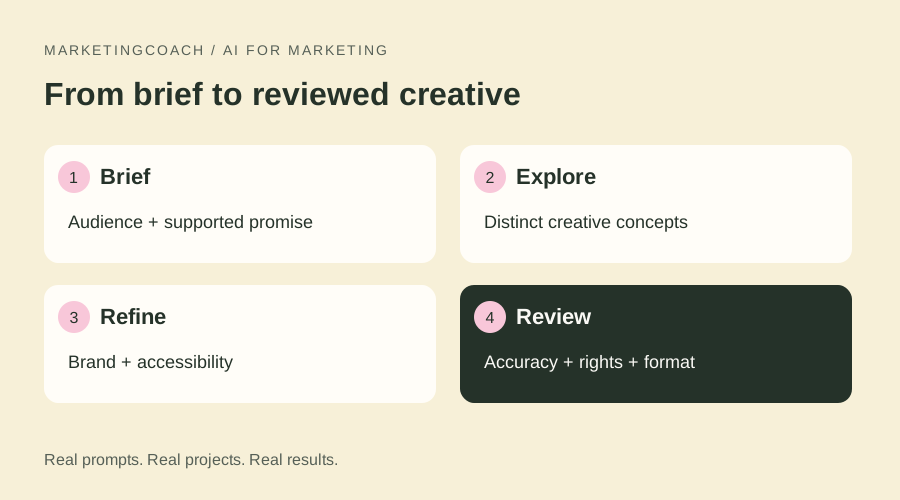
Write a visual brief: hierarchy, message, CTA, proof and constraints. Ask Claude Design to explore two concepts with different creative reasoning.
Choose a direction using audience needs and readability. Use Figma Design or Figma Make as appropriate to develop layouts, reusable components or an interactive prototype.
Check mobile hierarchy, keyboard use, labels, focus, contrast and text length. Replace invented copy and placeholder proof.
Give development the approved design, assets, states, behavior and acceptance criteria. Verify exported or generated code separately; a prototype is not automatically production ready.
A prompt you can reuse
Replace the brackets with your real context. Remove personal or confidential data unless you have permission and an appropriate workspace.
Design a landing-page concept for [offer] and [audience]. Use this approved copy and brand system: [inputs]. Show mobile and desktop hierarchy, one primary CTA, error and success states, and an accessible form. Explain two creative directions. Do not add invented testimonials or claims.
Example in practice
A course campaign tests a project-led headline against an outcome-led headline while keeping the form and offer consistent.
Human review checkpoint
Check font and asset licenses, real content fit and accessibility. Confirm export/integration options in your current plan.
Your finished deliverable
A responsive landing-page concept with an implementation handoff. Save the source material, your draft, the corrections you made and the next decision. Ask a colleague to explain what the work recommends; if they cannot, simplify it before moving on.
- Evidence and assumptions are clearly separated.
- The output matches the brief and has an accountable owner.
- Facts, links, accessibility and relevant permissions have been checked.
- The next step has a metric or observable acceptance criterion.