Build a Higgsfield video-ad creative test
Three storyboarded video concepts with a consistent offer and measurement plan.
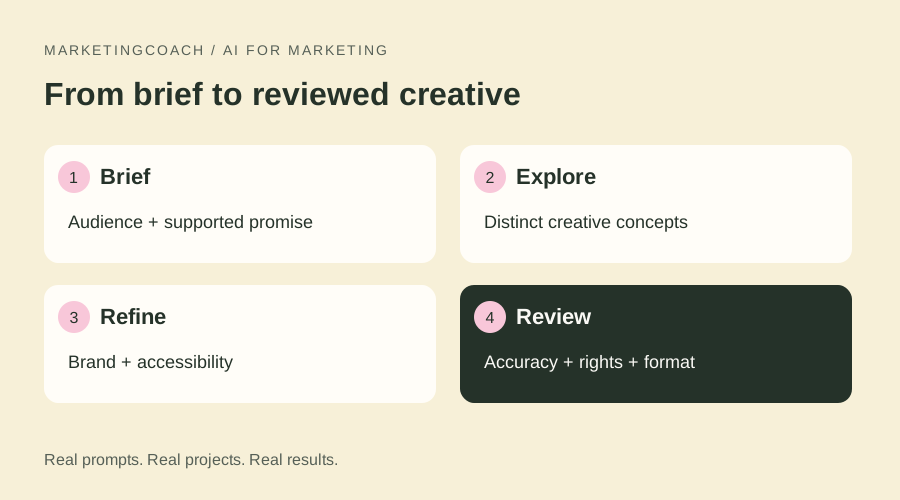
Bring these inputs
Approved product photos, accurate product details, brand kit, audience and channel placement.
Tools for this exercise
Higgsfield Marketing Studio and a human editor; generation options and limits depend on the selected plan.
Work through it, step by step
Write a short script with a hook, demonstration, supportable benefit and CTA. Make the product and use case clear.
In the available Higgsfield workflow, supply the product image or supported product link and brand inputs. Generate one concept first and inspect it.
Create distinct hook variants while keeping the offer, landing page and targeting stable. Review product accuracy, motion, text, audio and captions frame by frame.
Export for the selected placement and preview cropping and safe areas. Label synthetic content where required by the platform; never pass an avatar off as a real customer testimonial.
A prompt you can reuse
Replace the brackets with your real context. Remove personal or confidential data unless you have permission and an appropriate workspace.
Write three short video-ad storyboards for [product] and [audience]. Use only these supported benefits: [facts]. Vary the hook, keep the offer and CTA constant. For each provide scenes, voiceover, on-screen text, captions and a production QA checklist. Do not claim a real customer experience.
Example in practice
Compare problem-first, demonstration-first and objection-first hooks for the same product, then judge qualified landing-page actions rather than views alone.
Human review checkpoint
Generated footage must accurately represent the product. Verify rights to images, voices, music and likenesses before use.
Your finished deliverable
Three storyboarded video concepts with a consistent offer and measurement plan. Save the source material, your draft, the corrections you made and the next decision. Ask a colleague to explain what the work recommends; if they cannot, simplify it before moving on.
- Evidence and assumptions are clearly separated.
- The output matches the brief and has an accountable owner.
- Facts, links, accessibility and relevant permissions have been checked.
- The next step has a metric or observable acceptance criterion.